LA homelessness: Setting the stage for painful choices – an empirical (re-)framing

In 2023, I began a program of research on some innovative governance arrangements for addressing homelessness that  LA’s political, civic, bureaucratic and private sector leaders put in place as part of a determined effort  to finally come to grips with a long-festering crisis (see here and here).  Over the past two years, the tide of  Los Angeles’  homelessness seemed to turn. However, as highlighted by some extraordinarily forthright and stark presentations  (available here) at a  recent meeting  of one of the new bodies –  the multistakeholder Leadership Table for Regional Homeless Alignment –   new budgetary and economic pressures threaten reversal.

In coming months I plan to track how the  governance arrangements respond to this new trial by fire. This piece (and an accompanying  technical note)  sets the stage for that work by laying out –  from an empirical and ‘technocratic’ rather than a governance perspective –  how I have come to understand LA’s homelessness crisis.  The analysis builds on some recent innovative applications of  systems analysis (here and here)  that  frame  homelessness  as a “flow”, rather than only as a “stock”.  As the systems approach suggests, framing homelessness as a flow both helps surface some perhaps under-recognized aspects of LA’s homelessness challenge, and directs attention to some potentially important questions vis-à-vis the policy response to the new, straitened circumstances.

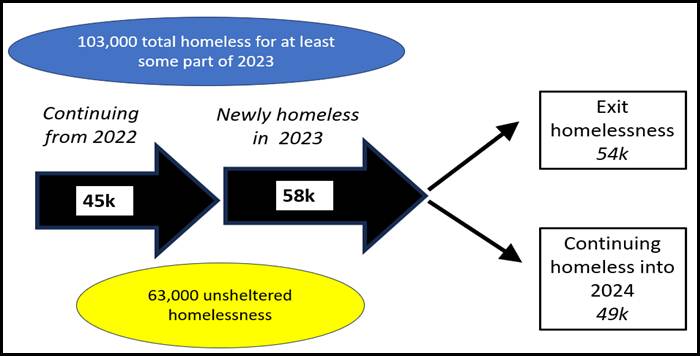
Figure 1: Homelessness in LA – inflows and outflows (2023)
Source:  Leadership Table

At first sight, Los Angeles’ challenge  seems straightforward: end homelessness for the 70,000 or so people  -roughly  50,000 of whom live on the streets –  identified as homeless in recent iterations of the region’s annual point-in-time (PIT)  count. However, as Figure 1 illustrates for 2023, the PIT count (a “stock”)  captures only a moment in an ongoing and much larger flow: in that year 103,000 people accessed  LA County’s homeless services. [Note that, while the analysis that follows draws principally on data from 2022/23, newly released data reports a 30% (!!!) increase to 133,000 in the number accessing these services in 2024/25.] Between 2020 and 2024, close to 300,000 people (3% of LA County’s population of 10 million) accessed the county’s homeless services at least once.

Viewed through a structural lens, the evidence is compelling that over time the aggregate number of people who enter into homelessness is driven by metropolitan-area level interactions between the cost of housing and income (both wages and safety net support) at the bottom end of the economy. As I summarize here, for many decades LA’s trends have been dismal vis-à-vis both housing and median-and-below wages . However, these structural drivers can only be reversed over the medium- and longer-term. In the near-term, the challenge is to make better use of existing resources.

How,  at a time when the regional economy is turning soft, the safety net is under threat, and funds to combat homelessness are set to contract, might available fiscal resources be more effectively deployed? The empirically-anchored analytical framework laid out in this piece might  hopefully  help address this near-term challenge.

Considered as a flow, homelessness is daunting in its complexity. Multiple drivers  lead to homelessness; there are multiple pathways through homelessness;  and multiple ways to exit. One way to cut through the complexity is to group the challenges posed by homelessness into three distinct ‘clusters’: 

  • Short-term homelessness –  those who enter and then exit homelessness within 6-12 month  (including initiatives to identify and pre-emptively support those most at risk of becoming homeless). 
  • ‘Slippery slope’ homelessness – those who lack/miss the ‘lifeboat’ of early exit and risk a deepening downward spiral.
  • ‘Chronic’ homelessness – those who have lived on the street for long enough and/or have personal vulnerabilities of a kind that render them unable to exit homelessness and live independently without sustained support.

The paragraphs that follow consider each of these, beginning with the last.

Many in LA view homelessness and chronic homelessness as synonymous. As the cluster framework signals,  this view is mistaken – though chronic homelessness indeed comprises the most highly visible aspect of homelessness,  and its magnitude  is large. (As the technical note details, the numbers vary depending on the definition used. According to LAHSA’s highly-granular  definition, in 2024 about 32,000 people were chronically homeless. Other estimates range widely –  from about  20-42,000 –   with the specifics varying according to the definition used.)

Careful micro-level research has shown that “housing first” (more precisely,  the provision of permanent supportive housing)  is the most effective and cost effective way of helping people who have been chronically homeless to live a stably housed life. Perhaps surprisingly to some, in recent years, LA has had an effective large-scale program of placing homeless people into permanent housing – about 20,000 annually, amounting to over 130,000 since 2017.  But permanent housing (especially with the necessary support services) does not come cheap; as of 2025, the LA region was spending well over $300 million annually on its PSH program.  

A central reason why implementing “housing first” is so costly is, of course, LA’s massive undersupply of affordable (and other) housing.  But this undersupply can only be addressed over the medium and longer-term – a narrow focus on “housing first” thus has little to offer vis-à-vis  the urgent immediate challenge of  how  best to deploy scarce fiscal resources to mitigate the damage to come.  Recognizing this brings to the fore   the two earlier stages in the homelessness “flow” –  short-term and slippery-slope homelessness. 

Estimates of the number of people who are homeless only for a short time vary widely. As the technical note details, “stock” estimates derived from the early-2024 PIT count range from 16-26,000, depending on how the cut-off duration is defined. This number is way below the 58,000 that, as per Figure 1, newly accessed homeless services over the course of 2023. [In 2024/25, the number newly accessing homeless services increased to 81,000.] A moment’s reflection will point to the reason for the disconnect –  most short-term homeless enter into and then exit from homelessness between  counts. As the companion technical note explores in detail, for most people  a spell of homelessness is relatively short: about 40% of those who become homeless exit within six months; an  additional 30% or so exit over the subsequent eighteen-month period; and a further 20% over the subsequent three years.  (Note that at the rates of exit just cited, nine out of ten people who become homeless  exit  over the subsequent five years – projecting forward this would imply that of the  60,000 people who became homeless in 2023, about 6,000 would remain so in 2028.)   

For at least three reasons, these seemingly rapid rates of exit should not be mis-interpreted as implying that homelessness is in large part self-correcting, with policy mattering little for how it evolves.  For one thing, the current rapid rates of exit are based on LA’s prevailing ambitious (and fiscally costly) efforts to reduce homelessness. In the coming period, as the presentations to the Leadership Table highlighted, budget cuts will undo a quite substantial part of this effort: entry into homelessness will accelerate;  rates of exit will slow.  For another, the number of people homeless at any point in time is the accumulated  total of those remaining homeless after initially becoming homeless in some prior year.  Increases are likely in the number of people who become newly homeless, the numbers will add up rapidly. Perhaps most fundamentally, the challenges of providing support and facilitating exit are not static –  what all-too-often happens to those who remain on the streets converts crisis into tragedy.  This last  brings us to the third ‘cluster – slippery slope homelessness.

As even casual observation of people living on the street reveals, there is a close association between homelessness and personal vulnerability. The background technical note details this association vis-a-vis  five sets of vulnerabilities: mental health (MH); substance abuse (SA); physical vulnerabilities, and vulnerabilities associated with prior experience  of prior foster care or incarceration.  As detailed there, an estimated 57% of an entering homeless cohort have at least one of the five vulnerabilities;  43% have none. (Note that while the impact of economic vulnerability is not analyzed directly, its role is implicit in the relatively  large share of  ‘none of the above’. )

Figure 2: Mental health and substance abuse among a (representative)  100 person homeless cohort  – change over  the course of  three years.
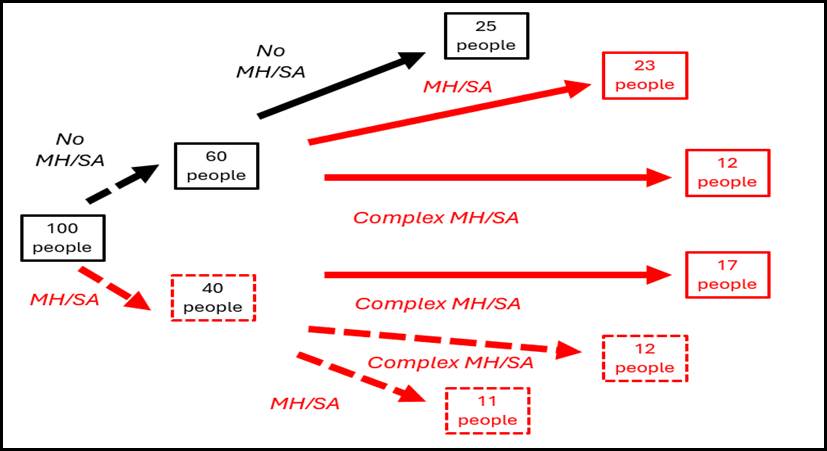
Crucially for policy, as Figure 2 above illustrates,  the homelessness-vulnerability association is not static  – the incidence of vulnerabilities among the continuing-homeless cohort changes with the passage of time. Why? Because mental health and substance abuse are both causes and consequences of homelessness.   Figure 2  provides specific estimates of the magnitudes by which  MH/SA challenges compound as a result of homelessness. (See the background note for details on how these “flow” parameters were estimated.) Forty of a representative cohort of  100 homeless people  had struggled with MH/SA issues prior to becoming homeless; for 17 of the 40, symptoms become more complex over the course of three homeless years. Even starker are the trends  among the 60 people who entered homelessness with no MH/SA challenges: After three years of homelessness, 35 of the 60 have MH/SA symptoms, including 12  who wrestle with complex MH/SA challenges.

Stepping back from the details, how might the three-cluster framework help address some urgent, looming policy challenges confronting LA’s efforts to address homelessness? At its recent meeting, the Leadership Table was put on notice that in the coming year, spending to address homelessness would need to be cut by about one-third (!!), even as the number of people becoming newly homeless would continue to rise. An obvious first step is to look for efficiency gains – how well are resources being used to deliver on programs already underway? But belt-tightening can only go so far. When the required cuts are large, attention also needs to be given to effectiveness – are we doing the right things? The three-cluster framework potentially offers some insights vis-à-vis the latter question.

Viewed as a “stock” the policy challenge is seemingly the relatively straightforward one of reducing numbers, with each person newly-housed (via, say, “housing first”) moving things closer to the goal, with priority for the chronically homeless. By contrast, viewing homelessness as a flow directs attention to the ‘short-term’ and ‘slippery-slope’ clusters –  and thus to the value of intervening  as early as possible in a person’s homelessness journey – the earlier the exit from homelessness, the lower are its personal, fiscal and social costs.   

Considering priorities through this latter lens, a variety of questions arise:   Are there cost effective ways of forestalling homelessness for those who are at greatest risk?    What facilitates rapid exit from homelessness?  For those for whom homelessness has begun to take hold, what can be done to reduce the risk of journeying all the way down the slippery slide to disaster?  

None of the above questions are new to those who have long labored to reduce homelessness.  Even so, at this moment of fiscal stringency when it is urgent to look again at how resources are being used, perhaps the empirical lens laid out in this note contributes in a small way to taking a more expansive view of the options available –  one that not only focuses on how to minimize damage to ongoing programs but also assesses comparatively  the cost effectiveness of a broad range of possibilities for  addressing our region’s homelessness crisis.
Hope in the dark? LA’s bold governance reforms to address homelessness

The drumbeat of dispiriting daily news makes it difficult to look beyond immediate crisis. Where to find hope? Los Angeles’ ongoing homelessness crisis might seem an especially unlikely place to look. As explored in detail here, every night nearly 50,000 people sleep unsheltered on the streets of Los Angeles County, and every year well over 60,000 people become newly homeless   – and the Trump administration’s efforts to shred the safety net threaten to make things much worse, soon.  Even so, as USC professor Yan Tang and I detail in a recent article in the National Civic Review,  a close look at how LA is addressing homelessness offers some unexpectedly good news.

Populists don’t just feed on socio-economic discontent. They feed on ineffective government” Ezra Klein and Derick Thompson argue in their bestselling book, Abundance, quoting two eminent scholars.  Klein and Thompson highlight failures in LA’s response to its twin crises of homelessness and a massive shortfall of affordable housing as exhibit number one in a broader indictment of progressive governance. But things have moved on. [Author’s note: This post was written prior to my recent ‘Achieving Abundance blog series; an updated version that explores in detail the links between homelessness in LA and the arguments laid out in that series will be forthcoming in a few weeks.]

As the Levy-Tang National Civic Review article details, the LA region’s  recent efforts to address homelessness  include some bold,  largely unheralded, but innovative and potentially transformative  governance reforms. These reforms, the article argues,  have the potential to provide a platform for far-reaching improvements in the effectiveness  of the LA region’s efforts to address its homelessness crisis.

Some of the governance reforms aim to bring more top-down coherence to how hierarchical authority is exercised. Others aim to foster greater horizontal alignment across jurisdictions and service providers.  The top-down reforms  are moving forward at breakneck speed – a new, consolidated Los Angeles County Department of Homeless Services and Housing, is scheduled to open on January 1, 2026.  Yet one can readily imagine a scenario in which, rather than embracing the possibilities of the new institutional environment, many of the multiple public and non-profit organizations working to address homelessness outside the umbrella of the new  department could become pre-occupied with fending for themselves.

The “horizontal”  governance reforms – the creation of two new multistakeholder bodies to support better alignment of approaches to homelessness across the LA region – potentially could address the risk of balkanization.   The county-wide adoption earlier this year of a set of top-line goals for reducing homelessness formulated by the two bodies points to their potential. However, unlike the new department, the multistakeholder bodies lack any obvious and established champion. While they are making substantial progress in clarifying and consolidating their roles going forward, the risk remains that the painstakingly constructed shared vision that led to their emergence could all-too-easily be washed away by the crises (and parochial interests) of the moment.

Indeed, if they are to succeed, the new governance arrangements will need to hit the ground running and successfully confront what is shaping up as a potentially massive  fiscal crisis. Addressing homelessness effectively takes resources: resources for support services, resources to help the most vulnerable pay their rents, and resources to expand the supply of affordable housing. In LA,  these costs are exacerbated not only by the number of people who are homeless,  but by decades of income stagnation for the bottom half of its residents on the one hand, and rising rents (fueled by an undersupply of housing) on the other.

A recent ballot initiative approved by voters raises about $1 billion annually (via increases in local sales taxes) to combat homelessness. One third of the resources is earmarked for a new initiative to build more affordable housing. The remaining two-thirds  replenish earlier (now expired) commitments – and are barely enough to sustain existing programs.  Even in the absence of the Trump cuts, the system already was overstretched. Current Trump administration budget proposals (some of which have so far been somewhat restrained by budget committees in the House and Senate)  include billions of dollars of further cuts  in rental assistance, in permanent housing support, in  Medicaid-funded housing for health initiatives, and in food stamps and other safety net programs. In the context of a regional economic slowdown and the already-extreme economic vulnerability of LA’s low-income earners, shredding the safety net could result in a tsunami of new homelessness.

What, then, is the balance between good news and bad news? It seems certain that bad news lies immediately ahead. Recent gains in reducing the number of people living on the streets will almost surely be reversed. Increases in homelessness could be large. Fiscal pressures will worsen. Daunting strategic decisions lie ahead. The new governance arrangements confront a trial by fire, even as they have barely left the starting gate.

But the following also is true: Prior to the recent reforms, LA’s governance arrangements to address homelessness were characterized by low trust, ambiguous authority, and the absence of any coherent ways of fostering co-operation and holding the system to account. As the National Civic Review article explores, the new arrangements address these weaknesses. They may not survive the trial that lies ahead, but they have a fighting chance.  Sometimes, crisis and adversity can focus effort in inspiring ways.  

Coming months will tell. Watch this space for updates.

Renewing the public domain: Can a more socially embedded bureaucracy help?

Even as time becomes shorter and the mood darker, I find it helpful to look beyond the immediacy of crisis and probe the possibilities of renewal. In so doing, I continue to take inspiration from Albert Hirschman’s  ‘possibilism’  – the endeavor to  “….try to widen the limits of what is perceived to be possible…. and figure out avenues of escape…. in  which the inventiveness of history  and a ‘passion for the possible’ are admitted as vital actors”.  In recent years, I have sought to bring the spirit of possibilism to an exploration of  governance at the interface between citizens and the public sector.

A combination of rule-boundedness  and insulation of public bureaucracies from day-to-day pressures have long been central tenets of conventional efforts to improve public governance. But conventional efforts have not helped stem a dramatic collapse in recent decades of trust in government and of civic perceptions regarding the legitimacy of the public domains. , As I  explored in some earlier work, multiple drivers account for this collapse in trust. Even so, the question of whether the narrowness of mainstream approaches to public sector reform has contributed to the loss of civic trust has continued to nag at me.  

Complementing mainstream approaches to public sector reform, might there perhaps be another way forward – one that can both help improve public-sector performance and, of particular import in these times of polarization and demonization of government,  do so in a way that helps to renew the legitimacy of the public domain?   Might a more ‘socially-embedded’ bureaucracy (SEB) help achieve gains on both the effectiveness and legitimacy fronts?  This blog post provides (as a substantial update to an earlier piece)  an overview of some of my recently published and ongoing work that addresses these questions.

Exploration of SEB’s possibilities often is met with skepticism. In part, this is because SEB is radically at variance with  the mainstream logic of how public bureaucracies should be organized; indeed, as I explore further below, embrace of SEB is not without hazard. But another reason for this skepticism is that SEB is  one facet of a broader agenda of research and experimentation that aims to help ‘redemocratize’ the public sector – and  enthusiasm among champions of redemocratization has all-too-often outrun both conceptual clarity and empirical evidence.  In a generally sympathetic review,  Laura Cataldi concludes that much of the discourse proceeds as:

“….an umbrella concept under which a large variety of governance innovations are assigned that may have very little in common……Most of the proposed solutions are situated at the level of principles such as participation, deliberation and co-creation of public value, rather than being concrete tools……[Protagonists]  seem to propose models of management, governance and reform that are too abstract, and ultimately lacking in terms of concrete administrative tools…..”

In the work introduced below, I have sought to distil from both the academic literature and the experience of practitioners a set of insights that can help strengthen SEB’s analytical foundation.

I define a ‘socially embedded bureaucracy’ (SEB) as one that incorporates “problem-focused relationships of co-operation between staff within public bureaucracies and stakeholders outside of government, including governance arrangements that support such co-operation.”   Questions concerning the value of SEB arise at both the micro and more systemic levels:

  • At the micro level: what is the potential for improving public-sector effectiveness by fostering problem-focused relationships of cooperation between staff within public bureaucracies and stakeholders outside government?
  • At the systemic level: To what extent do gains in addressing micro-level problems – and associated gains in trust among the stakeholders involved – cascade beyond their immediate context and transform perceptions more broadly, thereby contributing to a broader renewal of the perceived legitimacy of the public domain?

The  research papers introduced in this post explore the above questions. Two of the papers are largely conceptual (see here and here), and two are more empirically-oriented –  a case study of the governance of affordable housing and homelessness in Los Angeles, and an interpretive exploration (co-authored with long-time civil society activist Mark Heywood and anchored in two sectoral case studies) of the evolving interface between civil society and the public sector in South Africa.

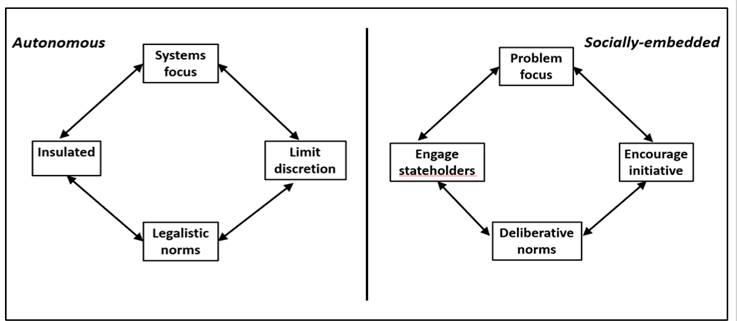
Figure 1  contrasts SEB with conventional notions of  how public bureaucracies should be governed.  In the conventional view, governance is organized hierarchically, with a focus on ‘getting the systems right’  Citizens engage upstream via their selection of political representatives who oversee both policymaking and implementation. The tasks of public officials are defined by legalistic, rule-bound processes, which also insulate public bureaucracy from political interference. Civil society’s  governance role is to bring pressure from the demand-side to help ‘hold government to account’.  By contrast, SEB is problem- rather than systems-oriented; it incorporates horizontal as well as hierarchical governance arrangements; interactions (both within the bureaucracy and at the interface with civil society) are less legalistic and more adaptive, oriented towards  deliberation and fostering initiative.

Figure 1: Autonomous and socially-embedded bureaucracies

SEB’s distinctive characteristics create opportunities for improving public sector performance via three channels that are unavailable to insulated bureaucratic hierarchies:

  • Fostering synergies  –  (problem-level) gains from co-operation between public bureaucracies and non-governmental actors;
  • Clarifying goals – alliance-building among reform-oriented public officials and civil society actors as a way of bringing greater clarity to the (problem-level) goals to be pursued by public agencies.
  • Streamlining monitoring – transforming the governance arrangements for (problem-level) monitoring and enforcement from a morass of red tape to trust-building interactions between public officials and service recipients.

Taken together, the above three channels have the potential to unleash human agency by  opening up (problem-level) space for public/civic entrepreneurs to champion change. (See my ‘microfoundations’ paper, published by the Thinking and Working Politically Community of Practice for detailed exploration of each of the channels. And see the Los Angeles case study for an exploration of how  these channels  are at the center of  efforts to more effectively address the  twin crises of affordable housing and homelessness.)

Alongside recognizing its potential,  a variety of  concerns vis-à-vis SEB also need to be taken seriously. The first two are evident at the micro-level:

  • The implications for public sector performance of a seeming inconsistency between SEB’s horizontal logic and the hierarchical logic of bureaucracies.
  • The hazards of capture or vetocracy that might follow from opening up the public bureaucracy to participation by non-governmental stakeholders.

The third is a systemic level concern, namely that:

  • Championing SEB as a way to renew the legitimacy of the public domain mis-specifies what are the underpinnings of social trust.

The paragraphs that follow consider each in turn.

To begin with the seeming tension between horizontal and hierarchical logics, the organizational literature on private organizations  suggests that there is perhaps less  inconsistency than it might seem on the surface. Viewed from the perspective of that literature,  the challenge is the familiar one  of reconciling innovation and mainstream organizational processes, and it has a clear answer:  ‘shelter’ innovation from an organization’s mainstream business processes. As Clayton Christensen put it in The Innovator’s Dilemma:

Disruptive projects can thrive only within organizationally distinct units…When autonomous team members can work together in a dedicated way, they are free from organizational rhythms, habits

Consistent with Christensen’s dictum, the problem-specific building blocks of SEB potentially provide space for protagonists to work together flexibly, at arms-length from broader organizational rigidities.

The second set of concerns  follows from SEB’s opening up of the public domain to participation by non-governmental stakeholders. At one extreme, an inadvertent consequence of opening up might be  a ‘vetocracy’,  with enhanced participation providing new mechanisms through which  status-quo-oriented stakeholders can stymie any efforts at public action. At the other extreme, openness might inadvertently facilitate capture by influential non-governmental insiders.  As the microfoundations paper explores, these hazards potentially can  be mitigated via a combination of  vigorous efforts to foster a commitment among stakeholders to clear, unambiguous and measurable shared goals – plus a complementary commitment to open and transparent processes. These commitments can build confidence in what is being done, while also reducing the pressure for control via heavy-handed, top-down systems of process compliance.

The third (systemic-level) concern interrogates the presumption that SEB can help to transform more broadly civic perceptions as to the legitimacy of the public domain. As my second TWP paper explores, a variety of eminent scholars (including Sam Bowles and Margaret Levi) have argued that initiatives that seek to renew the public domain by  building working-level relationships between civil society and public bureaucracy mis-specify what it takes to improve social trust. Social trust, they argue, rests more on the quality of institutional arrangements and commitment to universal norms than on the relational quality of the government-society interface. This argument is eminently plausible in contexts where background political institutions are strong and stable. But, as the TWP papers explore,  in contexts where disillusion and institutional decay have taken hold, renewal of the public domain – and thus confidence in the possibility of achieving collective gains through social cooperation –  requires more than yet another round of institutional engineering.

There are, to be sure,  many ways to foster ‘pro-sociality’  that are not linked to SEB-style initiatives at the interface between public officials and non-governmental actors. These include strengthening of trade unions  and other solidaristic organizations within civil society, and  intensified  efforts to foster economic inclusion in contexts characterized by high and rising economic inequality.  Even so, as examples from Los Angeles, South Africa and the USA illustrate, the systemic potential of SEB should not be dismissed out of hand.

Especially striking in Los Angeles has been the repeated willingness of voters to support ballot initiatives in which they tax themselves to finance homelessness services and the construction of affordable housing. However, as declining majorities for these initiatives signal, patience is wearing thin. The SEB-like governance reforms on which the LA case study focuses are intended to help renew civic commitment via transparent and participatory processes of goal-setting and accountability; how this is playing out in practice is my current research focus.

Turning to South Africa, my recent paper with long-time civil society activist Mark Heywood explored some interactions between  civil society strategies and state capacity over the quarter century since the country made its extraordinary transition to constitutional democracy. Civil society’s principal strategy of engagement has been adversarial. This adversarial approach yielded  major victories,  including the reversal of AIDS-denialism in government, and momentum for a successful push-back against state capture. Over time, however, a series of political drivers (explored here and here) resulted in a weakening of state capacity. In parallel, civil society’s wins through adversarialism became fewer, and the effect on citizen disillusion became correspondingly corrosive. The Heywood-Levy paper thus makes a case for civil society to complement confrontational strategies with approaches centered around building problem-level  coalitions with those public officials who remain committed to a vision of service. (The paper is slated to be part of a forthcoming edited volume by MISTRA; in the interim, interested readers can feel free to email me to request a PDF.)

Finally, opening the aperture even further, Robert Putnam’s 2020 book, The Upswing, raises the possibility that SEB might  usefully be part of a strategy for renewing civic perceptions of the legitimacy of the public domain, a way for forward-looking leaders to champion an electoral and governance platform centred around a vision of partnership between the public sector and non-governmental actors.   Political and social mobilization centered around deliberative problem-solving would be a radical departure from contemporary pressure-cooker discourses which thrive on raising rather than reducing the temperature. But, as Putnam explored,  it happened in the USA between the 1880s and the 1920s, and it might happen again:

A distinct feature of the Progressive Era was the translation of outrage and moral awakening into active citizenship… to reclaim individuals’ agency and reinvigorate democratic citizenship as the only reliable antidotes to overwhelming anxiety……[Similarly], our current problems are mutually reinforcing. Rather than siloed reform efforts, an upswing will require ‘immense collaboration’, [leveraging] the latent power of collective action not just to protest, but to rebuild.”

From crisis to renewal? Affordable housing and homelessness in Los Angeles

In dark times, I take inspiration from the great social scientist Albert Hirschman’s commitment to  the search for ‘a bias for hope’, for  “avenues of escape from exaggerated notions of absolute obstacles…. avenues in  which the inventiveness of history  and a ‘passion for the possible’ are admitted as vital actors”. Viewed from this perspective, the point of departure for effective action is not some idealized vision of how things should be, but  clarity  as to how things actually are – with this clarity providing the basis for a search for practical entry points capable of setting far-reaching cumulative change in motion.  This passion for the possible has inspired my research and practice for almost a half century; it is the guiding spirit of a new  cycle of research on the Los Angeles’ region’s twin crises of homelessness and scarcity of affordable housing (AHHLA)  that I introduce in this piece.

Los Angeles’ AHHLA crisis startles. LA County is among the world’s affluent locales, with a  2023 per capita income of over $78,000, well above the American average. Yet that same year about 55,000 people were living on LA’s streets, and over 30,000 of them had been there for more than one year.  Even more startling, every year about 60,000 people become newly homeless –  a cumulative total over five years of almost 3 percent of LA County’s population of 10 million.  For those who live in Los Angeles (among whom, having moved here in 2023, I now count myself) the AHHLA crisis is existential. But its significance goes beyond the local.

As recent books by Ezra Klein and Derek Thompson (2025) and Marc Dunkelman (2025) explore in depth, a broad national reckoning is underway to assess both how failures of progressive governance contributed to the rise of toxic populism, and what might be the contours of a renewed and effective progressivism.  AHHLA is ground zero of this broader crisis of contemporary American progressivism. In what ways did decades of progressive good intentions gone wrong fuel LA’s current crisis? Are there hopeful lessons to be learned from recent efforts to address AHHLA about how progressive approaches to governance can become part of the solution?

Here, to set the stage for addressing the above questions,  is AHHLA’s economic backdrop:

  • Over the past four decades, even as the affluent have thrived,  earnings have been stagnant for the poorer half of LA’s population. As of the early 2020s, 16.6 percent of LA residents lived below baseline (rent-adjusted) measures of absolute poverty – the highest percentage among California’s regions. (California is the state with the highest percentage in the USA.) In the absence of the public safety net, the LA percentage would be 26%.
  • Beginning in the 1990s, a combination of population growth, the end of the extensive margin and slow growth environmentalism/NIMBYism has resulted in an increasingly severe shortage of housing. Between 1960 and 1990, about  200,000 housing units were built each decade; between 1990 and 2020,  the decadal average was below 75,000 units. In 2023, 45 percent of the households that earn below LA County’s median income paid more than half their income in rent.
  • The unit costs of building publicly-subsidized affordable housing in Los Angeles are almost two and a half times the equivalent costs in Colorado and Texas; startlingly, within LA the total development costs per square foot are 50 percent higher for publicly-subsidized  than for unsubsidized, market rate housing built for private (self-pay) buyers.

Considered together, the combination of stagnant incomes, rising unit costs and a near cessation of new housing construction (except at the more affluent end of the market) was to make accommodation increasingly unaffordable for lower-income Angelenos. In important part, and as per the title of an influential book, Homelessness is a Housing Problem. More on all of this in coming weeks and months.

LA’s fragmented  governance arrangements have enabled the AHHLA crisis to fester. This fragmentation  is especially ill-suited to addressing homelessness – a multi-faceted ‘wicked’ problem  that calls for a multi-sectoral, multi-jurisdictional and multistakeholder  response. The roots of LA’s fragmented governance can be traced back (at least in part; racial ‘redlining’ also played a role….) to a century-long aspiration to avoid centralized, urban machine politics and cultivate instead more localized, small-town-like governance.  Some tasks are the responsibility of LA County government, and others are diffused among the County’s 88 municipalities, of which the City of LA (with a population of four million) is the largest. This fragmentation has been exacerbated by deepening commitment over the past half-century to open, often legally-mandated public deliberative processes in advance of any action, which further complicates local government’s decision-making.  

Moving towards more top-down governance (of varying degrees of draconianism) offers one possible response to fragmentation.  But widening the distance between citizens and local government risks worsening what already is a crisis of civic alienation from government in many countries (not least of which the USA) the world over. Might there be a third way, one that finesses the traps of top-down governance accompanied by citizen alienation, or civic participation plus ineffectual governance? 

In recent conceptual work (see here for an introductory overview), I have explored the potential and limits of this third way. The articles delineate three distinct channels through which ‘socially-embedded’ approaches to public governance might simultaneously  counter fragmentation, encourage participation  and enhance effectiveness:

  • A collective effort to enhance clarity as to goals;
  • Streamlined, transparent  and participatory approaches to performance monitoring; and
  • Collaborative, multistakeholder arrangements for service provision.

Recent initiatives in LA to reduce homelessness incorporate all three channels. Why these initiatives were adopted,, and whether they will continue to unfold in ways that contribute to reducing homelessness is the focus of an ongoing research project in collaboration with  the University of Southern California’s Professor Yan Tang (an eminent scholar in the tradition of Elinor Ostrom’s work on collective action). As our research will explore, one key to success is whether the protagonists in the LA efforts will be able to craft a credible way of sharing gains and burdens within a framework that can advance the collective interest. What follows will hopefully whet the reader’s appetite for the research project.  

Strikingly, at least since the early 2010s,  momentum for scaling-up and reshaping how LA responds to its homelessness crisis has come less from government than from civil society. The efforts have unfolded in two phases. In a first phase, political and civic leaders championed a series of ballot measures that successfully raised billions of dollars to address AHHLA. However, by the late 2010s, there was a dawning realization that the magnitude of the challenge went way beyond earlier perceptions. Not only was further financing required, effectively addressing the twin crises called for better  co-operation among multiple stakeholders – something that the region’s fragmented institutions were not well placed to achieve.  A 2021 report commissioned by civil society champions took stock of the governance challenges, and proposed a menu of reforms. Partly in response to this report, Los Angeles County’s Board of Supervisors  established a Blue Ribbon Commission on Homelessness Governance  and subsequently adopted its recommendations.

Since mid-2024, there has been an extraordinary burst of energy and  reform aimed at aligning LA’s multiple stakeholders  around a coherent governance platform for reducing homelessness. Major initiatives include:

  • The creation by LA County’s Board of Supervisors of a robust, formally-empowered multistakeholder platform, with a mandate to “help align the region’s approach to homelessness and provide critical accountability and oversight to ensure more meaningful results”.  
  • The  development and official adoption of specific, measurable targets for reducing  homelessness.  
  • The initiation of work by  the Los Angeles County Affordable Housing Solutions Agency (LACAHSA), established in a 2022 resolution of the California State Senate to increase the availability and affordability of housing in LA.
  • A radical restructuring (currently at an early stage, but on an accelerated timetable)  of the lead public  LA County and City agencies responsible for overseeing and implementing the LA region’s response.
  • A new effort to specify performance standards for each of the many elements that go into the homelessness response – as a necessary basis for both resource allocation and accountability.

The hope is that the above initiatives will together finally provide the coherence and momentum needed to make real inroads into  homelessness – and thereby  break a longstanding corrosive cycle of overpromising and then underdelivering.  Whether this will happen remains uncertain,  but if it does  LA could go from being seen as a notorious example of the failure of well-intentioned progressivism to effectively address urgent social challenges, to  becoming an exemplar of a renewed, legitimate and effective 21st century progressivism. What happens next thus matters well beyond LA itself.  Watch this space for further updates. 

Now what? – Strategic and unstrategic ways forward

Two days into DT’s second presidency, it is clear that constitutional democracy has (re-) entered into a time of extreme, urgent danger. Despair, complacency and (un-strategic) resistance traps abound. What, then, are ‘strategic’ ways forward? From the vantage point of January 2025, the crucial point is that the USA continues to be a democracy – and it is only 21 months until the next round of House and Senate elections. The overriding strategic goal is to act , between now and then, in ways that increase the odds that control of both shift back to the only political party in the USA that remains committed to constitutional democracy – the Democratic Party (and perhaps also to encourage any brave Republicans who run on a constitutional democracy platform in their party’s primaries).

Much follows from this point of departure, way more than can be said here. But (though the speed and ruthlessness are now much greater….) we were at a parallel point at the outset of DT’s first term. Back then, I wrote a piece, “hope in the dark”, that suggested some ways forward. What follows updates that earlier piece. [While I have added some new themes, and changed some emphases, much of what I said then remains relevant, and is quoted directly. Subsequent work, linked below, elaborates on some key themes. And here is a link to the original piece.]

*****

When power shifts and the presumptions that have underpinned our way of engaging the world no longer hold, what then? For the past quarter century, many of us engaged in policy analysis and implementation have worked in the spirit of ‘possibilism’ – seeking entry points for change that, though initially small, have the potential to set in motion far-reaching, positive consequences. But more than we perhaps had realized, our work has presupposed that the center broadly holds.

We have presumed that there is a reasonably stable ‘outer’ concentric circle within which experimentation plays out, facilitating an evolution-like process — momentum for initiatives that add value, and dead-ends for bad ideas.  But with the election of Donald Trump (henceforth DT) in the USA (and similar elsewhere, though in this piece I will write principally from a US perspective) we find ourselves in a world where the stability of the outer circle, the container, has itself been put into question. How, now, are we to engage?

In an earlier effort to explore possible pathways of development for messy democracies, I distinguished between long-run vision, medium-run strategy, and short run process. The vision as to what comprises the core elements of a flourishing democracy remains intact. However,  when confronting a risk of reversal of the magnitude which is possible under a DT presidency, strategy and tactics need to shift profoundly. But how?

The air is filled with talk of resistance, of the necessity of not normalizing  a DT administration. The urgency of the moment is clear, and I do not want to lessen it. So what follows might perhaps usefully be viewed as a complement rather than an alternative to this sense of urgency.  How can we act in ways that not only respond to the short-term imperatives, but also help incubate a platform for a reinvigorated politics and society?  Here (adapting some with the grain approaches for the current moment) are some  potential entry points.

First, checks and balances institutions – for societies endowed with them, these comprise the first, and crucial, line of defense against the erosion of freedom and democracy.

Second, protect the electoral process – and win elections. As per the opening of this blog, the 2026 midterm elections are only 21 months away. Those opposed to democracy will look to ways to fuel the flames of polarization in advance. [Think: “Reichstag fire” – on which, see more here.] Resist their provocations. Stay relentlessly focused on what it will take to win votes. Political parties are THE crucial actors.

Third, cultivate alliances. Beyond checks and balances institutions and programmatic political parties, the sustainability of democracy rests on a broad societal consensus in favor of democracy and the rule-of-law. This consensus has been America’s ‘civil religion’, one reason why it is so startling that so many voted for DT [in 2016 – and again in 2024]. But it is wildly premature to conclude that a short-term expression of discontent reflects a broader abandonment of America’s core principles. Defense of democracy requires a coalition that reaches across the traditional left-right ideological spectrum. Thus, rather than responding in kind to anger and polarization, opposition to DT needs to capture the higher ground of America’s political center.

Fourth, embrace a democracy-friendly discourse —  one which, as per Albert Hirschman, “moves beyond extreme, intransigent postures, with the hope that participants engage in meaningful discussion, ready to modify initially held opinions in the light of other arguments and new information”. DT’s discourse has, of course, been the exact opposite – an embrace of whatever might help to arouse supporters, with zero regard for its truth value.  But the breakdown in discourse goes beyond DT.

Openness to evidence comprises the bedrock foundation, the necessary condition, for civilization to thrive; yet we find ourselves in a world where the arbiters of the truth value of claims are losing their legitimacy. This can be explained, in our era of rapid change, by the power of cognitive dissonance to override inconvenient evidence.  But explaining is not enough. We urgently need to rebuild mutual confidence, a consensus across society as to the legitimacy, indeed the necessity, of fact-based discourse – else (if it is not already too late) all will be lost.

Fifth, focus on the consequences for inclusion and equity of the coming tsunami of policy initiatives from the DT administration. DT’s success is a (perverse) consequence of the accelerating dualism of American society – major gains at the top, stagnation for everyone else. In his campaign, DT promised to make things ‘great again’ for the struggling (predominantly white) middle. But the reality is (again) likely to be the opposite. Here are a few  examples:

Sixth, cultivate islands of effectiveness. Developmental forces continue to be present throughout society – within civil society, at state and local level, within public bureaucracies. As I explored in depth in my earlier work, in politically contested environments developmental actors can achieve valuable victories by focusing on specific initiatives, acting collectively, and building coalitions capable of fending off destructive, predatory influences. (Here is a link that introduces some new 2024/5 work that explores the possibilities of cross-cutting alliances between the public sector and civil society.) Not all space has closed. In a generally dispiriting time, showing what is possible continues to matter — both as antidote to despair and as inspiration, pointing the way towards a more hopeful future.

Some of the entry points I have highlighted above might seem inadequate to the moment. But it seems to me crucial that we look beyond a politics that offers nothing beyond deepening polarization. German politics in the interwar Weimar years of 1918-1933 provides a cautionary tale. As a white South African inspired by the fall of apartheid, as a Jew who has refused to be defined by history, the stereotypes of others (or a narrow ethno-nationalist vision of identity….), as a parent with two American children, I continue to believe that the life worth living is one fueled by our hopes and dreams, not our nightmares. The dream that all humans are created equal, with inalienable rights to life, liberty and the pursuit of happiness. The dream of equal dignity. The American dream (perhaps even now in 2025….]. The human dream.

Characterizing context – how power and institutions interact

Ambiguity has its uses – but only up to a point. Its limitations  became evident in an early 2016 research retreat  to take stock of progress in research on ‘political settlements’.  The retreat (sponsored by the Effective States and Inclusive Development research programme)  revealed that, beneath a shared, enthusiastic embrace of the transformative potential of political settlements  analysis for development practice, were very disparate understandings of the term.  Some researchers explored political settlements through the lens of power; others through the lens of institutions;  others moved ambiguously between the two.  

Work over the subsequent six years has, in my view, decisively resolved the ambiguity.  Reflecting the intellectual evolution, this piece explores conceptually how power and institutions interact to shape a variety of distinctive contexts for  development policymaking and implementation.  A companion blog summarizes how the resulting typology was applied in a recent comparative evaluation  of the political economy of  education systems and their reform in a dozen countries, prepared for the RISE research programme.  

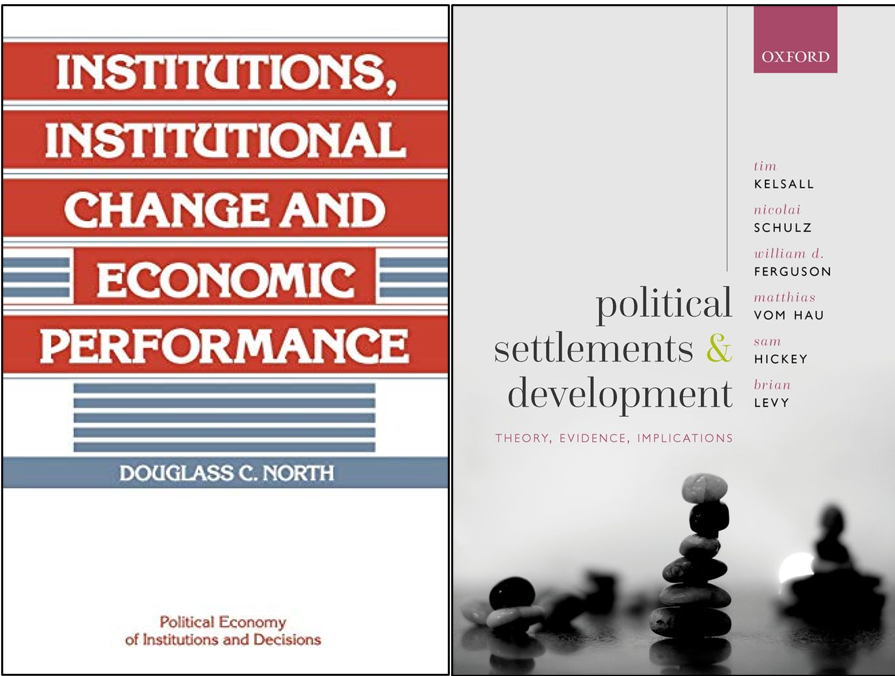
Typologies provide a useful way of drawing sharp distinctions among a small number of heuristic patterns that, considered together, delineate a variety of contexts along which many  real world polities might be aligned.  My 2014 book Working with the Grain  built a typology around cross-country variations in institutional characteristics.  The typology laid out in the 2022 book Political Settlements and Development: Theory, Evidence, Implications gives primacy to variations in the configuration of power.  (The book was a multi-author effort led by Tim Kelsall; I was one of the co-authors.)  This  piece integrates the two approaches,  using the four variables included in Figure 1.  

Kelsall et. al’s definition of a political settlement provides a  useful point of departure for clarifying the relationship between power and institutions. It defines a  settlement as:

“An ongoing agreement (or acquiescence) among a society’s most powerful groups over a set of political and economic institutions expected to generate for them a minimally acceptable level of benefits, which thereby ends or prevents generalized civil war and/or political and economic disorder”

While both power and institutions  feature in the above definition –  a settlement is reached when powerful groups agree on the  ‘rules of the game’ (i.e. the institutions)  that govern the settlement – the 2022 book focuses principally on the delineation of power, and its consequences. It carefully defines  two aspects of power:

  • The social foundation (SF) characterizes who is powerful –  the included socially salient groups (insiders, groups to which policy must somehow respond) as opposed to the excluded (outsiders)…along a spectrum that extends from broad (nearly all social salient groups belong) to narrow (most are excluded).
  • The concentration of power (PC)  characterizes the extent of power – the extent of coherence in the allocation of decision-making procedures and authority among insiders, ranging from concentrated (highly coherent) to dispersed (lacking in coherence).

The book reports measures of each of PC and SF over time in forty-two countries in the global South, and uses these measures to explore statistically the causal influence of each on development. Higher levels of PC turn out to be  associated with more rapid economic growth, and higher levels of SF with broad-based gains in social indicators.

Considering SF and PC from a more disaggregated perspective yields additional insights. The SF variable underscores the importance for  inclusive growth of empowering excluded actors– both at an aggregate level  and at more micro-levels by giving ‘voice’ to beneficiaries who are intended to benefit from social programs. The PC variable directs attention to the roles of three sets of drivers –  distributional, ideational and institutional – in shaping the balance between co-operation and conflict in a country’s polity:

  • Distributional drivers.   As per the definition of a political settlement, a necessary condition for a high PC (and thus rapid growth) is that the breadth of the SF and the distribution of economic benefits are aligned with  each other. (Note that both broad SF/inclusive growth and narrow SF/unequal growth are consistent with this condition, at least in the short-to-medium term.)  A loss of alignment between the distribution of power and of economic benefits is likely to result in a  decline in PC, with an associated slowdown in economic growth, and rise in political polarization. (See here and here.)
  • Ideational drivers. As the 2022 book details (building on Ferguson 2020) political settlements can usefully be understood through the lens of collective action. Shared ideas can provide a basis for achieving co-operative outcomes to mixed-motive bargaining challenges (and thus a high PC); ideational political entrepreneurs (populist or otherwise) can destabilize a previously stable settlement. (See here and here.)
  • Institutional drivers. As per the definition of a political settlement,  institutions (‘the rules of the game’)  provide the container for a political settlement. The institutional arrangements can take a variety of distinct forms,  each of which shapes interactions among stakeholders in a distinctive way. Attention to institutions is thus key to addressing a central question confronting practitioners:  Given the incentives and constraints prevailing in a specific context, what might be some tractable, context-aligned entry points for improving development outcomes?

This last question brings us to the two institutional variables identified in Figure 1.

Variable #3 in Figure 1 can usefully be interpreted as a continuum between wholly top-down (principal-agent)  governance and peer-to-peer governance among multiple principals. As its location at the power-institutions intersection in Figure 1 suggests, this continuum can be interpreted both from the perspective of institutions and of power:

  • As institutions, both principal-agent and multi-principal governance have been the focus of a voluminous literature (for example here, here, and here).
  • As power, each depicts a very different relationship among stakeholders – unequal power in the former, and interactions among relative equals in the latter. At all levels – from the micro (families; firms) to the meso (communities) to the national –  horizontal governance between peers plays out very differently than hierarchical governance arrangements that link those who are powerful with those who are not.

As variable #3 suggests, high PC can thus be achieved via two distinct institutional forms – top-down, hierarchical command-and-control,  or peer-to-peer resolution of horizontal challenges of collective action.

Variable #4 distinguishes among institutions according to  and whether the rules of the game take the form of personized deals or impersonal rules.  This distinction is given only limited attention in analyses of power (including the 2022 volume), but it is central to the contributions of Douglass North and colleagues (see here, here  and here), yet.  As North and colleagues argue persuasively, impersonal institutions cannot be created by fiat; they emerge as a facet of long-run processes of political, economic and social changes.

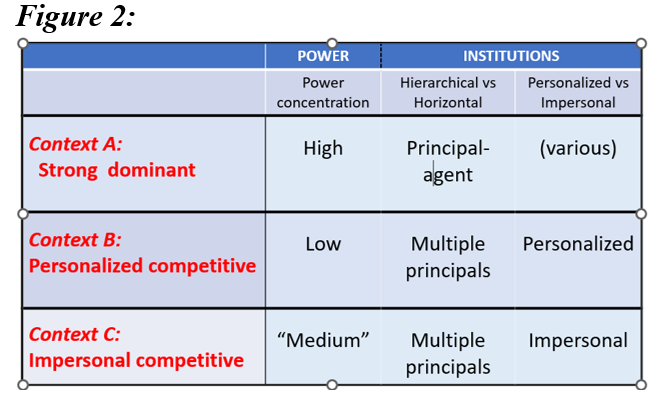
Considered together, variables #2, #3  and #4 provide the basis for a typology  that distinguishes among  a variety of political settlements, each with distinct institutional forms, and thus distinct, context-aligned entry points for improving development outcomes.  Logically, with three variables, each  aligned along a continuum, the number of possible types is large.  The goal, though  is not comprehensiveness, but to  focus  attention on a few core contexts – radically different from each other, each resonant with a familiar ‘real-world’ pattern, and each characterized by distinctive patterns of incentive and constraint, and thus distinctive entry points for improving outcomes.  Figure 2 below identifies three types that meet these criteria. (In applying this framework, I have found that many countries can be interpreted as hybrid combinations of the three – but I have not come upon a fourth type that  meets the tests of both real-world resonance and enough qualitative distinctiveness that it warrants inclusion as an additional category.) The paragraphs that follow elaborate on each of the  types, drawing on the companion blog on education systems to signal their practical relevance.

In context A (strong dominance), power is highly concentrated, and exercised top-down –  with all of the strengths of decisiveness, and the pathologies of hubris and demotivation of subordinates that can accompany this institutional mode of exercising power.  The political economy of education case studies for Indonesia, Ethiopia, Nigeria, Tanzania and Vietnam illustrate some of the ways in which dominance plays out in practice.   As the education research details, key to achieving gains in these contexts is to engage top-level leadership around purposes.

Context B (personalized competition)  is characterized by fragmented authority: multiple centers of power, limited capacity for co-operation, and limited compliance with formal rules (including the rules necessary for the functioning of a formal bureaucracy). In this context, as education case studies for Bangladesh, Ghana, Kenya and South Africa’s Eastern Cape province illustrate – and as a broader literature has explored in depth (see here, here and here) – entry points for achieving gains come not from efforts at systems reform, but from more focused efforts to strengthen islands/pockets of effectiveness.

Context C (impersonal competition) is characterized by strong formal ‘rules of the game’ intended  to provide a platform both for resolving conflict among stakeholders and their goals,  and for implementation. In successful, mature democracies this platform can indeed result in a shared commitment among powerful interests to craft win-win resolutions of collective action problems, and in the effective operation of public bureaucracy. However, as the education case studies of Chile, Peru, India and South Africa illustrate,  the all-too-common  result is instead a combination of  unresolved political contestation over  goals (and thus, as per Figure 2, a ‘medium-level of PC),  exaggerated rule compliance and/or performative isomorphic mimicry.

More broadly, as many democracies (even seemingly mature ones)  are demonstrating, polarized discourse renders impersonal competitive contexts increasingly vulnerable to a cumulative delegitimization of the public domain, and a downward spiral of institutional decay. Reversing downward spirals is a central challenge of our time. At a micro/sectoral level, as I summarize in the companion blog,  the education studies offer some interesting insights as to how this might be achieved across the different contexts. At a broader level, I explored some possibilities in a comparative analysis of interactions between inequality and polarization in South Africa and the United States. Extending this analysis into a broader exploration of what it will take to turn from rage to renewal will be a central focus of my work going forward.

South Africa’s changing tolerance for inequality

South Africa, along with many other countries, is struggling to renew hope in the wake of a difficult downward spiral. This struggle  is the focus of our new, co-authored  paper, to be launched on April 7th at a virtual event featuring Trudi Makhaya (economic adviser to President Ramaphosa) and Harvard’s Dani Rodrik. (Here’s a link to the event.)  

South Africa’s recent experience illustrates powerfully the fragility of hope. In the 1990s, the country was an iconic case of democratization. The subsequent collision between strong institutions and massive inequality makes its experience potentially of relevance not only for other middle-income countries, but also for many higher-income countries wrestling with a combination of a declining tolerance for high or rising inequality and institutions that seemed strong in the past but find their legitimacy increasingly being questioned.  

In a benign scenario, ideas, institutions, and growth all reinforce a hopeful, virtuous spiral. Ideas offer hope, encouraging cooperation, the pursuit of opportunities for win-win gains.  Institutions provide credibility that the bargains underpinning cooperation will be monitored and enforced. Together, ideas and institutions provide credible commitment, fueling economic growth. However, the benign scenario does not reckon with the ways in which persistent high inequality, accompanied by unresolved tensions between the distribution of economic and political power can both put pressure on institutions and catalyze a lurch from hope to anger. The consequence can be a cascading set of pressures, and an accelerating downward spiral. Turnaround calls for going beyond ‘with the grain’ approaches, and embracing a far-reaching vision and strategy of renewal.

The new paper, “South Africa: When Strong Institutions and Massive Inequalities Collide”,  co-authored with Alan Hirsch, Vinothan Naidoo and Musa Nxele has been published by the Carnegie Endowment for International Peace, in collaboration with the University of Cape Town’s Nelson Mandela School of Public Governance. It will be launched on April 7th at 10am (US East Coast time), at an open virtual event to be co-hosted by the CEIP’s Tom Carothers and Zainab Usman, and Faizel Ismail of the Mandela School, with Trudi Makhaya and Dani Rodrik as discussants.  A  modified version of the paper’s executive summary follows below

***

For South Africa’s first fifteen years of democracy, the combination of a shared willingness among stakeholders to believe in the power of cooperation and effective institutions that helped make promises of co-operation seem credible enabled the country to move beyond counterproductive conflict and pursue win-win outcomes. Growth began to accelerate, providing the fiscal means for addressing absolute poverty (as per Table 1), and offering some new opportunities for expanding the middle class. There were, however, some stark limitations in what was achieved. The poorest four deciles remain largely unemployed or underemployed, and mostly live in rural areas (designated during the apartheid era as “reserves” or “homelands”) and informal settlements around towns or cities.

Table 1. Some gains in reducing poverty, 1996-2011

19962011
Absolute poverty, with daily hunger28%11%
Access to:
 – electricity

58%

85%
 – piped water56%91%
Immunization coverage68%98%
Secondary school enrollment50%75%
Access to social grants (old age, child support, disability)2.4 million15 million

South Africa’s political settlement was built around four distinct sub-bargains:

  • A deal between the established (overwhelmingly white) economic elite and the country’s new political leadership. This included commitments to sustain the rule of law (including protection of private property), and to gradual ongoing economic transformation (including an elaborate program to support black economic empowerment, BEE).
  • A deal among the new political elites within the majority political party, the African National Congress (ANC).  The ANC is a broad tent encompassing many ideological proclivities; degrees of public-spiritedness; and regional, ethnic, and economic interests. Its implicit promise was that its formal structures, plus the structures of government, would channel this diversity toward a shared national purpose.
  • A promise of upward mobility. One aspect was a commitment to protect the interests of new (predominantly black) middle class insiders. Another aspect was a promise that a combination of education, job creation, and an end to racial discrimination would open up readily accessible opportunities for those on the cusp of middle-class status.  
  • A promise to reduce extreme poverty. A post-minority-rule redirection of public resources and services would benefit the whole population.

All of these sub-bargains except for the last one, which was pursued at least into the 2010s, were built on shaky foundations. Many BEE transactions straddled the boundary between rules-based and more personalized deal-making; who should participate in BEE initiatives became part of the ANC’s inter-elite conflict. Adapting to a transformed political order created new pressures for the public sector. Had South Africa been able to enjoy a combination of visionary leadership and East Asian rates of rapid economic growth for a sustained period, the expansion of opportunity throughout society might have trumped the limitations of the aspirational commitments. In reality, the country only briefly reached an annual rate of 5 percent from 2005 to 2008.

In 2009 Jacob Zuma became president, having won a bitterly contested struggle for ANC leadership. He inherited an economy that, though buffeted by the 2007/2008 financial crisis, seemingly was fundamentally sound. Indeed, in the initial years of Zuma’s presidency—which included the wildly successful, celebratory atmosphere of South Africa’s June 2010 hosting of the soccer World Cup—it seemed likely that the country would continue its positive trajectory and might even begin a new phase of renewal. 

However, a hopeful scenario was overtaken by a combination of events, deep-seated ongoing challenges caused by South Africa’s continuing extreme inequality, and Jacob Zuma’s approach to leadership.  The events comprised a change in presidential leadership and South Africa’s undisciplined and uncoordinated response to the global financial crisis, which short-circuited a virtuous circle of an economy and society on the mend. Subsequent to the global crisis, South Africa  failed to build momentum and (contrary to other MICs) stagnated, signaling that the global shock is not sufficient to account for the subsequent reversal.

The deep-seated ongoing challenge was the country’s persistent inequality. As Table 2 details, as of the mid-2010s less than a quarter of the total population, including essentially all white South Africans, enjoyed a standard of living that was middle class or better. More than all other middle-income countries, South Africans are either affluent or poor, with limited opportunities to move up the economic ladder.  There was ample reason for the majority of South Africans to feel that, notwithstanding the promises of mutual benefit, the deck remained stacked against them. This increased the vulnerability of South Africa’s political settlement.

Table 2. South Africa’s 2014 Population Distribution, by Ethnicity and Class

 TotalAfricanOther blackWhite
Chronic poor49.5%46.9%2.5%0%
Transient poor121020.1
Vulnerable151320
Middle class209.546.5
Elite3.50.60.52.4
% population100%80%11%9%
Source: Schotte, Zizzamia and Leibbrandt (SALDRU, 2017)

Over the course of his nine years in office, Jacob Zuma governed in an increasingly personalized way, with increasing recourse to polarizing rhetoric. When Zuma took office, many who backed him hoped that he would bring an inclusive, coalition-building, popular touch to leadership—a contrast to Mbeki’s remote, technocratic, and somewhat imperious style. In the event, Zuma proved to be a cunning, ruthless, and charismatic tactician.

The paper describes in detail three successive turns that set in motion what looked to be  an accelerating downward spiral of decline:

  • Rising pressure on institutions, sparked by the continuing ambiguities and unresolved tensions in the bargains between economic and political elites, and among the various influential sub-groups within the ANC itself.
  • A rising tide of disillusion when per capita income growth entered and remained in negative territory. Zero-sum contestation over public positions and resources at the national, provincial and local levels became acute.  Those on the cusp of the formal economy found themselves unable to consolidate middle-class status;  unemployment steadily increased.
  • An ideational turn toward anger, catalyzed by both genuine grievance and political opportunism. In the face of thwarted opportunity, an increasing number of South Africa’s population came to see the privilege enjoyed by the mostly white economic elite—and the tide of apparent corruption that seemed to be the only way that new elites could share in that privilege—as a provocation. In turn, opportunistic ethno-populist political entrepreneurs sought to use the disillusion to strengthen their position within inter-elite political struggles.

All the elements seemed to be in place for a fourth turn – a  rapidly accelerating cumulative slide, with weakened economic performance, institutional decay, anger and ethno-populism feeding on one another. The December 2017 election of Cyril Ramaphosa as leader of the ANC and his subsequent accession to the country’s presidency signaled a pause to this slide. However, three years later, President Ramaphosa has not been able to move decisively beyond a promise to “stop the rot” and offer a renewed positive vision. Hard hit also by the Covid-19 pandemic, the country is not out of the woods.

What has been missing so far has been a vision capable of renewing hope across South African society. The path of least resistance for established elites would be to return to “the basics,” reembracing the trajectory of the Mandela and Mbeki presidencies. However, for reasons detailed in the paper, such a muddling-through scenario is unlikely to have the broad-based political support needed for it to be sustainable over the medium term.

The paper suggests  a credible promise of upward mobility for a wide spectrum of society as the centerpiece of a next-generation inclusive development strategy for South Africa.  In the first fifteen or so years of democracy, the elimination of racial barriers and the country’s accelerating growth were sufficient to usher in a season of hope. However, once the low-hanging fruit of the opportunity opened up by the end of apartheid’s racial privileges was gone, the limited economic prospects of those outside the elite became evident. A credible promise of upward mobility would offer a vision of hope and possibility for better lives across society as a whole, renewing perceptions as to the legitimacy of the social and economic order. (The paper details some aspects of a strategy along these lines.)

South Africa’s experience suggests four potentially useful propositions for the many countries struggling to maintain a positive social, political, and economic trajectory in the face of a declining tolerance for high or rising inequality.

  1. The trajectory of change is a knife-edge. There is the potential to set in motion virtuous circles of positive interactions among ideas, institutions, and economic growth. At the same time, there is a substantial risk that unaddressed distributional imbalances can set in motion a cumulative downward spiral of decline.
  • Ideas matter—a hopeful vision of change, when combined with a “good enough” responsiveness to distributional concerns, can be sufficient to launch a positive trajectory.
  • Both ideas and institutions can be shields against adversity—but only up to a point. Hopeful ideas can evoke positive agency and help mobilize for collective action. Institutions can function as shock absorbers. However, both need reinforcement, including ongoing attention to festering imbalances.
  • Initiating a new cycle of renewal requires a set of ideas and actions which address in a “good enough” way the imbalances which had resulted in derailment.

Leadership needs to risk of mobilizing new coalitions capable of overcoming the vested interests that stymie inclusive change. Can South Africa’s leadership—and can leadership in other countries, where a similar sense of disillusion has taken hold—summon the necessary boldness to rise to this challenge?

*****

For the authors’ presentation, and Trudi Makhaya and Dani Rodrik’s perspectives on the paper, join the co-sponsored Carnegie and Mandela School event, on April 7th or view the session (via this link) at some later time

Puzzling over ‘anti-corruption’

anti-CorruptionI’ve been puzzling (yet again!) over the usefulness of anti-corruption as an entry point for engagement by civil society, donors and other developmental champions. Always and everywhere, behaving ethically is surely crucial to meet the most important test of all — the “look oneself in the mirror every morning” test. The question for activists is not whether we should model ethical behavior — an obvious “yes” —  but what are the pros and cons of an anti-corruption ‘framing’.  I list below three analytically strong arguments against using anti-corruption as an entry point– but also one compelling argument for its use. It would be terrific if this post could get some fresh new conversation underway on the dilemma.

 Here (to establish that I’m not coming at this as an apologist) is the argument ‘for’ focusing on anti-corruption. Impunity is corrosive. It can over time destroy a country’s entire development platform. In the absence of sustained vigilance, some political leaders might find themselves wading, step by incremental step, deeper and deeper into the mire of corruption – setting a tone at the top which progressively pervades layer after layer of a country’s institutions. The absence of a strong anti-corruption voice in society can help ‘enable’ this type of downward slide.

But here are the three arguments against leading with an ‘anti-corruption’ focus:

  • First is the logic of ‘limited access orders’ — as laid out in landmark work by Nobel-prize winning economist Douglass North and his co-authors. They show compellingly that in the large majority of countries today (and historically everywhere), before impersonal institutions have taken root, personalized deal-making among elites is the basis for political stability. They argue also that the development of a country’s institutions and its economy are interdependent, and that the process evolves incrementally. Taken together, as they argue, these insights suggest that “transplanting institutions [can] undermine the political arrangements maintaining stability, [and can] unleash disorder, making the society significantly worse off.”
  • Second is the logic of clientelism – spelled out in useful detail by Francis Fukuyama in his recent book, Political Order and Political Decay. Fukuyama argues that the allocation of public sector jobs to political allies will almost inevitably be present in societies that democratize before they build strong state capability. He suggests that in settings with democratic contestation but without a capable state  “clientelism should be considered an early form of democratic accountability and be distinguished from other forms of corruption – or indeed not considered a form of corruption at all.”
  • Third is the central importance of the ‘capacity to co-operate’ in achieving development outcomes – and, as per the path-breaking work of Elinor Ostrom (another Nobel-prize winner), the role of encouraging trust  and  mutual learning in building this capacity. In a world where (as she puts it) “there are some saints and some sinners, but mostly regular folk capable of both types of behavior….norms can evolve to support co-operation.” As Ostrom’s good practice principles for effective co-operation suggest, co-operation and trust are built by a combination of close monitoring and encouraging people to put their ‘best foot’ forward, even in the face of imperfection, not by punitive admonition. [Chapter 8 of my book, Working with the Grain  includes a comprehensive discussion of how we can bring Ostrom’s insights more into the mainstream of the development policy and implementation discourse; more information about the book is available on this website.]

A few years ago, I began asking colleagues within the development community how one might tell the difference between those political and bureaucratic leaders who were doing what was necessary to achieve developmental goals in settings where formal institutions were weak – and those who had crossed over to the ‘dark side’ of impunity and predation. It took many months before I finally came across a colleague who (based on his many years of experience in an African country which had experienced both types of leadership) provided a compelling answer.  “It’s easy”, he said. “In the former case, the informal rules of the game are clear, and the leaders play by them. In the latter, the rules are not clear – and, whatever, they might be, they do not apply to the leaders themselves”.

Compelling, yes – but how can activists translate the above into a strategy which provides a ‘tripwire’ in the face of impunity but, at the same time, sustains a positive discourse for the development endeavor as a whole? Reflections appreciated – and more on this in subsequent posts….