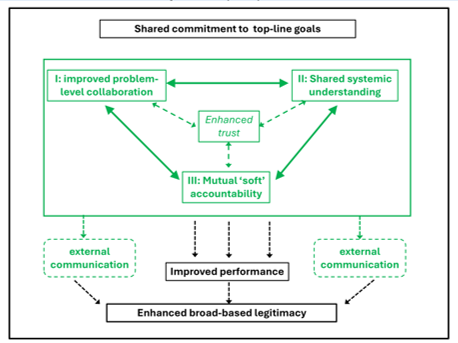
LA’s governance arrangements for addressing homelessness continue to evolve – with continuing fluidity as to how the various parts align with each other. Against that backdrop, the University of Southern California’s Price School Professor of Public Policy Shui Yan Tang and I have been invited to make a presentation at the June 18th meeting of the multistakeholder Leadership Table on “How the Leadership Table can sustainably add value”. As the presentation details, we argue that it can do so via three mutually-reinforcing mechanisms – each valuable in its own right, and collectively mutually reinforcing, with success vis-à-vis one entry point enhancing trust and thus the effectiveness of the others. The three are:
Problem-focused collaborative governance;
Fostering a shared systemic understanding of how the various parts fit together – how the whole adds up to more than the sum of its parts; and
‘soft mutual accountability’, centered around shared purpose, vis-a-vis budgetary trade-offs, operational efficiency, and effectiveness in prioritization.
For readers interested in some earlier work by Professor Tang and myself on the challenges of homelessness and its governance in the LA region, here are links to three articles:
In 2023, I began a program of research on some innovative governance arrangements for addressing homelessness that LA’s political, civic, bureaucratic and private sector leaders put in place as part of a determined effort to finally come to grips with a long-festering crisis (see here and here). In 2024 and 2025, the tide of Los Angeles’ homelessness seemed to turn. However, as highlighted by some extraordinarily forthright and stark presentations (available here) at an October 2025 meeting of one of the new bodies – the multistakeholder Leadership Table for Regional Homeless Alignment – new budgetary and economic pressures threaten reversal.
This piece (and an accompanying technical note, both initially posted in October 2025, updated in May 2026) sets the stage for that work by laying out – from an empirical and ‘technocratic’ rather than a governance perspective – how I have come to understand LA’s homelessness crisis. The technical note presents a carefully-specified empirical framework, and makes explicit the details of the data, parameters and causal relationships that underlie it. Building on some recent innovative applications of systems analysis (here and here), the technical analysis frames homelessness as a “flow”, complementing more familiar “stock” perspectives. This piece provides an overview of the empirical framework, and highlights its implications for policy and strategy. As a prelude to laying out the framework, it is necessary to set the stage.
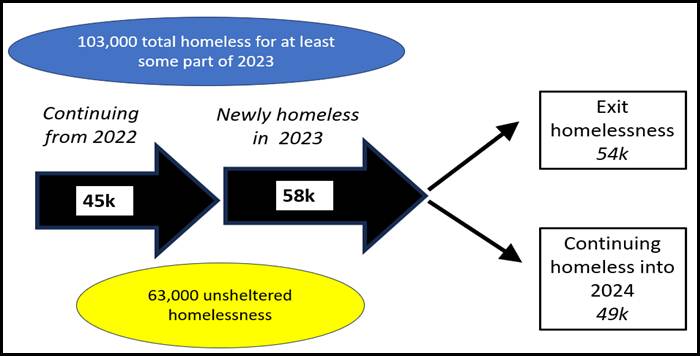
Figure 1: Homelessness in LA – inflows and outflows (2023)
Source: Leadership Table
At first sight, Los Angeles’ challenge seems straightforward: end homelessness for the 70,000 or so people -roughly 50,000 of whom live on the streets – identified as homeless in recent iterations of the region’s annual point-in-time (PIT) count. However, as Figure 1 illustrates for 2023, the PIT count (a “stock”) captures only a moment in an ongoing and much larger flow: in that year 103,000 people accessed LA County’s homeless services. Between 2020 and 2024, close to 300,000 people (3% of LA County’s population of 10 million) accessed the county’s homeless services at least once.
Viewed through a structural lens, the evidence is compelling that over time the aggregate number of people who enter into homelessness is driven by metropolitan-area level interactions between the cost of housing and income (both wages and safety net support) at the bottom end of the economy. As I summarize here, for many decades LA’s trends have been dismal vis-à-vis both housing and median-and-below wages . However, these structural drivers can only be reversed over the medium- and longer-term. In the near-term, the challenge is to make better use of existing resources.
How, at a time when the regional economy is turning soft, the safety net is under threat, and funds to combat homelessness are set to contract, might available fiscal resources be more effectively deployed? The empirically-anchored analytical framework laid out in this piece might hopefully help address this near-term challenge.
Considered as a flow, homelessness is daunting in its complexity. Multiple drivers lead to homelessness; there are multiple pathways through homelessness; and multiple ways to exit. One way to cut through the complexity is to group the challenges posed by homelessness into three distinct ‘clusters’:
Short-term homelessness – those who enter and then exit homelessness within 6-12 month (including initiatives to identify and pre-emptively support those most at risk of becoming homeless).
‘Slippery slope’ homelessness – those who lack/miss the ‘lifeboat’ of early exit and risk a deepening downward spiral.
‘Chronic’ homelessness – those who have lived on the street for long enough and/or have personal vulnerabilities of a kind that render them unable to exit homelessness and live independently without sustained support.
The paragraphs that follow consider each of these, beginning with the last.
To begin with the chronically homeless cluster, many in LA view homelessness and chronic homelessness as synonymous. However, as both Figure 1 and the cluster framework signal, this view is mistaken – though chronic homelessness indeed comprises homelessness’s most visible aspect of homelessness, and its magnitude is large – though estimates vary widely depending on the definition used. The technical note estimates the cluster’s magnitude by disaggregating the PIT count in a way that combines information on homelessness duration and the severity of mental health and substance abuse symptoms. This yields a 2023 total of about 39,000 chronically homeless people.
Careful micro-level research has shown that “housing first” (more precisely, the provision of permanent supportive housing) is the most effective and cost effective way of helping people who have been chronically homeless to live a stably housed life. Perhaps surprisingly to some, in recent years, LA has had an effective large-scale program of placing homeless people into permanent housing – about 20,000 annually, amounting to over 130,000 since 2017. But permanent housing (especially with the necessary support services) does not come cheap; as of 2025, the LA region was spending well over $300 million annually on its PSH program.
A central reason why implementing “housing first” is so costly is, of course, LA’s massive undersupply of affordable (and other) housing. But this undersupply can only be addressed over the medium and longer-term – a narrow focus on “housing first” thus has little to offer vis-à-vis the urgent immediate challenge of how best to deploy scarce fiscal resources to mitigate the damage to come. Recognizing this brings to the fore the question of whether, in a housing (and fiscally) constrained environment the two earlier stages in the homelessness “flow” – short-term and slippery-slope homelessness – might offer added cost-effective opportunities for reducing homelessness.
Short-term homelessness affects a large number of people – and, given its magnitude, receives surprisingly little attention within the broader homelessness policy discourse. To be sure, substantial (and increasing) attention is given to ‘prevention’ – initiatives that aim to identify and pre-emptively support those most at risk of becoming homeless. Notwithstanding efforts at prevention, as Figure 1 signals for 2023, in Los Angeles County roughly 60,000 people become newly homeless each year. (Note that, for reasons explored in the technical note, PIT count estimates of short-term homelessness are way lower.) Many of the 60,000 exit homeless rapidly – as the companion technical note details, about 40% of those who become homeless exit within six months; and an additional 15% or so exit over the subsequent six-month period, making for an only-short-term homeless cluster total of about 32,000
These seemingly rapid exit rates do not imply that homelessness will resolve itself. For one thing, the current rapid rates of exit are based on LA’s prevailing ambitious (and fiscally costly) efforts to reduce homelessness; in the coming period, budget cuts could undo a quite substantial part of this effort. For another, the number of people homeless at any point in time is the accumulated total of those remaining homeless after initially becoming homeless in some prior year. If the number of people who become newly homeless stays high (or, as is very plausible, increases), then the total will add up rapidly. Finally, and perhaps most fundamentally, alongside those who exit rapidly, is an almost as-large number -roughly 28,000 – who remain homeless beyond one year. This brings us to the ‘slippery slope’ cluster, and the interplay between homelessness and vulnerability.
As the technical note details, homelessness and vulnerability are intertwined – and especially so vis-à-vis mental health (MH) and substance abuse (SA). As of the time of becoming homeless, about 40 percent of a newly homeless population already was wrestling with one or both of MH/SA challenges. But MH/SA are a consequence as well as a cause of homelessness – among those who remain homeless for three or more years, over 85 percent deal with MH/SA symptoms. While much of this increased share can be explained by differential rates of exit, roughly a quarter of the long-term homeless population had no MH/SA symptoms as of the time of becoming homeless; a further 15-20 percent progressed to more complex MH/SA symptoms over time.
The slippery slope homelessness cluster comprises precisely those people who have been homeless for more than a year, so are no longer on a short-term exit path, and have not yet crossed into chronic homelessness – but are at risk of a deepening downward spiral. They are the pivotal ‘in-between’ population for whom policy choices can most strongly influence whether exit from homelessness into self-sustaining daily life remains plausible, or whether some form of permanent supportive housing will be called for. As the technical note details, estimates vary widely – depending on definitions and the data used, the size of the slippery-slope homeless cluster can range from 27,000 to 38,000.
Stepping back from the details, how might the three-cluster framework help in crafting a strategic response to the increasingly stark fiscal and political challenges confronting LA’’s efforts to reduce homelessness? An obvious first step is to look for efficiency gains – how well are resources being used to deliver on programs already underway? But belt-tightening can only go so far. When the required cuts are large, attention also needs to be given to effectiveness – are we doing the right things?
Directing attention to the ‘short-term’ and ‘slippery-slope’ clusters points to the value of intervening as early as possible in a person’s homelessness journey – with the aim of shifting the trajectory of the homelessness flow so that fewer people move all the way from short-term homelessness into the costly, long-duration end of the system. A variety of follow-on questions arise: Are there cost effective ways of forestalling homelessness for those who are at greatest risk? What facilitates rapid exit from homelessness? How important are time-limited rental and other subsidies, and other non-pecuniary supports in facilitating exit? How could these subsidies be targeted more effectively? For those for whom homelessness has taken hold, what can be done to reduce the risk of journeying all the way down the slippery slide to disaster? Finally, viewed from both outcome and fiscal perspectives, how to navigate the impossible trade-off between supporting this group and meeting the needs of the chronically homeless?
None of these questions are new to those who have long labored to reduce homelessness. Even so, at this moment of fiscal stringency it can be especially helpful to take a more expansive view of the options available – one that not only focuses on how to minimize damage to ongoing programs but also assesses comparatively the cost effectiveness of a broad range of possibilities for addressing our region’s homelessness crisis.