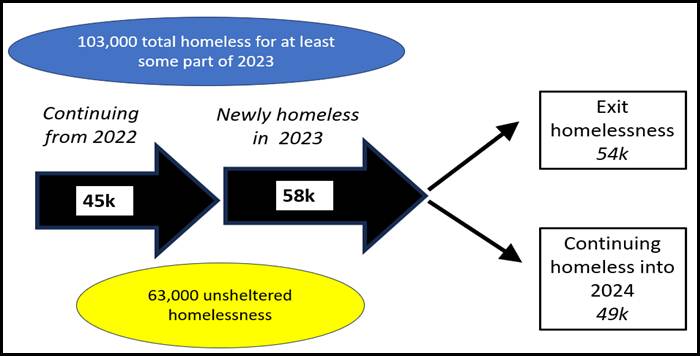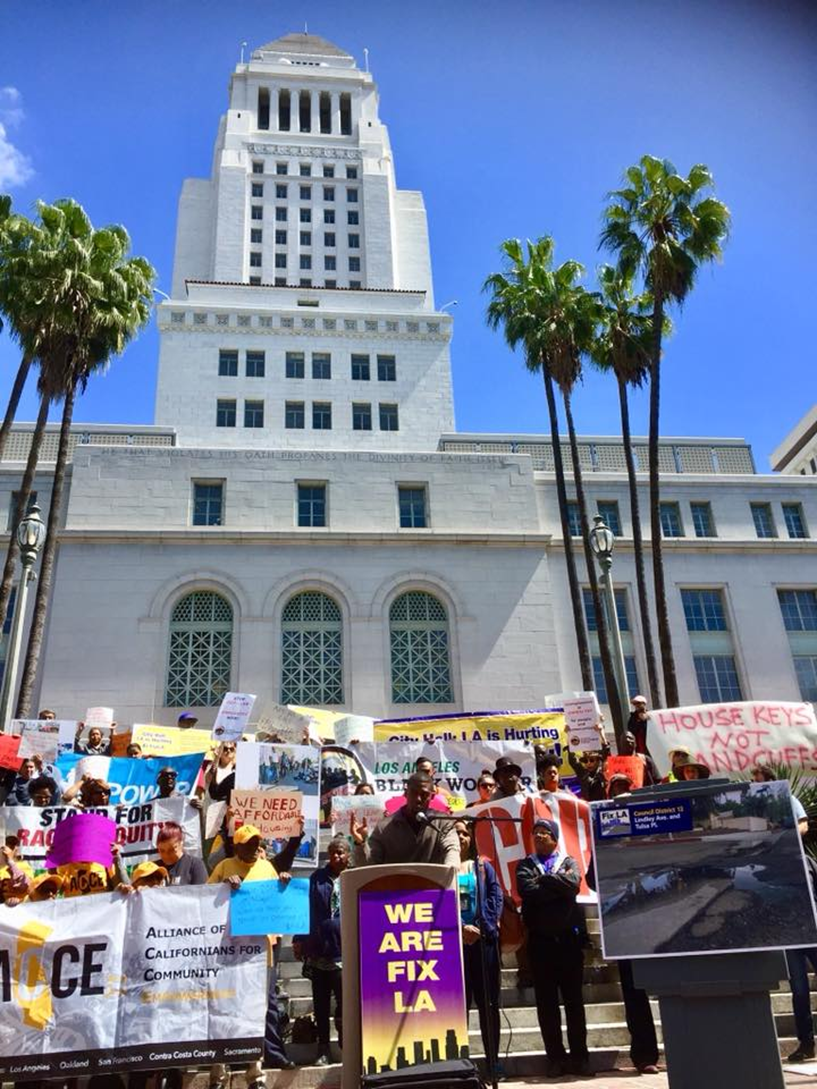
The drumbeat of dispiriting daily news makes it difficult to look beyond immediate crisis. Where to find hope? Los Angeles’ ongoing homelessness crisis might seem an especially unlikely place to look. As explored in detail here, every night nearly 50,000 people sleep unsheltered on the streets of Los Angeles County, and every year well over 60,000 people become newly homeless – and the Trump administration’s efforts to shred the safety net threaten to make things much worse, soon. Even so, as USC professor Yan Tang and I detail in a recent article in the National Civic Review, a close look at how LA is addressing homelessness offers some unexpectedly good news.
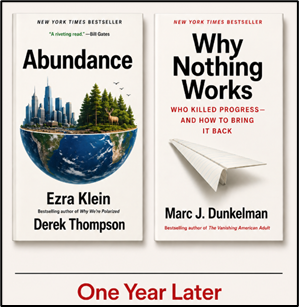
“Populists don’t just feed on socio-economic discontent. They feed on ineffective government” Ezra Klein and Derick Thompson argue in their bestselling book, Abundance, quoting two eminent scholars. Klein and Thompson highlight failures in LA’s response to its twin crises of homelessness and a massive shortfall of affordable housing as exhibit number one in a broader indictment of progressive governance. But things have moved on. [Author’s note: This post was written prior to my recent ‘Achieving Abundance blog series; an updated version that explores in detail the links between homelessness in LA and the arguments laid out in that series will be forthcoming in a few weeks.]
As the Levy-Tang National Civic Review article details, the LA region’s recent efforts to address homelessness include some bold, largely unheralded, but innovative and potentially transformative governance reforms. These reforms, the article argues, have the potential to provide a platform for far-reaching improvements in the effectiveness of the LA region’s efforts to address its homelessness crisis.
Some of the governance reforms aim to bring more top-down coherence to how hierarchical authority is exercised. Others aim to foster greater horizontal alignment across jurisdictions and service providers. The top-down reforms are moving forward at breakneck speed – a new, consolidated Los Angeles County Department of Homeless Services and Housing, is scheduled to open on January 1, 2026. Yet one can readily imagine a scenario in which, rather than embracing the possibilities of the new institutional environment, many of the multiple public and non-profit organizations working to address homelessness outside the umbrella of the new department could become pre-occupied with fending for themselves.
The “horizontal” governance reforms – the creation of two new multistakeholder bodies to support better alignment of approaches to homelessness across the LA region – potentially could address the risk of balkanization. The county-wide adoption earlier this year of a set of top-line goals for reducing homelessness formulated by the two bodies points to their potential. However, unlike the new department, the multistakeholder bodies lack any obvious and established champion. While they are making substantial progress in clarifying and consolidating their roles going forward, the risk remains that the painstakingly constructed shared vision that led to their emergence could all-too-easily be washed away by the crises (and parochial interests) of the moment.
Indeed, if they are to succeed, the new governance arrangements will need to hit the ground running and successfully confront what is shaping up as a potentially massive fiscal crisis. Addressing homelessness effectively takes resources: resources for support services, resources to help the most vulnerable pay their rents, and resources to expand the supply of affordable housing. In LA, these costs are exacerbated not only by the number of people who are homeless, but by decades of income stagnation for the bottom half of its residents on the one hand, and rising rents (fueled by an undersupply of housing) on the other.
A recent ballot initiative approved by voters raises about $1 billion annually (via increases in local sales taxes) to combat homelessness. One third of the resources is earmarked for a new initiative to build more affordable housing. The remaining two-thirds replenish earlier (now expired) commitments – and are barely enough to sustain existing programs. Even in the absence of the Trump cuts, the system already was overstretched. Current Trump administration budget proposals (some of which have so far been somewhat restrained by budget committees in the House and Senate) include billions of dollars of further cuts in rental assistance, in permanent housing support, in Medicaid-funded housing for health initiatives, and in food stamps and other safety net programs. In the context of a regional economic slowdown and the already-extreme economic vulnerability of LA’s low-income earners, shredding the safety net could result in a tsunami of new homelessness.
What, then, is the balance between good news and bad news? It seems certain that bad news lies immediately ahead. Recent gains in reducing the number of people living on the streets will almost surely be reversed. Increases in homelessness could be large. Fiscal pressures will worsen. Daunting strategic decisions lie ahead. The new governance arrangements confront a trial by fire, even as they have barely left the starting gate.
But the following also is true: Prior to the recent reforms, LA’s governance arrangements to address homelessness were characterized by low trust, ambiguous authority, and the absence of any coherent ways of fostering co-operation and holding the system to account. As the National Civic Review article explores, the new arrangements address these weaknesses. They may not survive the trial that lies ahead, but they have a fighting chance. Sometimes, crisis and adversity can focus effort in inspiring ways.
Coming months will tell. Watch this space for updates.
I’ve lived through this before. My first two decades of life were during peak apartheid in Cape Town, South Africa. Beneath the glistening surface of the city’s sunshine, mountains and ocean was tyranny. Police cars roamed the street, looking to immediately deport black people who didn’t have the required ‘dompas’ document. Families were forcibly removed from their homes. Informal settlements were bulldozed. Brutalization coarsened life -not only for those who were direct targets, but for everyone.
When I came to the United States in the late 1970s, it was with a sense of relief, hope and possibility – now I was living in a land dedicated to “life, liberty and the pursuit of happiness”, a country that promised, in words engraved above the main entrance to the Supreme Court building, “equal justice before the law”. And when I moved to Los Angeles about three years ago, I was thrilled to discover a city that, contrary to East Coast stereotypes, was vibrant, welcoming, and rich in its cultural diversity. Yet in the days since the Trump administration unleashed Immigration and Customs Enforcement (ICE) and federal troops on the city I have lain awake at night, shocked and distressed by the parallels between my early years in Cape Town and what is happening in LA.
As someone committed to exploring how history shapes culture, politics and the economy I am mindful of the many differences between LA and Cape Town, and their implications for policy choices. But in what follows my primary purpose is not to explore nuance, but to assemble some baseline data (taken, except where noted, from a 2024 California-wide study, centered around 2019 data) in a way that directs attention to two urgent issues: (i) the catastrophic social and economic consequences for LA if the Trump administration continues to pursue its militarized and rhetorically shrill and polarizing approach to forced removals; and thus (ii) the urgency of crafting a different way forward. I organize the data around five sets of stubborn facts.
Stubborn Facts I: Undocumented residents comprise a significant share of of LA’s – and California’s – population.
Undocumented residents account for 9.5% of Los Angeles County’s population of about 10 million people; another 20-25% of LA County’s population is foreign born.
Across California, 2.8 million of the state’s total (2019) population of 39 million was undocumented.
Stubborn Facts II: Undocumented residents are deeply embedded into Californian society.
31% of California’s 2019 undocumented population had been resident in the state for 20 or more years; 41% for 10-19 years; 13% for 5-9 years; and 15% for less than five years.
More than half of the undocumented population live in households that include a citizen or permanent resident.
86% of California’s total Latino population of 15.2 million people are citizens or permanent residents.
As of 2019, about 75% of California’s undocumented population was Latino; almost 1.7 million people came from Mexico, and a further 360,000 from El Salvador and Guatemala. An additional 2.3 million Latino citizens of California live in a household where at least one person is undocumented; 4 million people will thus be directly affected by mass deportations.
Across California, 29% of Latino children live in a household where at least one person is undocumented.
Undocumented residents are intertwined with California’s long-established Latino community – a community that cuts across classes, and localities. In the vibrant, culturally-diverse Los Angeles County, whose Latino residents are neighbors, friends, and co-workers, targeting the undocumented Latino population for forced removal will be devastating – not only for those immediately affected, but for all of us.
Stubborn Facts IV: Undocumented residents are woven deep into the economic fabric of Los Angeles.
As of 2019, over 64% of all California’s undocumented residents above the age of sixteen were employed (as compared with 59% for the working age population as a whole); less than 5 percent were unemployed.
Median 2019 hourly wages across California were $13 per for undocumented workers, $19 for immigrants and $26 for the US-born population
Across California, 52 percent of undocumented residents have less than a high school education; 22% have a high school diploma; and 26% have at least some college education.
Across California, undocumented workers account for approximately half of all employment in agriculture – and a similar percentage of child care, home aide, housecleaning and other domestic workers.
Forced removal of undocumented workers will thus have devastating consequences for labor supply at the less skilled end of the labor market, with widespread bankruptcies and cost escalations likely in multiple sectors.
****
History doesn’t repeat itself, but it rhymes. South Africa’s forced removals began in the late 1940s. They set in motion a cascading cycle of decade-long protest, two decades of brutal repression and dehumanization – and then mass civic uprising. Sustained efforts at forced removals in LA will almost surely be accompanied by a parallel combination of protest and repression – a massive blow to the heart of a great city.
How to avoid catastrophe? To address this question, we need to add a fifth set of stubborn facts to the four laid out above. Between 1970 and 2024, the share of the American population that was foreign born rose from 4.7% to 15.6%, with the latter the highest percentage since at least 1850. In the four years of the Biden administration the estimated number of undocumented people living in the United States rose by over 5 million. If catastrophe is to be avoided, simply ignoring the structural underpinnings of America’s current anti-immigrant fervor is not an option.
It has been clear for decades where a constructive path might be found – through the hard work of legislative reform. But instead of reform, contestation over immigration policy has become Exhibit Number One of a broken political system. Back in 1986, Republican-championed immigration reforms, signed into law by then president Ronald Reagan, provided a path to citizenship for undocumented migrants who had lived and worked in the USA for at least five years. By contrast, a 2024 effort at legislative compromise offered a path to permanent residence and citizenship only for undocumented residents who both were married to US citizens, and had been in the USA for at least ten years – an astonishingly inadequate proposal when viewed through an LA lens. Even so, it was the opposition of then presidential candidate Donald Trump, not Democratic opposition, that ended the reform effort.)
But the parallel with South Africa does not only provide a cautionary tale of how things could go wrong; it also points to the possibility of something radically different. The country’s extraordinary ‘rainbow miracle’ transition to democracy shows that, even for conflicts that seemingly are intractable, a collective commitment to finding a way forward can yield transformational positive change. Has the USA become so incapable of collective, problem-solving deliberation that (to paraphrase the eighteenth century philosopher Samuel Johnon) even the threat of a hanging cannot focus our minds?
Beneath the surface of Los Angeles’ continuing homelessness crisis, something promising has been underway – a sustained effort by a a committed group of public officials, political and civic leaders from across the region to crafting a set of ambitious and achievable goals that can guide the region’s efforts. As I explore in an Op-Ed piece published today in the Los Angeles Times, “In a fragmented governance environment like L.A.’s — and for a multifaceted problem like homelessness — goal clarification is a vital early step. Clear goals serve as a shared point of reference for setting priorities, helping multiple participants to better align their choices. They provide a platform for institutions to be held accountable by the public.”https://www.latimes.com/opinion/story/2025-05-21/los-angeles-city-county-homelessness-goals
For those who cannot access the piece via the link, see below for the full pre-publication text.
******
“Los Angeles’ continuing struggle to reduce homelessness has become exhibit number one for a broader critique of the failure of progressive governance. Recent tensions between city and county government over how to organize the provision of homeless services have not helped. But look a little deeper and something more promising comes into focus.
For the past nine months, a committed group of public officials, political and civic leaders from across the LA region have been collaborating to develop a road map for reducing homelessness – and, in so doing, to break with LA’s longstanding pattern of overpromising and underdelivering. Central to their endeavors has been the crafting by a multistakeholder ‘Leadership Table’ of a set of ambitious and achievable goals that can be a north star guiding the region’s efforts.
These efforts reached a crucial milestone in late March, when LA County’s Board of Supervisors endorsed three monitorable top-line goals, including specific targets for 2030. One goal aims for a 20 percent reduction in the number of people becoming newly homeless each year. Another aims to place 30,000 people into permanent housing—an increase of over 50 percent from current levels. A third targets a reduction in the number of people living on the streets in 2030 by nearly a third.
I have spent decades exploring comparatively, as both practitioner and scholar, the ways in which participatory approaches can enhance the public sector’s problem-solving ability. That experience shows that, far from being a pie-in-the-sky academic exercise, a focus on goals can yield enormous practical benefits.
In a fragmented governance environment like LA’s – and for a multi-faceted problem like homelessness – goal clarification is a vital early step. Clear goals serve as a point of reference for setting priorities and making difficult choices. They provide a platform for civic accountability. Further, the combination of goals, their monitorability, and accountability to citizens fosters practicality – sustaining civic support requires that target goals are neither so modest as to cause cynicism, nor so overly-ambitious that they set the stage for failure. Viewed from this perspective, the way in which LA has gone about collaboratively crafting and codifying its top-line goals provides a basis for cautious optimism that its homelessness governance system may finally be on a path to sustained gains.
To be sure, at first blush the goal of reducing LA’s unsheltered population by not-quite a third over five years is hardly headline-worthy. Ending homelessness would be relatively straightforward if the task was simply to find suitable housing for the approximately 50,000 people who currently live on LA County’s streets. Indeed, contrary to the common perception that little is being done, LA’s homelessness support system currently permanently re-houses about 20,000 people each year, more than any other city in the country.
But the region’s homelessness crisis goes well beyond the number of people on the street at a point in time. Each year, a combination of wage stagnation, an extreme shortage of affordable housing, and other personal hardships results in over 60,000 people becoming newly homeless. Given these realities – plus the likelihood that federal budget cuts will shred the social safety net – reaching the target of 30 percent less unsheltered homelessness by 2030 would be a major accomplishment. But getting there will require both public officials and civil society to move beyond business-as-usual.
For public officials, clear, ambitious-and-achievable goals provides the requisite platform to stop endlessly cycling from one seemingly appealing initiative to another, and engage systematically with the dual challenges of improving effectiveness and efficiency. Effectiveness calls for decisions on how to prioritize scarce resources: Which interventions are most effective in reducing inflow into homelessness? Which services and supports—psychological and social support, rental subsidies, or interim housing—best help homeless people get permanently housed? And, looming above all of these, how to expand the supply of affordable housing?
Clarity vis-a-vis effectiveness enables efficiency to move to the front-burner: For each prioritized intervention, what is a minimum set of acceptable standards? Do public, private and non-profit providers meet these standards? What will be the mechanisms for improving performance, or clawing back resources, from providers that fall short?
For civil society, an informed embrace of ambitious-and-achievable goals provides a basis for moving beyond exhortation and criticism, and embracing new ways of providing the accountability and oversight needed to ensure meaningful results. This includes – and goes well beyond – tracking whether agreed-upon targets are being met.
All-too-often insider interests that stand to lose from reforms that take effectiveness and efficiency seriously will try and protect the status quo. Civil society can bring countervailing pressure. Such pressure might come from purpose-built multistakeholder arrangements (for example the ‘Leadership Table’ that led the goal-formulation effort) and other local organizing groups and coalitions. Local officials will also no doubt recognize the risk that if they fail to make progress on these goals, voters may turn against them at the ballot box.
The people of LA identify homelessness as the region’s number one crisis. The successful recent effort to collaboratively set and adopt ambitious and achievable goals for 2030 is a major milestone. Success in meeting these goals could rebuild the public confidence in local government that has eroded over many years. To be sure, it’s still early days, and there is much uncertainty. But the stakes couldn’t be higher. If LA’s effort to combat homelessness can stay on track, there would be a golden opportunity to flip the narrative – from being a poster child of the failure of good intentions to address urgent social challenges, to becoming the face of a renewed and effective 21st century progressivism.
Even as time becomes shorter and the mood darker, I find it helpful to look beyond the immediacy of crisis and probe the possibilities of renewal. In so doing, I continue to take inspiration from Albert Hirschman’s ‘possibilism’ – the endeavor to “….try to widen the limits of what is perceived to be possible…. and figure out avenues of escape…. in which the inventiveness of history and a ‘passion for the possible’ are admitted as vital actors”. In recent years, I have sought to bring the spirit of possibilism to an exploration of governance at the interface between citizens and the public sector.
A combination of rule-boundedness and insulation of public bureaucracies from day-to-day pressures have long been central tenets of conventional efforts to improve public governance. But conventional efforts have not helped stem a dramatic collapse in recent decades of trust in government and of civic perceptions regarding the legitimacy of the public domains. , As I explored in some earlier work, multiple drivers account for this collapse in trust. Even so, the question of whether the narrowness of mainstream approaches to public sector reform has contributed to the loss of civic trust has continued to nag at me.
Complementing mainstream approaches to public sector reform, might there perhaps be another way forward – one that can both help improve public-sector performance and, of particular import in these times of polarization and demonization of government, do so in a way that helps to renew the legitimacy of the public domain? Might a more ‘socially-embedded’ bureaucracy (SEB) help achieve gains on both the effectiveness and legitimacy fronts? This blog post provides (as a substantial update to an earlier piece) an overview of some of my recently published and ongoing work that addresses these questions.
Exploration of SEB’s possibilities often is met with skepticism. In part, this is because SEB is radically at variance with the mainstream logic of how public bureaucracies should be organized; indeed, as I explore further below, embrace of SEB is not without hazard. But another reason for this skepticism is that SEB is one facet of a broader agenda of research and experimentation that aims to help ‘redemocratize’ the public sector – and enthusiasm among champions of redemocratization has all-too-often outrun both conceptual clarity and empirical evidence. In a generally sympathetic review, Laura Cataldi concludes that much of the discourse proceeds as:
“….an umbrella concept under which a large variety of governance innovations are assigned that may have very little in common……Most of the proposed solutions are situated at the level of principles such as participation, deliberation and co-creation of public value, rather than being concrete tools……[Protagonists] seem to propose models of management, governance and reform that are too abstract, and ultimately lacking in terms of concrete administrative tools…..”
In the work introduced below, I have sought to distil from both the academic literature and the experience of practitioners a set of insights that can help strengthen SEB’s analytical foundation.
I define a ‘socially embedded bureaucracy’ (SEB) as one that incorporates “problem-focused relationships of co-operation between staff within public bureaucracies and stakeholders outside of government, including governance arrangements that support such co-operation.” Questions concerning the value of SEB arise at both the micro and more systemic levels:
At the micro level: what is the potential for improving public-sector effectiveness by fostering problem-focused relationships of cooperation between staff within public bureaucracies and stakeholders outside government?
At the systemic level: To what extent do gains in addressing micro-level problems – and associated gains in trust among the stakeholders involved – cascade beyond their immediate context and transform perceptions more broadly, thereby contributing to a broader renewal of the perceived legitimacy of the public domain?
The research papers introduced in this post explore the above questions. Two of the papers are largely conceptual (see here and here), and two are more empirically-oriented – a case study of the governance of affordable housing and homelessness in Los Angeles, and an interpretive exploration (co-authored with long-time civil society activist Mark Heywood and anchored in two sectoral case studies) of the evolving interface between civil society and the public sector in South Africa.
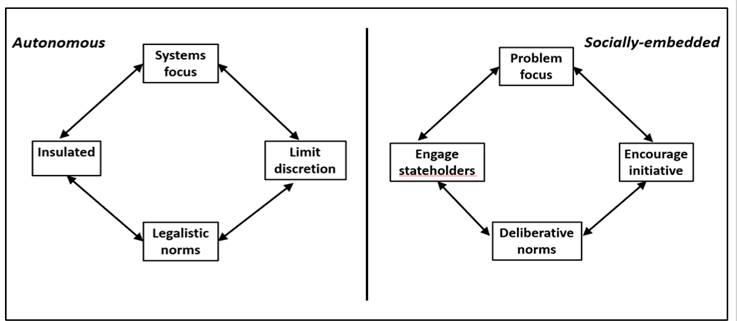
Figure 1 contrasts SEB with conventional notions of how public bureaucracies should be governed. In the conventional view, governance is organized hierarchically, with a focus on ‘getting the systems right’ Citizens engage upstream via their selection of political representatives who oversee both policymaking and implementation. The tasks of public officials are defined by legalistic, rule-bound processes, which also insulate public bureaucracy from political interference. Civil society’s governance role is to bring pressure from the demand-side to help ‘hold government to account’. By contrast, SEB is problem- rather than systems-oriented; it incorporates horizontal as well as hierarchical governance arrangements; interactions (both within the bureaucracy and at the interface with civil society) are less legalistic and more adaptive, oriented towards deliberation and fostering initiative.
Figure 1: Autonomous and socially-embedded bureaucracies
SEB’s distinctive characteristics create opportunities for improving public sector performance via three channels that are unavailable to insulated bureaucratic hierarchies:
Fostering synergies – (problem-level) gains from co-operation between public bureaucracies and non-governmental actors;
Clarifying goals – alliance-building among reform-oriented public officials and civil society actors as a way of bringing greater clarity to the (problem-level) goals to be pursued by public agencies.
Streamlining monitoring – transforming the governance arrangements for (problem-level) monitoring and enforcement from a morass of red tape to trust-building interactions between public officials and service recipients.
Taken together, the above three channels have the potential to unleash human agency by opening up (problem-level) space for public/civic entrepreneurs to champion change. (See my ‘microfoundations’ paper, published by the Thinking and Working Politically Community of Practice for detailed exploration of each of the channels. And see the Los Angeles case study for an exploration of how these channels are at the center of efforts to more effectively address the twin crises of affordable housing and homelessness.)
Alongside recognizing its potential, a variety of concerns vis-à-vis SEB also need to be taken seriously. The first two are evident at the micro-level:
The implications for public sector performance of a seeming inconsistency between SEB’s horizontal logic and the hierarchical logic of bureaucracies.
The hazards of capture or vetocracy that might follow from opening up the public bureaucracy to participation by non-governmental stakeholders.
The third is a systemic level concern, namely that:
Championing SEB as a way to renew the legitimacy of the public domain mis-specifies what are the underpinnings of social trust.
The paragraphs that follow consider each in turn.
To begin with the seeming tension between horizontal and hierarchical logics, the organizational literature on private organizations suggests that there is perhaps less inconsistency than it might seem on the surface. Viewed from the perspective of that literature, the challenge is the familiar one of reconciling innovation and mainstream organizational processes, and it has a clear answer: ‘shelter’ innovation from an organization’s mainstream business processes. As Clayton Christensen put it in The Innovator’s Dilemma:
Disruptive projects can thrive only within organizationally distinct units…When autonomous team members can work together in a dedicated way, they are free from organizational rhythms, habits
Consistent with Christensen’s dictum, the problem-specific building blocks of SEB potentially provide space for protagonists to work together flexibly, at arms-length from broader organizational rigidities.
The second set of concerns follows from SEB’s opening up of the public domain to participation by non-governmental stakeholders. At one extreme, an inadvertent consequence of opening up might be a ‘vetocracy’, with enhanced participation providing new mechanisms through which status-quo-oriented stakeholders can stymie any efforts at public action. At the other extreme, openness might inadvertently facilitate capture by influential non-governmental insiders. As the microfoundations paper explores, these hazards potentially can be mitigated via a combination of vigorous efforts to foster a commitment among stakeholders to clear, unambiguous and measurable shared goals – plus a complementary commitment to open and transparent processes. These commitments can build confidence in what is being done, while also reducing the pressure for control via heavy-handed, top-down systems of process compliance.
The third (systemic-level) concern interrogates the presumption that SEB can help to transform more broadly civic perceptions as to the legitimacy of the public domain. As my second TWP paper explores, a variety of eminent scholars (including Sam Bowles and Margaret Levi) have argued that initiatives that seek to renew the public domain by building working-level relationships between civil society and public bureaucracy mis-specify what it takes to improve social trust. Social trust, they argue, rests more on the quality of institutional arrangements and commitment to universal norms than on the relational quality of the government-society interface. This argument is eminently plausible in contexts where background political institutions are strong and stable. But, as the TWP papers explore, in contexts where disillusion and institutional decay have taken hold, renewal of the public domain – and thus confidence in the possibility of achieving collective gains through social cooperation – requires more than yet another round of institutional engineering.
Especially striking in Los Angeles has been the repeated willingness of voters to support ballot initiatives in which they tax themselves to finance homelessness services and the construction of affordable housing. However, as declining majorities for these initiatives signal, patience is wearing thin. The SEB-like governance reforms on which the LA case study focuses are intended to help renew civic commitment via transparent and participatory processes of goal-setting and accountability; how this is playing out in practice is my current research focus.
Turning to South Africa, my recent paper with long-time civil society activist Mark Heywood explored some interactions between civil society strategies and state capacity over the quarter century since the country made its extraordinary transition to constitutional democracy. Civil society’s principal strategy of engagement has been adversarial. This adversarial approach yielded major victories, including the reversal of AIDS-denialism in government, and momentum for a successful push-back against state capture. Over time, however, a series of political drivers (explored here and here) resulted in a weakening of state capacity. In parallel, civil society’s wins through adversarialism became fewer, and the effect on citizen disillusion became correspondingly corrosive. The Heywood-Levy paper thus makes a case for civil society to complement confrontational strategies with approaches centered around building problem-level coalitions with those public officials who remain committed to a vision of service. (The paper is slated to be part of a forthcoming edited volume by MISTRA; in the interim, interested readers can feel free to email me to request a PDF.)
Finally, opening the aperture even further, Robert Putnam’s 2020 book, The Upswing, raises the possibility that SEB might usefully be part of a strategy for renewing civic perceptions of the legitimacy of the public domain, a way for forward-looking leaders to champion an electoral and governance platform centred around a vision of partnership between the public sector and non-governmental actors. Political and social mobilization centered around deliberative problem-solving would be a radical departure from contemporary pressure-cooker discourses which thrive on raising rather than reducing the temperature. But, as Putnam explored, it happened in the USA between the 1880s and the 1920s, and it might happen again:
A distinct feature of the Progressive Era was the translation of outrage and moral awakening into active citizenship… to reclaim individuals’ agency and reinvigorate democratic citizenship as the only reliable antidotes to overwhelming anxiety……[Similarly], our current problems are mutually reinforcing. Rather than siloed reform efforts, an upswing will require ‘immense collaboration’, [leveraging] the latent power of collective action not just to protest, but to rebuild.”
In dark times, I take inspiration from the great social scientist Albert Hirschman’s commitment to the search for ‘a bias for hope’, for “avenues of escape from exaggerated notions of absolute obstacles…. avenues in which the inventiveness of history and a ‘passion for the possible’ are admitted as vital actors”. Viewed from this perspective, the point of departure for effective action is not some idealized vision of how things should be, but clarity as to how things actually are – with this clarity providing the basis for a search for practical entry points capable of setting far-reaching cumulative change in motion. This passion for the possible has inspired my research and practice for almost a half century; it is the guiding spirit of a new cycle of research on the Los Angeles’ region’s twin crises of homelessness and scarcity of affordable housing (AHHLA) that I introduce in this piece.
Los Angeles’ AHHLA crisis startles. LA County is among the world’s affluent locales, with a 2023 per capita income of over $78,000, well above the American average. Yet that same year about 55,000 people were living on LA’s streets, and over 30,000 of them had been there for more than one year. Even more startling, every year about 60,000 people become newly homeless – a cumulative total over five years of almost 3 percent of LA County’s population of 10 million. For those who live in Los Angeles (among whom, having moved here in 2023, I now count myself) the AHHLA crisis is existential. But its significance goes beyond the local.
As recent books by Ezra Klein and Derek Thompson (2025) and Marc Dunkelman (2025) explore in depth, a broad national reckoning is underway to assess both how failures of progressive governance contributed to the rise of toxic populism, and what might be the contours of a renewed and effective progressivism. AHHLA is ground zero of this broader crisis of contemporary American progressivism. In what ways did decades of progressive good intentions gone wrong fuel LA’s current crisis? Are there hopeful lessons to be learned from recent efforts to address AHHLA about how progressive approaches to governance can become part of the solution?
Here, to set the stage for addressing the above questions, is AHHLA’s economic backdrop:
Over the past four decades, even as the affluent have thrived, earnings have been stagnant for the poorer half of LA’s population. As of the early 2020s, 16.6 percent of LA residents lived below baseline (rent-adjusted) measures of absolute poverty – the highest percentage among California’s regions. (California is the state with the highest percentage in the USA.) In the absence of the public safety net, the LA percentage would be 26%.
Beginning in the 1990s, a combination of population growth, the end of the extensive margin and slow growth environmentalism/NIMBYism has resulted in an increasingly severe shortage of housing. Between 1960 and 1990, about 200,000 housing units were built each decade; between 1990 and 2020, the decadal average was below 75,000 units. In 2023, 45 percent of the households that earn below LA County’s median income paid more than half their income in rent.
The unit costs of building publicly-subsidized affordable housing in Los Angeles are almost two and a half times the equivalent costs in Colorado and Texas; startlingly, within LA the total development costs per square foot are 50 percent higher for publicly-subsidized than for unsubsidized, market rate housing built for private (self-pay) buyers.
Considered together, the combination of stagnant incomes, rising unit costs and a near cessation of new housing construction (except at the more affluent end of the market) was to make accommodation increasingly unaffordable for lower-income Angelenos. In important part, and as per the title of an influential book, Homelessness is a Housing Problem. More on all of this in coming weeks and months.
LA’s fragmented governance arrangements have enabled the AHHLA crisis to fester. This fragmentation is especially ill-suited to addressing homelessness – a multi-faceted ‘wicked’ problem that calls for a multi-sectoral, multi-jurisdictional and multistakeholder response. The roots of LA’s fragmented governance can be traced back (at least in part; racial ‘redlining’ also played a role….) to a century-long aspiration to avoid centralized, urban machine politics and cultivate instead more localized, small-town-like governance. Some tasks are the responsibility of LA County government, and others are diffused among the County’s 88 municipalities, of which the City of LA (with a population of four million) is the largest. This fragmentation has been exacerbated by deepening commitment over the past half-century to open, often legally-mandated public deliberative processes in advance of any action, which further complicates local government’s decision-making.
Moving towards more top-down governance (of varying degrees of draconianism) offers one possible response to fragmentation. But widening the distance between citizens and local government risks worsening what already is a crisis of civic alienation from government in many countries (not least of which the USA) the world over. Might there be a third way, one that finesses the traps of top-down governance accompanied by citizen alienation, or civic participation plus ineffectual governance?
In recent conceptual work (see here for an introductory overview), I have explored the potential and limits of this third way. The articles delineate three distinct channels through which ‘socially-embedded’ approaches to public governance might simultaneously counter fragmentation, encourage participation and enhance effectiveness:
A collective effort to enhance clarity as to goals;
Streamlined, transparent and participatory approaches to performance monitoring; and
Collaborative, multistakeholder arrangements for service provision.
Recent initiatives in LA to reduce homelessness incorporate all three channels. Why these initiatives were adopted,, and whether they will continue to unfold in ways that contribute to reducing homelessness is the focus of an ongoing research project in collaboration with the University of Southern California’s Professor Yan Tang (an eminent scholar in the tradition of Elinor Ostrom’s work on collective action). As our research will explore, one key to success is whether the protagonists in the LA efforts will be able to craft a credible way of sharing gains and burdens within a framework that can advance the collective interest. What follows will hopefully whet the reader’s appetite for the research project.
Strikingly, at least since the early 2010s, momentum for scaling-up and reshaping how LA responds to its homelessness crisis has come less from government than from civil society. The efforts have unfolded in two phases. In a first phase, political and civic leaders championed a series of ballot measures that successfully raised billions of dollars to address AHHLA. However, by the late 2010s, there was a dawning realization that the magnitude of the challenge went way beyond earlier perceptions. Not only was further financing required, effectively addressing the twin crises called for better co-operation among multiple stakeholders – something that the region’s fragmented institutions were not well placed to achieve. A 2021 report commissioned by civil society champions took stock of the governance challenges, and proposed a menu of reforms. Partly in response to this report, Los Angeles County’s Board of Supervisors established a Blue Ribbon Commission on Homelessness Governance and subsequently adopted its recommendations.
Since mid-2024, there has been an extraordinary burst of energy and reform aimed at aligning LA’s multiple stakeholders around a coherent governance platform for reducing homelessness. Major initiatives include:
The development and official adoption of specific, measurable targets for reducing homelessness.
The initiation of work by the Los Angeles County Affordable Housing Solutions Agency (LACAHSA), established in a 2022 resolution of the California State Senate to increase the availability and affordability of housing in LA.
A radical restructuring (currently at an early stage, but on an accelerated timetable) of the lead public LA County and City agencies responsible for overseeing and implementing the LA region’s response.
A new effort to specify performance standards for each of the many elements that go into the homelessness response – as a necessary basis for both resource allocation and accountability.
The hope is that the above initiatives will together finally provide the coherence and momentum needed to make real inroads into homelessness – and thereby break a longstanding corrosive cycle of overpromising and then underdelivering. Whether this will happen remains uncertain, but if it does LA could go from being seen as a notorious example of the failure of well-intentioned progressivism to effectively address urgent social challenges, to becoming an exemplar of a renewed, legitimate and effective 21st century progressivism. What happens next thus matters well beyond LA itself. Watch this space for further updates.