Breaking the Spell: From Polarization to Renewal

How can we break the spell of a toxic downward spiral? In a piece recently published in Persuasion, I draw out Lessons in Combating Polarization”by reflecting on the USA’s current crisis through the lens of South Africa’s successful reversal of two  polarization-driven downward spirals. This companion blog post has two purposes. First, it situates the Persuasion analysis within a broader framework that explores  what it takes for a downwardly spiraling trajectory of rage first to be interrupted, and then  transformed into a virtuous spiral of renewal.  Second, building on that broader framing, it lays out five propositions that  summarize and extend  the analysis in the Persuasion article. 

Until a decade ago, my focus had been on the tension between a technocratic search for ‘best practices’ and a pragmatic effort to find ‘with the grain’, incremental ways forward.  That work focused primarily on how to make incremental progress in messy, constrained contexts. But  at moments of discontinuous change the constraints themselves shift abruptly – sometimes for better, sometimes for worse. At such times something more than incrementalism is called for.  

I have long drawn inspiration from the work of the great twentieth century social scientist Albert Hirschman. My research on incrementalism was in the spirit of his classic analyses of development in Latin America. In the 1970s, though, the spirit of a Bias for Hope”  collided with what Hirschman described as being   “mugged by [the] reality” of 1970s Latin America’s turn to authoritarianism. His response was to turn his attention to the drivers  of discontinuous change. Here is a flavor of his approach. (Note that  while Hirschman highlights ‘tolerance for inequality’ as the driver of change, the implicit  framework is more general):

“Tolerance for inequality is like a credit that falls due at a certain date. It is extended in the expectation that eventually the disparities will narrow again…. Non-realization of the expectation that my turn will soon come will at some point result in my ‘becoming furious’ that is, in my turning into an enemy of the established order.  No particular outward event sets off this dramatic turnaround.”

Paralleling Hirschman, I also was mugged by reality. Throughout the 2010s, I divided my time between the USA and South Africa – and in each I was witness to a hijack of the institutions of constitutional democracy, with both hijacks characterized by an insidious interpenetration of  rage-evoking ethno-populism and predatory state capture. In an effort to surface some parallels in what had happened across the two countries, I again turned to Hirschman, but now with a focus on his insights into discontinuous change.

For all of the power of Hirschman’s insights, what he did not do – and what is especially central in responding skillfully to the USA’s immediate crisis – was to carefully unbundle the causal mechanisms that drive change. To do so, it is useful to distinguish between  three questions, each addressing a different phase of the journey:

  • Once a downward spiral has taken hold, what does it take to break the spell?
  • Having achieved a pause in the downward spiral of polarization, what does it take to set a journey of renewal in motion?
  • How to sustain that journey once the initial burst of momentum has dissipated?

The Persuasion article focuses on  the first question. (See here and here for some initial exploration of the second and third questions.)

Here is the first of the five propositions that summarize and extend the Persuasion article’s argument:

  • While leadership matters, it only comes into play once the ground  has been prepared – and this happens through the interplay of civic activism and elite response.

In both of the South African episodes, the spell of us/them polarization was broken via a sequence that began with resistance, and was followed by a reset by a strategically important ‘middle group’ of elites—neither early resisters nor unshakably loyal to the incumbents—who saw where things were heading and became increasingly willing to try and move things in a different direction. Then came a hinge moment where the combined efforts of civic mobilization, action by these semi-insider elites, and leadership unleashed a far-reaching cascade of positive change.

The second proposition applies the first one to the US context:

  • The contrast is stark between the response of South African and American elites – so far a crucial subgroup of American elites largely has been missing from action.  

What does it take for a middle group of ambivalent-but-hitherto-acquiescent elites to reset its calculus as to the benefits and costs of inaction, and act accordingly? The American Purpose piece details when, how and why this middle group stepped forward in South Africa.  But in the USA, even in the face of an ongoing, relentless attack on the impersonal, rule-based economic and political institutions that have long underpinned a thriving economy and free, open and (mostly) stable society, a  middle group of corporate elites, wealthy individuals, and right-of-center political insiders has chosen to interpret what is unfolding as politics as usual.  Will this group continue to sleepwalk its way into disaster?

The third proposition locates the USA’s immediate challenge within  a longer time-frame:

  • Breaking the spell is an early step in a much longer journey from rage to renewal – and  what is needed is very different at each phase of the journey.

The USA’s current crisis did not arise from nowhere—any durable reset will require grappling with far-reaching imbalances and frontier challenges that have accumulated over decades. But before any of the deep-seated structural issues can be addressed, the downward spiral needs to end. Keeping the phases of the journey distinct helps clarify –  both analytically and for purposes of  activism – both the  immediate challenges  and what must follow if any initial gains are to prove durable.

Thinking in time is especially crucial  for civic activists. As the fourth proposition highlights:

  • Civic mobilization is key to reshaping the broader societal calculus – especially among ambivalent elites – in a way that  sets in motion a journey of renewal. This will require a ‘big tent’ approach centered around building broad-based alliances.

Addressing economic and social imbalances will not be easy – but for that exploration to be a journey of hope, the spell of a  downward spiral of polarization must first be broken.  Resistance that seeks to  fight fire with fire would almost by definition accelerate polarization, further weaken the center –  and  risk nudging ambivalent elites towards acquiescing to so-called “strongmen” promising stability.  (The Persuasion article illustrates using the example of early 1930s Weimar Germany.)  What is called for from the start – and throughout –  is an inclusive approach to activism, one that skillfully balances urgency and hope.

Fifth, and finally: a critical juncture is fast approaching in the USA:

  • The upcoming USA midterm elections offer a focal point for breaking the spell.

The midterms matter not only as an electoral contest, but as a potential focal point around which expectations, behaviors, and elite calculations can shift. As we have seen in country after country, when those who fuel polarization also control the levers of state power, electoral contestation can all-too-readily be accompanied by an accelerating downward spiral of efforts to  undermine the election – subverting access to the polls, disputing the results, and  fueling street violence. And all of this could culminate in the siren song of a call for decisive state action to restore order.   But (as Hungary’s recent election has revealed) an opposite outcome – an electoral escape route from the downward spiral – is also possible, if  a critical mass of hitherto ambivalent-but-acquiescent elites put their weight behind free and fair midterm electoral processes, and voters go on to decisively repudiate us/them politics.

To be sure,  as South Africa’s difficult experience in recent years reveals,  even after the spell is broken,  many challenges lie ahead.  But South Africa also teaches that first things need to come first. The immediate task is to break the spell of polarization. Across America’s political spectrum, there is a choice to make:  pay the price of letting go of comfortable illusions now—or pay a far greater price later. Which is it to be?

Abundance: The Implementation Challenge

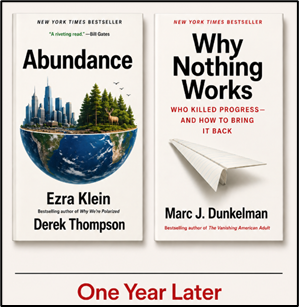
In a recent podcast, a year after Abundances publication, Ezra Klein, Derek Thompson and Marc Dunkelman took stock of where things stand. They largely agree that their core vision – “the promise not just of more, but more of what matters”  – has gained traction. And they remain ‘all in’ (as do I….)  on their critique of current progressive approaches to governance as doing more harm than good. However, they continue to frame the implementation challenge of getting from here to there in a way that, while useful, is ultimately too narrow –  their conversation repeatedly returns to a familiar contrast between an earlier generation of progressive success via top-down public action and a contemporary progressive pre-occupation with formal process as the way to give voice to citizens.

Implementation need not be approached in this constricted way. On the contrary, as this piece will argue, taking a more expansive view of how to make the journey from vision to action helps strengthen the case for Abundance.

For many of today’s hardest problems, the challenge is not simply to plan and then act. It is to get multiple actors to work together in settings where goals overlap but do not fully align.  Practitioners  who have spent decades working around the world on the challenge of integrating governance reform and practical strategies for improving peoples’ lives have learned the hard way that “just do it”  top-down approaches  can all-too-often be a recipe for hubris, disappointment, and subsequent cynicism.  Gradually, after repeated cycles of high ambition and dashed hopes, hard-won lessons in practicality have taken hold, and a distinctive approach to achieving results amid broader messiness has emerged. Its contours can be most clearly seen by contrasting them with more conventional approaches.

Consider two contrasting pathways to results-focused renewal: a top-down, plan-then-implement “engineering” approach, and an approach centered on problem-driven coalition-building and social learning. The pathways differ in their answers to two fundamental questions: what should be the focus of reform, and how should it be pursued?

On the question of “what”: Top-down approaches typically focus on improving formal management systems. Strengthening the institutional architecture of government is a worthy endeavor—but it gains traction only when political power is relatively coherent, and usually yields practical results only over the medium term. Where the broader context is messy (as it is in most places, most of the time), system-wide reform efforts all too easily get lost in bureaucratic minutiae and achieve little.

By contrast, a problem-driven approach provides a more immediate focal point for action. As per its champions, the approach offers 
“…..a  ‘true north’ definition of ‘problem solved’ to guide, motivate and inspire action…. A good problem cannot be ignored, and matters to key change agents; can be broken down into easily-addressed causal elements; allows real, sequenced strategic responses.” 

(Abundance’s focus on housing, transportation, energy, and health—on “the goods needed to build a good life”—lends itself naturally to this kind of problem-focused reform.)

The contrast between the two approaches extends beyond what reforms to target to how reform is pursued. The top-down approach combines rule-centered process compliance with insulation of the public sector from ongoing interaction with civil society. This can work for logistical tasks if the political economy is supportive. But it is poorly suited to multifaceted challenges that require continual adaptation.

A problem-focused approach is ideally suited for the latter. It centers around  getting multiple actors—public agencies, different levels of government, and nongovernmental organizations—to learn to co-operate around a shared purpose, despite overlapping but not identical goals, in ways that hold together politically as well as operationally. The aim is not process for its own sake, but to build problem-focused coalitions that can align action, adapt to the unexpected, and sustain momentum over time.

Central to a problem-focused approach is the way in which it engages with power. Rather than assuming that space for reform is determined primarily through electoral outcomes, it works to expand that space through problem-level coalition-building. Some stakeholders are natural allies; others are potential spoilers, seeking to capture or undermine reform efforts. Building problem-level coalitions that are strong enough to advance shared goals—and resilient enough to withstand predation—is a core task.

This, in turn, calls for shifts in how actors interact. For civil society, it can mean setting aside—at least in part—the allure of adversarialism in favor of more collaborative engagement. For the public sector, it requires moving, in some domains, from a purely legalistic perspective toward a more deliberative mode of interaction. The latter is both  valuable in itself, and also key to enabling the kind of sustained cooperation that complex problem-solving demands.

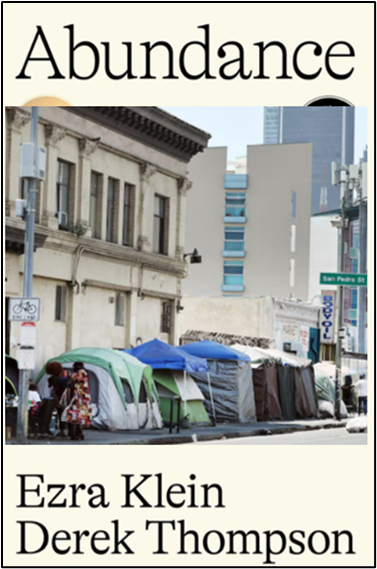
Approaches along these lines have demonstrated their potential across a wide range of settings—from participatory health provision in Ceará, Brazil, to South Africa’s globally-renowned HIV-AIDS Treatment Action Campaign, to improvements in learning outcomes in parts of Kenya,  Peru, Ghana and Bangladesh. Within the United States, there is a rich literature on the promise and limits of collaborative governance. (See here, here and here.) Of more immediate relevance—especially given its usual status (including in Abundance) as Exhibit Number One of progressive failure—is Los Angeles’ recent and still unfolding effort to address homelessness. These efforts offer a vivid—and surprising—illustration of what can be achieved through an approach that engages complexity directly, focuses on results, and works to align fragmented actors —and what might be its limits.

In 2016 and 2017,  LA voters approved two ballot initiatives to finance homeless services and new affordable housing.  However, within a few  years it became apparent that these initiatives fell far short of what was needed.  As I detail in a piece recently published on the Persuasion platform,  in the wake of the failure of these efforts, LA’s political and civic leaders embraced  an innovative combination of hierarchical and horizontal governance reforms that, together, are transforming the region’s approach to homelessness.  Recent gains include:  The collaborative crafting and formal political approval of a set of ambitious and achievable targets for 2030;  the creation of a powerful new county-wide Department of Homeless Services and Housing; and difficult service cuts – made under fiscal pressure, but nonetheless in ways that leveraged the new horizontal governance arrangements to secure broad stakeholder acceptance.  

To be sure, what comes next is uncertain. LA has to balance unexpected fiscal stringency and the massive, ongoing needs of an effective system to combat homelessness. More efficient and effective use of resources  will be key  to finding that balance.   Whether LA’s hard-won, innovative and results-focused center can hold in the face of the adversities that are sure to come remains to be seen –  but the achievements fly in the face of the ‘punching bag’ narrative through which LA’s efforts to address homelessness generally are framed.

More broadly, when it comes to addressing ‘wicked’ problems,  top-down efforts are not enough. Without perceived fairness and credibility, even technically sound solutions can unravel – so legitimacy is central. But as is hopefully now evident,  problem-level legitimacy need not come only through  burdensome formal participatory processes or high visibility actions to hold government to account. Problem-level legitimacy   can also come from a vision of implementation centered around  cross-cutting, problem-solving coalitions. This broader perspective continues to be left out of the Abundance  discourse.  

Abundance was written with transformative intent, not to provide yet another policy manual –  it aimed to  connect viscerally as well as intellectually. By that measure, it has succeeded brilliantly. But a consequence has been that it has framed the challenge of implementation in overly narrow terms. 

Widening the aperture  by taking complexity seriously need not weigh down the message with a surfeit of detail.  On the contrary, attention to the practical can inspire – through its focus on concrete gains, its evocation of human agency and the power that can come from cultivating shared (problem-level) purpose to get things done. Taking the workaday seriously need not detract from  Abundance’s vision. It can align with it – and, in its practicality, enhance its potency.

Abundance, homelessness, and the renewal of legitimacy

A month ago, as part of a series of short pieces on Abundance, I signaled that I was working on an article that considered Los Angeles’ homelessness challenge through an Abundance lens; the article has now been published in American Purpose. This short, orienting post explains why I have been engaging with the Abundance debate, how that connects to my work on homelessness in Los Angeles, and where some of my related work can be found.

I was drawn into the Abundance conversation because it addresses questions that have motivated my work over many decades: How to achieve gains in addressing concrete problems in the midst of broader governance messiness? And, more broadly, how to renew civic confidence in the effectiveness and legitimacy of the public domain? My longstanding focus has been on addressing these questions in middle- and lower-income countries where governance is messy. Three years ago, in moving to LA, I decided to explore whether this work might have some relevance in helping to address LA’s twin challenges of homelessness and a scarcity of affordable housing.

LA is often treated as Exhibit One in arguments about progressive governance failure. But it is also a place where, beneath the surface, large-scale and serious efforts are underway to reform how the problem is governed: clarifying goals, reworking institutional arrangements, building shared understanding among stakeholders, and trying to learn systematically about what works and what does not. Progress is uneven and uncertain — but the effort itself has been determined and sustained. Looking beyond the crises that are shaking the broader polity and society, they potentially offer hope for what can come after.

For readers interested in my engagement with the Abundance debate, here are links to three earlier posts:
https://workingwiththegrain.com/2025/12/08/achieving-abundance-towards-a-new-political-order/
This post takes a big-picture view, using a political order lens to assess what Klein & Thompson have achieved, and where their argument falls short in bridging vision and action.

https://workingwiththegrain.com/2025/12/08/achieving-abundance-from-vision-to-action/
This post explores three mutually-reinforcing entry points that can help address the book’s gap between vision & action: a focus on problems, not just systems; deliberative rather than legalistic bureaucratic norms; and coalitions between non-governmental actors and reformers in the public bureaucracy.

https://workingwiththegrain.com/2025/12/08/problem-focused-coalitional-governance-in-action-three-case-studies/
This post uses three mini-case studies to explore a central dilemma for civil society that emerges from Abundance’s vision: When is civil society’s primary role to engage with the state adversarially—and when is it more productive to enter into (sometimes) uneasy, problem-focused coalitions with reformers inside government?

For readers interested in my work on affordable housing and homelessness in LA, here are links to three articles:
(i) An empirical analysis of LA homelessness as a flow:
https://workingwiththegrain.com/2025/10/31/la-homelessness-setting-the-stage-for-painful-choices-an-empirical-re-framing/
(ii) A Los Angeles Times Op-Ed piece on LA’s recently-adopted goals for addressing homelessness:
https://www.latimes.com/opinion/story/2025-05-21/los-angeles-city-county-homelessness-goals
(iii) An article in the National Civic Review on recent governance reforms in the Los Angeles region, co-authored with USC Professor of Public Policy Shui-Yan Tang:
https://www.nationalcivicleague.org/ncr-article/addressing-homelessness-the-los-angeles-regions-bold-governance-reforms/

‘Abundance’ and the quest for a new political order

(Part of a series)  

What will it take to break the downward spiral of polarization in which we seem trapped? In their best-selling book, Abundance, Ezra Klein and Derek Thompson offer their answer, wielding ideas as their weapon of choice.

For ideas to be truly transformative, they need to do more than persuade intellectually, they need also to connect viscerally – both in their resonance with the prevailing discourse, and in the energy they evoke among their potential champions.  Abundance has been written with that transformative intent. The book offers both a wake-up call and a positive vision.  But it largely is silent vis-à- third task, one that is key to inspiring a sense of hope, of possibility   – it does  very little to translate its positive vision into a practical, positive agenda for action. The result has been that instead of  serving as an invitation to progressives to loosen the grip of conventional ways of doing things and embark on a new quest  Abundance  has become yet another source of polarized political combat.

The blog series introduced here endeavors to fill the gap – its principal focus is how to get from here to there. A companion post (see here) lays out  an approach for moving from vision to action centered around building problem-focused coalitions among reform-minded public officials and non-governmental actors. The third and fourth posts provide empirical  illustrations of the approach (both potential and challenges). The third post explores some interactions between civil society and the public sector in democratic South Africa. The fourth post (forthcoming in January) will be a stocktaking and update of Los Angeles’ efforts to address homelessness in the face of a a worsening fiscal crisis. (See here for some of my recent research on both LA’s crisis and recent governance reforms aimed at addressing it.) This post sets the stage, by locating the exploration within Klein & Thompson’s broader vision of the interaction between governance and political orders.

Drawing on the work of  Gary Gerstle, Klein & Thompson define a political order as: “a ‘constellation of ideologies, policies and constituencies…..that endures beyond [individual] election cycles”. Political orders don’t change simply via the promulgation of new policies or even electoral alternation. Rather: “policy is downstream of  values……What is needed is a change in political culture, not just a change in legislation …..New ideas give way to new laws, new arguments and new customs. People working at all levels of society, inside and outside government, bring these ideas into their labors….”. As Gerstle puts it: “For a political order to triumph, it must have a narrative, a story it tells about the good life”.

A story about the good life has been central to both of the political orders that shaped American politics over the past century: the New Deal order (roughly 1933 to1979) offered a vision of middle-class prosperity; its vision ran aground in the face of social conflict in the 1960s, and stagflation in the 1970s. The neoliberal political order (roughly 1980-2015) followed; it was centered around a vision of abundance fueled by unleashing the power of private entrepreneurship and the capitalist marketplace.  But by the mid-2010s, it also had reached its sell-by date – undermined by a combination of rising inequality, financial crisis, political polarization, and (in the wake of the election of Barack Obama) resurgent racism.

Klein & Thompson argue that at least since Donald Trump’s  first electoral victory in 2016 we have been living in  “A messy interregnum between political orders; a molten moment when old institutions are failing, traditional elites are flailing, and the public is casting about for a politics that feels like it is of today rather than yesterday.Abundance’s implicit goal is nothing less than to offer some foundational ideas for a next-generation renewal of a progressive political order.

As per its title,  the book’s  narrative about the good life’  is one of……….abundance….. but framed from a progressive perspective. Conventionally, the pathway to abundance is via the market – and the abundance that is offered is the familiar consumer cornucopia. Abundance offers something different: “We have a startling abundance of the goods that fill a house, and a shortage of what’s needed to build a good life……… Housing. Transportation. Energy. Health. Abundance is the promise of not just more, but more of what matters….It is a determination to align our collective genius with the needs of both the planet and each other…..

Addressing the shortages calls not only for the entrepreneurial flair of private, for-profit business, but also for the effective provision of public goods – and thus for a capable state.  But how to achieve the latter?  As their (indirect)  answer to this question, Klein & Thompson offer a wake-up call.

Alongside its positive vision, Abundance lays out a relentless  “….critique of the ways that liberals have governed and thought over the past fifty years”. (p. 211) Klein and Thompson argue that two deeply-held progressive nostrums stand in the way of achieving abundance.  There is an ‘everything bagel’ approach to governance: “At every level where liberals govern….they often add too many goals to a single project. A government that tries to accomplish too much all at once often ends up accomplishing nothing at all……Many of the goals are good goals. But are they good goals to include in [this] project? ….with no discussion of trade-offs….or any admission that anything asked for even represented a trade-off”. 

And there is a pre-occupation with formal process, fueled by a hyper-sensitivity to the hazard that government will all-too-easily be captured by powerful special interests. In consequence: “Liberal legalism – and through it, liberal government – has become process-obsessed rather than outcomes oriented. It had convinced itself that the state’s legitimacy would be earned through compliance with an endless catalog of rules and restraints rather than through getting things done for the people it claimed to serve.” (pp. 90-91)

Both critiques are underpinned with a wealth of damning examples ranging from the morass of regulatory obstacles to expanding the supply of affordable housing, to hyper-cautious constraints on the financing of scientific innovation; and to the disaster of a California high speed rail project that was approved in 2008, spent close to $15 billion over the subsequent seventeen years, but has not yet laid any high speed rail track.

Beyond the very general assertion that “to pursue abundance is to pursue institutional renewal”, Klein &Thompson’s discussion of governance is framed almost entirely as a critique. They largely  are silent vis-à-vis the question posed at the beginning of this blog post – how to translate their positive vision into a practical, positive agenda for action?  

In his recent book, Why Nothing Works, Greg Dunkelman suggests a way to close the gap between vision and action that aligns closely with Klein & Thompson’s analysis. He frames the issue as a tension between Hamiltonian and Jeffersonian approaches to governance: “When progressives perceive a challenge through the Hamiltonian lens, the movement tends to embrace solutions that will pull power up and in. When, by contrast, a problem appears born of some nefarious centralized authority, the movement argues for pushing power down and out……our (contemporary) aversion to power renders government incompetent, and incompetent government undermines progressivism’s political appeal.”

A seemingly obvious conclusion follows: getting things done means becoming less Jeffersonian, and more Hamiltonian – to become more willing to use top-down power to get things done. A corollary follows: stop weighing projects down with too many goals and too many processes.

But Dunkelman’s prescription is accompanied by two large vulnerabilities of its own.  The first is highlighted in a question recently posed by Francis Fukuyama: Recognizing that the formal rules of American democracy by themselves are inadequate to create a healthy democracy, how do we design new participatory institutions that are compatible with getting things done?   A companion post explores in detail a variety of possible answers to this question. The second vulnerability is one that  practitioners who have spent decades wrestling with the challenge of integrating governance reform and practical strategies for improving peoples’ lives know all-too-well – the argument that  to change anything one must change everything. Argumentation along these lines has proven to be a recipe for hubris, disappointment, and subsequent cynicism.  

Gradually, after repeated cycles of high ambition and dashed hopes, a hard-won lesson in humility has been learned. Gains on the ground generally cumulatively, step-by-step  – achieved even in the midst of broader political and institutional messiness. As the second post in this series explores, three mutually-reinforcing guideposts seem key to success: focus on problems rather than systems; champion deliberative, rather than hierarchical/ legalistic bureaucratic norms; foster coalition building that brings together non-governmental actors and those within the public bureaucracy committed to realizing the public purpose.  (Case studies in posts three and four explore some  practical implications  – both opportunities and challenges –   of applying these guideposts.)

Here, to preview, is the overarching message of this series: Transformational change does not require fixing everything, everywhere, all at once. On the contrary,  as subsequent posts will explore,  bringing attention to the practical can inspire – through   its focus on concrete gains,  its evocation of human agency and, more broadly, in the power that comes from cultivating shared (problem-level) purpose to actually get things done.

Taking the workaday seriously does not detract from Abundance’s vision. It aligns with it – and, in its practicality, enhances its potency.   Indeed,  as per Klein & Thompson’s vision of a transformed political order, as subsequent posts in this series explore (and as I analyze in depth in an article for the Thinking and Working Politically Community of Practice), perhaps focusing activism around “the goods needed to build a good life”  has the potential to set in motion a new kind of social movement, one centered around a vision of deliberative, problem-focused partnerships between the public sector and non-governmental actors – a social movement fueled not by polarizing rage but by practical, inclusive hope.

‘Abundance’ and the quest for a new political order

(Part of a series)  

What will it take to break the downward spiral of polarization in which we seem trapped? In their best-selling book, Abundance, Ezra Klein and Derek Thompson offer their answer, wielding ideas as their weapon of choice.

For ideas to be truly transformative, they need to do more than persuade intellectually, they need also to connect viscerally – both in their resonance with the prevailing discourse, and in the energy they evoke among their potential champions.  Abundance has been written with that transformative intent. The book offers both a wake-up call and a positive vision.  But it largely is silent vis-à- third task, one that is key to inspiring a sense of hope, of possibility   – it does  very little to translate its positive vision into a practical, positive agenda for action. The result has been that instead of  serving as an invitation to progressives to loosen the grip of conventional ways of doing things and embark on a new quest  Abundance  has become yet another source of polarized political combat.

The blog series introduced here endeavors to fill the gap – its principal focus is how to get from here to there. A companion post (see here) lays out  an approach for moving from vision to action centered around building problem-focused coalitions among reform-minded public officials and non-governmental actors. The third and fourth posts provide empirical  illustrations of the approach (both potential and challenges). The third post explores some interactions between civil society and the public sector in democratic South Africa. The fourth post (forthcoming in January) will be a stocktaking and update of Los Angeles’ efforts to address homelessness in the face of a a worsening fiscal crisis. (See here for some of my recent research on both LA’s crisis and recent governance reforms aimed at addressing it.) This post sets the stage, by locating the exploration within Klein & Thompson’s broader vision of the interaction between governance and political orders.

Drawing on the work of  Gary Gerstle, Klein & Thompson define a political order as: “a ‘constellation of ideologies, policies and constituencies…..that endures beyond [individual] election cycles”. Political orders don’t change simply via the promulgation of new policies or even electoral alternation. Rather: “policy is downstream of  values……What is needed is a change in political culture, not just a change in legislation …..New ideas give way to new laws, new arguments and new customs. People working at all levels of society, inside and outside government, bring these ideas into their labors….”. As Gerstle puts it: “For a political order to triumph, it must have a narrative, a story it tells about the good life”.

A story about the good life has been central to both of the political orders that shaped American politics over the past century: the New Deal order (roughly 1933 to1979) offered a vision of middle-class prosperity; its vision ran aground in the face of social conflict in the 1960s, and stagflation in the 1970s. The neoliberal political order (roughly 1980-2015) followed; it was centered around a vision of abundance fueled by unleashing the power of private entrepreneurship and the capitalist marketplace.  But by the mid-2010s, it also had reached its sell-by date – undermined by a combination of rising inequality, financial crisis, political polarization, and (in the wake of the election of Barack Obama) resurgent racism.

Klein & Thompson argue that at least since Donald Trump’s  first electoral victory in 2016 we have been living in  “A messy interregnum between political orders; a molten moment when old institutions are failing, traditional elites are flailing, and the public is casting about for a politics that feels like it is of today rather than yesterday.Abundance’s implicit goal is nothing less than to offer some foundational ideas for a next-generation renewal of a progressive political order.

As per its title,  the book’s  narrative about the good life’  is one of……….abundance….. but framed from a progressive perspective. Conventionally, the pathway to abundance is via the market – and the abundance that is offered is the familiar consumer cornucopia. Abundance offers something different: “We have a startling abundance of the goods that fill a house, and a shortage of what’s needed to build a good life……… Housing. Transportation. Energy. Health. Abundance is the promise of not just more, but more of what matters….It is a determination to align our collective genius with the needs of both the planet and each other…..

Addressing the shortages calls not only for the entrepreneurial flair of private, for-profit business, but also for the effective provision of public goods – and thus for a capable state.  But how to achieve the latter?  As their (indirect)  answer to this question, Klein & Thompson offer a wake-up call.

Alongside its positive vision, Abundance lays out a relentless  “….critique of the ways that liberals have governed and thought over the past fifty years”. (p. 211) Klein and Thompson argue that two deeply-held progressive nostrums stand in the way of achieving abundance.  There is an ‘everything bagel’ approach to governance: “At every level where liberals govern….they often add too many goals to a single project. A government that tries to accomplish too much all at once often ends up accomplishing nothing at all……Many of the goals are good goals. But are they good goals to include in [this] project? ….with no discussion of trade-offs….or any admission that anything asked for even represented a trade-off”. 

And there is a pre-occupation with formal process, fueled by a hyper-sensitivity to the hazard that government will all-too-easily be captured by powerful special interests. In consequence: “Liberal legalism – and through it, liberal government – has become process-obsessed rather than outcomes oriented. It had convinced itself that the state’s legitimacy would be earned through compliance with an endless catalog of rules and restraints rather than through getting things done for the people it claimed to serve.” (pp. 90-91)

Both critiques are underpinned with a wealth of damning examples ranging from the morass of regulatory obstacles to expanding the supply of affordable housing, to hyper-cautious constraints on the financing of scientific innovation; and to the disaster of a California high speed rail project that was approved in 2008, spent close to $15 billion over the subsequent seventeen years, but has not yet laid any high speed rail track.

Beyond the very general assertion that “to pursue abundance is to pursue institutional renewal”, Klein &Thompson’s discussion of governance is framed almost entirely as a critique. They largely  are silent vis-à-vis the question posed at the beginning of this blog post – how to translate their positive vision into a practical, positive agenda for action?  

In his recent book, Why Nothing Works, Greg Dunkelman suggests a way to close the gap between vision and action that aligns closely with Klein & Thompson’s analysis. He frames the issue as a tension between Hamiltonian and Jeffersonian approaches to governance: “When progressives perceive a challenge through the Hamiltonian lens, the movement tends to embrace solutions that will pull power up and in. When, by contrast, a problem appears born of some nefarious centralized authority, the movement argues for pushing power down and out……our (contemporary) aversion to power renders government incompetent, and incompetent government undermines progressivism’s political appeal.”

A seemingly obvious conclusion follows: getting things done means becoming less Jeffersonian, and more Hamiltonian – to become more willing to use top-down power to get things done. A corollary follows: stop weighing projects down with too many goals and too many processes.

But Dunkelman’s prescription is accompanied by two large vulnerabilities of its own.  The first is highlighted in a question recently posed by Francis Fukuyama: Recognizing that the formal rules of American democracy by themselves are inadequate to create a healthy democracy, how do we design new participatory institutions that are compatible with getting things done?   A companion post explores in detail a variety of possible answers to this question. The second vulnerability is one that  practitioners who have spent decades wrestling with the challenge of integrating governance reform and practical strategies for improving peoples’ lives know all-too-well – the argument that  to change anything one must change everything. Argumentation along these lines has proven to be a recipe for hubris, disappointment, and subsequent cynicism.  

Gradually, after repeated cycles of high ambition and dashed hopes, a hard-won lesson in humility has been learned. Gains on the ground generally cumulatively, step-by-step  – achieved even in the midst of broader political and institutional messiness. As the second post in this series explores, three mutually-reinforcing guideposts seem key to success: focus on problems rather than systems; champion deliberative, rather than hierarchical/ legalistic bureaucratic norms; foster coalition building that brings together non-governmental actors and those within the public bureaucracy committed to realizing the public purpose.  (Case studies in posts three and four explore some  practical implications  – both opportunities and challenges –   of applying these guideposts.)

Here, to preview, is the overarching message of this series: Transformational change does not require fixing everything, everywhere, all at once. On the contrary,  as subsequent posts will explore,  bringing attention to the practical can inspire – through   its focus on concrete gains,  its evocation of human agency and, more broadly, in the power that comes from cultivating shared (problem-level) purpose to actually get things done.

Taking the workaday seriously does not detract from Abundance’s vision. It aligns with it – and, in its practicality, enhances its potency.   Indeed,  as per Klein & Thompson’s vision of a transformed political order, as subsequent posts in this series explore (and as I analyze in depth in an article for the Thinking and Working Politically Community of Practice), perhaps focusing activism around “the goods needed to build a good life”  has the potential to set in motion a new kind of social movement, one centered around a vision of deliberative, problem-focused partnerships between the public sector and non-governmental actors – a social movement fueled not by polarizing rage but by practical, inclusive hope.

Achieving ‘Abundance’  –  from vision to action  

(part of a series)

Increasingly, we seem trapped in an accelerating downward spiral of polarization, with no way out. What will it take to break the spell? In their best-selling book, Abundance, Ezra Klein & Derek Thompson seek to answer the question by leading with ideas. They lay out a compelling positive vision, accompanied by a stark wake-up call. However, they say little about how to translate their positive vision into a practical agenda for action. The resulting gap leaves the field open for their critics to presume the worst.

This post, the lead in a series that aims to build on Abundance’s hope-evoking foundation, lays out an approach for filling the vision-to-action gap.  Subsequent posts use case studies to explore how the approach introduced here plays out in practice – both the successes that have been achieved, and challenges that have arisen. But before before getting into the details of the journey from vision to action, it is helpful to briefly recapitulate Abundance’s core argument (See this preliminary stage-setting post for a more comprehensive treatment.)

In the usual political discourse,  the pathway to abundance is via the market – and the abundance that is offered is the familiar consumer cornucopia. Klein & Thompson, by contrast, offer a vision  “not just of  more, but more of what matters ”   More housing. Better public transportation. Clean, affordable energy. And a health system that works for everyone.Achieving these requires not only private entrepreneurship but also  a capable state.  Thus, Klein & Thompson suggest, “to pursue abundance is to pursue institutional renewal,”  However, they say very little about  what this implies in practice, and offer instead  a relentless critique of how progressive governance is prone to an excess of (performative) responsiveness, with well-meaning initiatives becoming overloaded with  too-many goals and  too-many checks on decision-making.

As Greg Dunkelman elaborates in his book Why Nothing Works, the seemingly obvious way to close the gap between vision and action is to become more willing to use top-down power  to get things done. A greater willingness to act  is indeed part of what is needed. But  a call for bold top-down institutional renewal can also become a trap – the argument that to change anything one must change everything. 

Practitioners  who have spent decades wrestling with the challenge of integrating governance reform and practical strategies for improving peoples’ lives have learned the hard way that “best practice” argumentation along these lines can all-too-often be a recipe for hubris, disappointment, and subsequent cynicism. Gradually, after repeated cycles of high ambition and dashed hopes, a hard-won lesson in humility and practicality has taken hold. Gains can be achieved even in the midst of broader governance and political messiness – not in one fell swoop, but cumulatively.

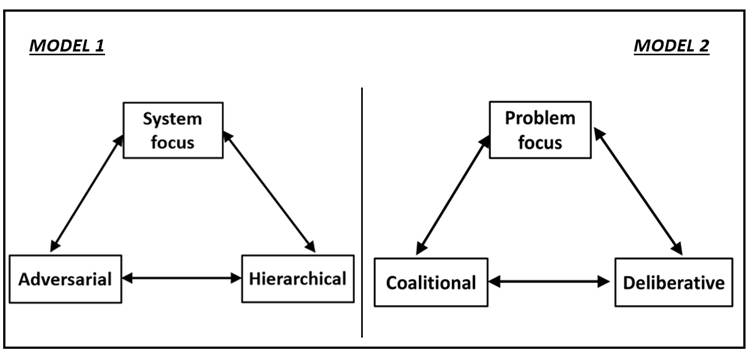
The figure below encapsulates what has been learned in the form of  two contrasting ‘models’ for fostering   results-focused renewal of government – a top-down, plan-then-implement  ‘engineering’ model, and a model centered around iterative social learning in the midst of uncertainty. (See here for an in depth technical presentation of the approach, and its provenance in the public management literature.) As the paragraphs that follow detail, the ‘models’  vary radically from one another in their answers to two fundamental  questions: “What”  should be the focus of the  reform effort?  “How”  should reform should be pursued?  Each question is considered in turn.

The difference between the two models in  the ‘what’ of reform  is captured in the top boxes in the figure  – systems-reform versus reform that focuses on the problem-level.  Improving ‘systems’ – the institutional architecture of government – is a worthy endeavor, but it yields results on the ground only over the medium term. Especially when the broader political and institutional context is messy (as it is in most places, most of the time),  reforms that aim to systematically reshuffle the bureaucratic deck can all too easily get lost in bureaucratic minutiae and end up achieving nothing.

By contrast, a problem-focus provides a compelling focal point for results-oriented action. As per its champions, it offers “…..a  ‘true north’ definition of ‘problem solved’ to guide, motivate and inspire action…. A good problem cannot be ignored, and matters to key change agents; can be broken down into easily-addressed causal elements; allows real, sequenced strategic responses.” (Note that Abundance’s  focus on housing, transportation, energy and health – on “the goods needed to build a good life” – lends itself naturally to a problem-focused approach to reform.) 

Turning to the ‘how’ of reform,  a useful point of departure for surfacing differences between the two models is a question posed by Francis Fukuyama in a recent piece  on the practical potential of Abundance.   While Fukuyama  is sympathetic both to the ideas in Abundance and to Dunkelman’s call for more top-down governance, he points to a troubling dilemma for democratic decision-making  that follows from the prescription: “Public participation is one of the thorniest issues with which modern democracies need to deal…..Public input to democratic decision-making is absolutely necessary….It has been a long time since anyone believed that the formal rules of American democracy by themselves are adequate to create a healthy democracy……But how do we design new participatory institutions to meet the conditions [….needed to get things done]? Model 1 and model 2 offer very different answers to Fukuyama’s question.

In model 1, participation plays a role on the margin, an add-on of sorts to its top-down approach to getting things done. This add-on can take one or all of a variety of forms:

  • Enhancing accountability for performance via a variety of formal checks and balances plus a range of less formal demand-side mechanisms (for example, advocacy/protest and investigative journalism).
  • Championing transparency as a way to support arms-length efforts at monitoring and enforcement.
  • Deliberative democracy – structured, time-bound mechanisms for eliciting input from citizens (see here and here).  

Note the arms-length (and sometimes adversarial) relationship between the public sector and non-governmental actors that underlies each of these. As the case study of South Africa in the third blog post in this series suggests, when underlying state capacity is strong arms-length and adversarial approaches can be effective in improving performance; but they can be counterproductive when capacity is less and citizens have become increasingly disillusioned and cynical.

Model 2’s  approach to participation is very different. The model brings non-governmental actors to center stage, not as adversaries or point-in-time deliberators, but as coalitional allies in the co-production of social value. As the figure signals, this differs from model 1 in two  far-reaching ways – in how stakeholders engage with power, and in how they interact with one another.

To begin with power,  model 1 presumes that space for reform is won and lost electorally. By contrast, in model 2  problem-level coalition-building is key to opening up space for reform. Stakeholders with an interest in the problem at hand differ  radically from one another in both their goals and in the power they can command. Some are unambiguously supportive of the social purpose associated with the coalitional endeavor. Others are predators who seek to capture for their own private purposes what the protagonists are seeking to build. Coalition-building offers a way to achieve gains via the construction of problem-focused alliances that are sufficiently strong to fend off predators who might have private and political reasons for undermining the initiatives.   

Beyond the immediate task of opening up space for reform, model 2 also  involves an ongoing shift in ways of doing things on the part of  both civil actors and reformers within government. For  civil society, a central challenge is to put aside, for  at least some problems and some key junctures in the process of change,  the allure of adversarialism and embrace a more collaborative mode of engagement with the public sector. Correspondingly, the task for the public sector is to shift, in at least in some domains of activity, from a legalistic to a deliberative mode of engagement – valuable both in itself and as key to working collaboratively with civil society.    (The third blog post in this series explores the opportunities and challenges associated with making this shift, centered around a recent in-depth analysis of interactions between civil society and the public sector in democratic South Africa. The fourth post (forthcoming in January) will be a stocktaking and update of Los Angeles’ efforts to address homelessness in the face of a worsening fiscal crisis. (See here for some of my recent research on both LA’s crisis and recent governance reforms aimed at addressing it.) 

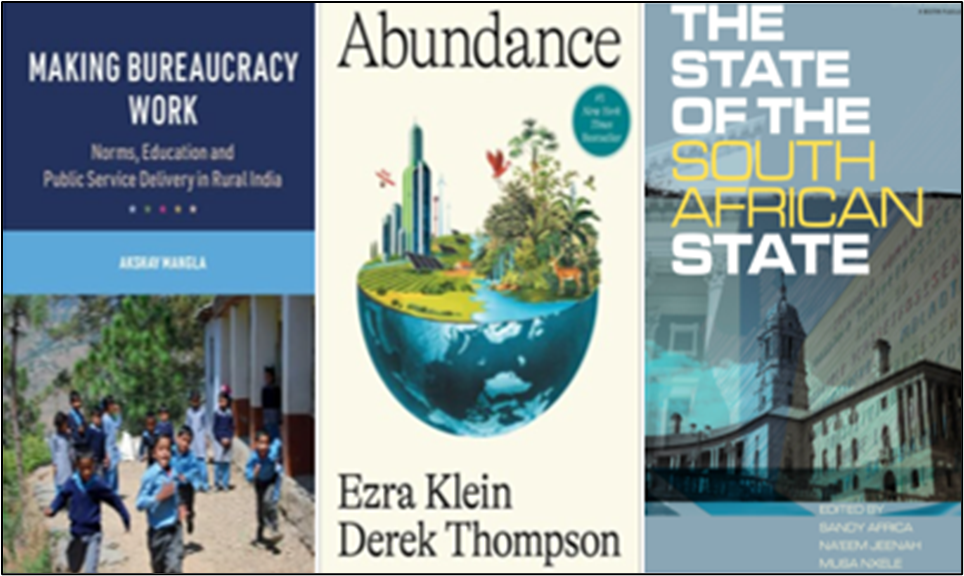
In his award-winning 2022 comparative analysis of the performance of education systems in two Indian states, Making Bureaucracy Work. Akshay Mangla captures the essence of the difference between how legalistic/hierarchical  and deliberative bureaucracies do things. As he puts it:

“Legalistic bureaucracy urges fidelity to administrative rules and procedures….The ideal-typical Weberian state motivates bureaucrats to set aside their private interests and advance the public good…by insulating bureaucrats from political pressures and instilling a commitment to rational-legal norms….Bureaucrats are judged for following rules and not for the consequences that emanate from their actions….”

By contrast: “Deliberative  bureaucracy promotes flexibility and problem-solving….it induces a participatory dynamic that urges officials to negotiate policy problems through discussion and adjust their outlooks to shifting circumstances….  It is found to have made a decisive impact with respect to literacy and the quality of education policy…  It enables state officials to undertake complex tasks, co-ordinate with society and adapt policies to local needs, yielding higher quality education services.”

As Mangla details using the example of basic education, legalistic bureaucracy is more effective in addressing logistical tasks (eg building schools);  deliberative bureaucracy is better at  addressing complex tasks that require ongoing adaptation (eg improving learning outcomes and multi-dimensional challenges such as reducing homelessness).

Embracing problem-focused coalitions rather than insulating government from civil society comes with risks: the risks of reproducing performative progressivism that inhibits action; the risks of capture. But risks can be managed and,  as argued earlier, these risks need to be set against the hazards of hubris, stasis and disillusion –  of bold-sounding reforms that lead nowhere. There is risk and opportunity in all directions. Both/and is the way forward.

In sum, stepping back from the details of the two models,  transformational change does not require fixing everything, everywhere, all at once. On the contrary,  bringing attention to the practical can inspire in its focus on concrete gains, in its evocation of human agency, and in the power that comes from cultivating shared (problem-level) purpose to actually get things done. Taking the workaday seriously does not detract from Abundance’s vision, it aligns with it – and, in its practicality, gives it greater potency.

Perhaps even more may be possible. In the spirit with which Klein & Thompson wrote Abundance  (see the companion stage-setting post) might problem-level gains provide a platform for a broader transformation of the interface between citizens and public officials?  Might forward-looking political leaders embrace an electoral and governance platform centred around a problem-focused vision of partnership between the public sector and non-governmental actors to deliver “more of what matters to build a good life”? This would, of course,  be a radical departure from contemporary pressure-cooker discourses that thrive on raising rather than reducing the temperature.  But, as Robert Putnam explored in his 2020 book The Upswing,   it happened in the USA between the 1880s and the 1920s, and it could happen again: 

A distinct feature of the Progressive Era was the translation of outrage and moral awakening into active citizenship …Progressive Era innovations were seeking to reclaim individuals’ agency and reinvigorate democratic citizenship as the only reliable antidotes to overwhelming anxiety… National leadership came after sustained, widespread citizen engagement….. A [new] upswing will require ‘immense collaboration’, [leveraging] the latent power of collective action not just to protest, but to rebuild.”

Problem-focused coalitional governance in action – three case studies

(Abundance series #3)

Ideas can help break an accelerating downward spiral of polarization by offering inspiration – but to be credible, a positive vision also needs to be accompanied by a practical agenda for action. Ezra Klein & Derek Thompson’s best-selling book, Abundance offers a compelling positive vision along with a sharp wake-up call for progressive governance. But it largely leaves unresolved how that vision can become a strategy for action.

This post explores that question through three linked mini- case studies which focus on one central dimension of problem-focused coalitional governance: how civil society engages at the level of concrete problems – and how different modes of engagement shape outcomes. The three cases are:

  • Mini-case study #1 explores how ongoing, adaptive engagement by civil society has been key to South Africa’s reversal of a disastrous HIV/AIDS pandemic  – a decade-long high-profile adversarial campaign was followed by  sustained efforts to work more coalitionally with reformers within government to help strengthen both policymaking and implementation.
  • Mini-case study #2  explores how problem-focused coalitional governance helped improve learning outcomes in a half-dozen countries, even in the face of broader governance messiness.
  • Mini-case study #3  explores how a disproportionate emphasis on hierarchical, arms-length and adversarial modes of engagement has constrained national, subnational and school-level  efforts to improve learning outcomes in South Africa.  

The mini-case studies draw on a chapter, co-authored with long-time civil society activist Mark Heywood, in a just-published book, The State of the South African State, plus a decade of prior comparative research on the political economy of education sector reform.

Together with two companion essays, this piece forms part of a short series that probes how to close the gap between vision and action.  A stage-setting post  situates Abundance within the larger arc of literature on political orders, and highlights both the book’s positive vision and its critique of progressive governance. A companion conceptual post (see here) lays out a framework centered around the collective efforts of coalitions of reform-oriented public officials and non-governmental actors to address concrete problems. (A fourth post, forthcoming in January, will be a stocktaking and update of Los Angeles’ efforts to address homelessness in the face of a a worsening fiscal crisis. (See here for some of my recent research on both LA’s crisis and recent governance reforms aimed at addressing it.)

****

Mini case study #1: South Africa’s HIV-AIDS Treatment Action Campaign (TAC) (Click here for access to the Levy-Heywood case study;  Heywood has played a leadership role in the TAC since its inception.)

The TAC is an extraordinary example of successful activism on the part of civil society: “Upon the TAC’s formation in 1998, no person living with AIDS was receiving life-saving antiretroviral treatment in the public health sector and almost all infected people died….. [A decade later, South Africa began to roll out what has become….]  the largest HIV treatment program in the world, now covering over 5.8 million people and nearly 80 per cent of the eight million people living with HIV in South Africa.   Perhaps the most dramatic evidence of this programs results has been a rise in life expectancy of more than a decade for men and women and a massive drop in infant mortality due to HIV infection.”

The case study explores the interplay between adversarial and coalitional strategies over the TAC’s quarter century of effort: “The TAC’s history can be divided into two parts: a period of confrontation over government policy and President Mbeki’s AIDS denialism (1998–2007); and a coalitional period (and when deemed necessary, confrontation and/or challenge), working with committed public officials over implementation of a policy that TAC eventually managed to co-create with the government (2007 to the present).”

The first period was characterized by: “….almost a decade of intense conflict between TAC and the government over its policy, particularly its refusal to include a treatment component to HIV prevention and care….This first period was bitter and divisive……

Eventually, government responded to pressure from the TAC (and broader disquiet , including from within the ANC, with the prevailing policies): In late 2006/7, the TAC delegated several of its leaders to work with the Office of the Deputy President to develop a new framework for a National Strategic Plan on HIV….agreement was reached in early 2007….. Key TAC leaders were appointed to senior positions in the South African National AIDS Council, SANAC  (a body that had been set up by President Mbeki in 1999), where they worked closely with government. For a period SANAC became a forum for de facto co-governance of the AIDS response.

From 2007 onwards, there was a far-reaching transformation in how government and civil society engaged with each other: “The TAC offered public servants in the Health Department a vision of care and treatment that provided hope, encouraged innovation and inspired (rather than commanded) performance…… Through its branches, TAC assessed the actual state of delivery on the ground and frequently allied with local health workers. It was central to setting up organizations like the Stop Stockouts Project which monitors the availability of essential healthcare medicines and children’s vaccines…..The TAC tackled the serious stigma that surrounds HIV infection by building hundreds of branches for people living with HIV. Its branches were conduits for its pioneering program of ‘treatment literacy’ carried out with the guidance and support of health professionals.”

South Africa’s approach to addressing HIV-AIDS had shifted from accelerating disaster to an exemplar of what coalitional,  learning-oriented and deliberative governance can achieve – a ‘best practice’ case that paralleled the primary health care reforms in the Brazilian state of Ceara, documented by Judith Tendler in her classic book, Good Government in the Tropics.  (Note, though that, as mini-case-study #3 will explore further, an embrace of coalitional engagement has been more the exception than the rule in democratic South Africa.)

****

Mini case study #2: improving learning outcomes in middle income countries.

The second mini-case study draws on a synthesis of a dozen country studies of  the politics of education policy reform and implementation written for the Research Programme on Improving Systems of Education (RISE).  What follows highlights some striking (and paradoxical when considered through a conventional lens) findings on how problem-focused coalitional governance added value at each of national, provincial, district and school levels.

At national level:

A comparison of the case studies of education sector governance in  Chile and Peru points to both some limitations of top-down governance, and some strengths of problem-focused coalitions. In Chile,  interactions among stakeholders largely were top-down and systematically managed, yet improvements in learning outcomes were modest.  By contrast,Peru achieved large gains in learning outcomes, even though it has long had to navigate an extraordinarily turbulent political and institutional environment – including an education sector led by 20 ministers in 25 years. As the Peru country case study  explored in depth,  Peru’s messier, less formalistic and more iterative process of policy formulation and adaptation helped build broad legitimacy among stakeholders:

“ Civil society organizations – NGOs, universities, think tanks and research centers – have also played a key role in defining policy agendas [and….]  in the development of education policies and reforms. Though agreements are often ignored by ministerial administrations and political parties,   they have certainly contributed to the continuity of agendas and to the advancement, through piecemeal, of reforms.”

At provincial level

In his award-winning 2022 book, Making Bureaucracy Work: Norms, Education and Public Service Delivery in Rural India  Akshay Mangla distinguishes conceptually between legalistic and deliberative bureaucracies, and analyzes the strengths and weakness of each in improving learning outcomes in two Indian states:

“Legalistic bureaucracy in Uttar Pradesh has promoted gains in primary school enrollment and infrastructure…. enabling officials to resist political interference when providing inputs to schools…..[But] local administration’s adherence to rules imposed administrative burdens…. Cumulatively, these processes contributed to low quality education….”

By contrast, in Himachal Pradesh, deliberative norms and participatory/coalitional governance have been mutually reinforcing. “At independence, Himachal Pradesh was among India’s least literate states…. HP is now among India’s leading states with respect to literacy and primary education policy education indicators….. Deliberative bureaucracy is found to have made a decisive impact…  enabling state officials to undertake complex tasks, co-ordinate with society and adapt policies to local needs, yielding higher quality education services.”

At district level.

Ghana and Bangladesh  illustrate how local coalitions helped improve learning outcomes, even in the face of broader systemic weaknesses. In Ghana, interactions between decentralization and clientelism added to the incoherence and politicisation of the education sector. But there was a silver lining: “The drivers of improved performance and accountability do not flow from the national to the local level, but instead have to be regenerated at the level of districts and schools…. In [some] districts…. there was evidence of the emergence of a developmental coalition between community, school and district-level actors….including ‘political officials and teacher unions…..evident at district level, and mirrored at the community level.”

Similarly: “Bangladesh features an education system which, while formally highly centralized, is in practice fairly decentralized and discretionary in whether and how it implements reforms….. Learning reforms were adopted and implemented to the extent that the relationship between school authorities, the local elites involved in school governance, and the wider community aligned behind improved teacher and student performance.”

At school level

Kenya’s long history of involving parents and communities in the governance of schools has had far-reaching consequences. As a long-standing observer of the system reported: “What one sees is an expectation for kids to learn and be able to have basic skills…. Exam results are…. posted in every school and over time so that trends can be seen. Head teachers are held accountable for those results to the extent of being paraded around the community if they did well or literally ban from school and kicked out of the community if they did badly.”

****

Mini case study #3: South Africa’s fraught efforts to improve learning outcomes.

Notwithstanding the encouraging examples in mini-case-study #2, many education systems seem stuck in low-level equilibria, with repeated fruitless attempts to improve poor learning outcomes by doubling down on top-down, legalistic reforms.  Heywood and Levy’s second case study (which draws on Levy et. al, 2018) explores the balance between adversarial/legalistic and coalitional/deliberative approaches at each of national, provincial and school-levels. 

At national-level: “South Africa’s education sector stakeholders (inside and outside of government)  have failed to co-operate sufficiently to be able to bring about effective change. Part of the reason for this failure can be traced to more general societal pre-occupations with adversarial civil society approaches and bureaucratic insulation. [Examples include]:

  •  A failure among experts to constructively work through their disagreements has been an important part of why the country has repeatedly failed to put in place any systematic assessments of learning before the end of twelfth grade……
  • South African Democratic Teachers Union (SADTU) has almost uniformly been demonized by sector professionals, media and many politicians as disruptive and as a principal cause of the sector’s failures even though, as with teachers’ unions everywhere, SADTU has to navigate inherent tensions between its role as an advocate of the material interests of teachers and its role as a professional organization. Coalitional approaches would include efforts to build common cause with teachers committed to the more professional parts of this dual identity….”

At subnational-level: “Civil society’s default mode of engagement at provincial level often has been adversarial. Yet judicial victories and resulting court-imposed obligations to improve infrastructure have limited potential for impact [in those provinces]  where bureaucracies lack the legalistic/logistical capacity for follow-through.”

At school-level: The 1996 South African Schools Act (SASA)  included reforms that gave far-reaching authority to school governing bodies in which parents were the majority. These reforms were motivated in part by the liberatory impulses of grass-roots democratic movements, and in part by the concerns of apartheid-era elites about how schools would be governed. The latter has enabled public schools serving (now more multi-racial) elites to perform well. By contrast:

“While a few exemplary civil society organizations work collaboratively at school and community levels, there has been little sustained effort to breathe life into the SASA architecture within low-income communities….. We [Heywood and Levy] recognize that, outside elite settings, it can be difficult for parents and communities to exercise their voices…but it is not the practical challenges facing civil society that account for the lack of attention paid to the possibilities for inclusive governance created by SASA. Rather, it is the ideational lens through which South Africans approach the role of civil society in public service provision.”

****

As the mixed response to Abundance reveals, efforts to translate a positive vision into a practical agenda for change seem repeatedly to become snarled in binary either/or discourses. The reasons seem rooted less in evidence than in competing ideational ‘priors’ – in this instance a ‘high modernist’ perspective that top-down institutional engineering is necessary and sufficient to effect change,  versus a ‘social justice’ perspective centered around mobilizing against unjust and corrupt elites.

The case studies in this blog post (and the conceptual framework laid out in a companion post) point towards a hopeful third possibility – namely that bringing attention to the practical can inspire in its focus on concrete gains, in its evocation of human agency, and in the power that comes from cultivating shared (problem-level) purpose to actually get things done. As Heywood & Levy argue, what to prioritize varies by place and time.

Here is how we open our chapter: “Civil society played a key role in the struggle to end apartheid. In the first three decades of South Africa’s democracy, civil society’s continuing efforts to hold government to account have yielded some massive, vital victories. But times have changed……” 

Here is how we conclude: “A crucial, continuing challenge for the South African state is to renew a sense of hope and possibility. Highlighting failures and mobilizing around them  does not renew hope – on the contrary, it can risk deepening disillusionment. The times call not for deepening confrontation, but for a mode of social mobilization on the part of civil society that fosters, rather than undercuts, a sense of solidarity and shared purpose.”

The above is not relevant only to South Africa.  The contemporary USA finds itself trapped in its own downward spiral of disillusionment and polarization.  In Abundance, Klein & Thompson offer acounter- vision that is intended to inspire. This, they  suggest, will require a state that is both capable and willing to act. But as a vibrant recent literature (synthesized here) has explored, effectiveness alone is not sufficient to renew civic perceptions of the legitimacy of the public domain. n his 2020 book, The Upswing, Robert Putnam sought to draw lessons for the contemporary USA from the 1880s and the 1920s: 

A distinct feature of the Progressive Era was the translation of outrage and moral awakening into active citizenship …Progressive Era innovations were seeking to reclaim individuals’ agency and reinvigorate democratic citizenship as the only reliable antidotes to overwhelming anxiety… National leadership came after sustained, widespread citizen engagement….. A [new] upswing will require ‘immense collaboration’, [leveraging] the latent power of collective action not just to protest, but to rebuild.”

Perhaps the ideas and experiences laid out in this blog series can contribute in a small way to setting aside either/or polarities and embracing a similarly inclusive vision of change.

LA homelessness: Setting the stage for painful choices – an empirical (re-)framing

In 2023, I began a program of research on some innovative governance arrangements for addressing homelessness that  LA’s political, civic, bureaucratic and private sector leaders put in place as part of a determined effort  to finally come to grips with a long-festering crisis (see here and here).  In 2024 and 2025, the tide of  Los Angeles’  homelessness seemed to turn. However, as highlighted by some extraordinarily forthright and stark presentations  (available here) at an October 2025 meeting  of one of the new bodies –  the multistakeholder Leadership Table for Regional Homeless Alignment –   new budgetary and economic pressures threaten reversal.

This piece (and an accompanying technical note, both initially posted in October 2025, updated in May 2026) sets the stage for that work by laying out –  from an empirical and ‘technocratic’ rather than a governance perspective –  how I have come to understand LA’s homelessness crisis.  The technical note presents a carefully-specified empirical framework, and makes explicit the details of the data, parameters and causal relationships that underlie it. Building on some recent innovative applications of  systems analysis (here and here), the technical analysis  frames homelessness  as a “flow”, complementing more familiar “stock” perspectives.  This  piece provides an overview of the empirical framework, and highlights its implications for policy and strategy. As a prelude to laying out the framework, it is necessary to set the stage.

Figure 1: Homelessness in LA – inflows and outflows (2023)

Source:  Leadership Table

At first sight, Los Angeles’ challenge  seems straightforward: end homelessness for the 70,000 or so people  -roughly  50,000 of whom live on the streets –  identified as homeless in recent iterations of the region’s annual point-in-time (PIT)  count. However, as Figure 1 illustrates for 2023, the PIT count (a “stock”)  captures only a moment in an ongoing and much larger flow: in that year 103,000 people accessed  LA County’s homeless services. Between 2020 and 2024, close to 300,000 people (3% of LA County’s population of 10 million) accessed the county’s homeless services at least once.

Viewed through a structural lens, the evidence is compelling that over time the aggregate number of people who enter into homelessness is driven by metropolitan-area level interactions between the cost of housing and income (both wages and safety net support) at the bottom end of the economy. As I summarize here, for many decades LA’s trends have been dismal vis-à-vis both housing and median-and-below wages . However, these structural drivers can only be reversed over the medium- and longer-term. In the near-term, the challenge is to make better use of existing resources.

How,  at a time when the regional economy is turning soft, the safety net is under threat, and funds to combat homelessness are set to contract, might available fiscal resources be more effectively deployed? The empirically-anchored analytical framework laid out in this piece might  hopefully  help address this near-term challenge.

Considered as a flow, homelessness is daunting in its complexity. Multiple drivers  lead to homelessness; there are multiple pathways through homelessness;  and multiple ways to exit. One way to cut through the complexity is to group the challenges posed by homelessness into three distinct ‘clusters’: 

  • Short-term homelessness –  those who enter and then exit homelessness within 6-12 month  (including initiatives to identify and pre-emptively support those most at risk of becoming homeless). 
  • ‘Slippery slope’ homelessness – those who lack/miss the ‘lifeboat’ of early exit and risk a deepening downward spiral.
  • ‘Chronic’ homelessness – those who have lived on the street for long enough and/or have personal vulnerabilities of a kind that render them unable to exit homelessness and live independently without sustained support.

The paragraphs that follow consider each of these, beginning with the last.

To begin with the chronically homeless cluster, many in LA view homelessness and chronic homelessness as synonymous. However, as both Figure 1 and the cluster framework signal,  this view is mistaken – though chronic homelessness indeed comprises homelessness’s  most  visible aspect of homelessness,  and its magnitude  is large – though estimates vary widely depending on the definition used. The technical note estimates the cluster’s magnitude by  disaggregating  the PIT count in a way that combines information on homelessness duration and the severity of mental health and substance abuse symptoms. This  yields a 2023 total of about 39,000 chronically homeless people.

Careful micro-level research has shown that “housing first” (more precisely,  the provision of permanent supportive housing)  is the most effective and cost effective way of helping people who have been chronically homeless to live a stably housed life. Perhaps surprisingly to some, in recent years, LA has had an effective large-scale program of placing homeless people into permanent housing – about 20,000 annually, amounting to over 130,000 since 2017.  But permanent housing (especially with the necessary support services) does not come cheap; as of 2025, the LA region was spending well over $300 million annually on its PSH program.  

A central reason why implementing “housing first” is so costly is, of course, LA’s massive undersupply of affordable (and other) housing.  But this undersupply can only be addressed over the medium and longer-term – a narrow focus on “housing first” thus has little to offer vis-à-vis  the urgent immediate challenge of  how  best to deploy scarce fiscal resources to mitigate the damage to come.  Recognizing this brings to the fore the question of whether, in a housing (and fiscally) constrained environment the two earlier stages in the homelessness “flow” – short-term and slippery-slope homelessness – might offer added cost-effective opportunities for reducing homelessness.

Short-term homelessness  affects a large number of people – and, given its magnitude, receives surprisingly little attention within the broader homelessness policy discourse. To be sure, substantial (and increasing) attention is given to ‘prevention’ – initiatives that aim to identify and pre-emptively support those most at risk of becoming homeless. Notwithstanding efforts at prevention, as Figure 1 signals for 2023, in Los Angeles County roughly 60,000 people become newly homeless each year. (Note that, for reasons explored in the technical note, PIT count estimates of short-term homelessness are way lower.)  Many of the 60,000  exit homeless rapidly – as the companion technical note details, about 40% of those who become homeless exit within six months; and an  additional 15% or so exit over the subsequent six-month period, making for an only-short-term homeless cluster total of about 32,000

These seemingly rapid exit rates do not imply that homelessness will resolve itself.  For one thing, the current rapid rates of exit are based on LA’s prevailing ambitious (and fiscally costly) efforts to reduce homelessness; in the coming period,  budget cuts could undo a quite substantial part of this effort.  For another, the number of people homeless at any point in time is the accumulated  total of those remaining homeless after initially becoming homeless in some prior year.  If the number of people who become newly homeless stays high (or, as is very plausible, increases), then the  total  will add up rapidly. Finally, and perhaps most fundamentally, alongside those who exit rapidly, is an almost as-large number  -roughly 28,000 – who remain homeless beyond one year. This brings us to the ‘slippery slope’ cluster, and the interplay between homelessness and vulnerability.

As the technical note details, homelessness and vulnerability are intertwined – and  especially so vis-à-vis mental health (MH) and substance abuse (SA). As of the time of becoming homeless, about 40 percent of a newly homeless population already was wrestling with one or both of MH/SA challenges.  But MH/SA are a consequence as well as a cause of homelessness – among those who remain homeless for three or more years, over 85 percent deal with MH/SA symptoms.  While much of this increased share can be explained by differential rates of exit, roughly a quarter of the long-term homeless population had no MH/SA symptoms as of the time of becoming homeless; a further 15-20 percent progressed to more complex MH/SA symptoms over time.

The slippery slope homelessness cluster comprises precisely those people  who have been homeless for more than a year, so are no longer on a short-term exit path, and have not yet crossed into chronic homelessness – but are at risk of a deepening downward spiral. They are the pivotal ‘in-between’ population for whom policy choices can most strongly influence whether exit from homelessness into self-sustaining daily life remains plausible,  or whether some form of permanent supportive housing will be called for.  As the technical note details, estimates vary widely –  depending on definitions and the data used, the size of the slippery-slope homeless cluster can range from 27,000 to 38,000.  

Stepping back from the details, how might the three-cluster framework  help in crafting a strategic response to the increasingly stark fiscal and political challenges confronting LA’’s efforts to reduce homelessness? An obvious first step is to look for efficiency gains – how well are resources being used to deliver on programs already underway? But belt-tightening can only go so far. When the required cuts are large, attention also needs to be given to effectiveness – are we doing the right things?

Directing attention to the ‘short-term’ and ‘slippery-slope’ clusters points to the value of intervening  as early as possible in a person’s homelessness journey  – with the aim of shifting the trajectory of the homelessness flow so that fewer people move all the way from short-term homelessness into the costly, long-duration end of the system.  A variety of follow-on questions arise:   Are there cost effective ways of forestalling homelessness for those who are at greatest risk?    What facilitates rapid exit from homelessness?  How important are time-limited rental and other subsidies, and other non-pecuniary supports in facilitating exit? How could these subsidies be targeted more effectively?  For those for whom homelessness has taken hold, what can be done to reduce the risk of journeying all the way down the slippery slide to disaster?  Finally, viewed from both outcome and fiscal perspectives, how to navigate the impossible trade-off between supporting this group and meeting the needs of the chronically homeless?

None of these questions are new to those who have long labored to reduce homelessness.  Even so, at this moment of fiscal stringency  it can be especially helpful to take  a more expansive view of the options available –  one that not only focuses on how to minimize damage to ongoing programs but also assesses comparatively  the cost effectiveness of a broad range of possibilities for  addressing our region’s homelessness crisis.

Hope in the dark? LA’s bold governance reforms to address homelessness

The drumbeat of dispiriting daily news makes it difficult to look beyond immediate crisis. Where to find hope? Los Angeles’ ongoing homelessness crisis might seem an especially unlikely place to look. As explored in detail here, every night nearly 50,000 people sleep unsheltered on the streets of Los Angeles County, and every year well over 60,000 people become newly homeless   – and the Trump administration’s efforts to shred the safety net threaten to make things much worse, soon.  Even so, as USC professor Yan Tang and I detail in a recent article in the National Civic Review,  a close look at how LA is addressing homelessness offers some unexpectedly good news.

Populists don’t just feed on socio-economic discontent. They feed on ineffective government” Ezra Klein and Derick Thompson argue in their bestselling book, Abundance, quoting two eminent scholars.  Klein and Thompson highlight failures in LA’s response to its twin crises of homelessness and a massive shortfall of affordable housing as exhibit number one in a broader indictment of progressive governance. But things have moved on. [Author’s note: This post was written prior to my recent ‘Achieving Abundance blog series; an updated version that explores in detail the links between homelessness in LA and the arguments laid out in that series will be forthcoming in a few weeks.]

As the Levy-Tang National Civic Review article details, the LA region’s  recent efforts to address homelessness  include some bold,  largely unheralded, but innovative and potentially transformative  governance reforms. These reforms, the article argues,  have the potential to provide a platform for far-reaching improvements in the effectiveness  of the LA region’s efforts to address its homelessness crisis.

Some of the governance reforms aim to bring more top-down coherence to how hierarchical authority is exercised. Others aim to foster greater horizontal alignment across jurisdictions and service providers.  The top-down reforms  are moving forward at breakneck speed – a new, consolidated Los Angeles County Department of Homeless Services and Housing, is scheduled to open on January 1, 2026.  Yet one can readily imagine a scenario in which, rather than embracing the possibilities of the new institutional environment, many of the multiple public and non-profit organizations working to address homelessness outside the umbrella of the new  department could become pre-occupied with fending for themselves.

The “horizontal”  governance reforms – the creation of two new multistakeholder bodies to support better alignment of approaches to homelessness across the LA region – potentially could address the risk of balkanization.   The county-wide adoption earlier this year of a set of top-line goals for reducing homelessness formulated by the two bodies points to their potential. However, unlike the new department, the multistakeholder bodies lack any obvious and established champion. While they are making substantial progress in clarifying and consolidating their roles going forward, the risk remains that the painstakingly constructed shared vision that led to their emergence could all-too-easily be washed away by the crises (and parochial interests) of the moment.

Indeed, if they are to succeed, the new governance arrangements will need to hit the ground running and successfully confront what is shaping up as a potentially massive  fiscal crisis. Addressing homelessness effectively takes resources: resources for support services, resources to help the most vulnerable pay their rents, and resources to expand the supply of affordable housing. In LA,  these costs are exacerbated not only by the number of people who are homeless,  but by decades of income stagnation for the bottom half of its residents on the one hand, and rising rents (fueled by an undersupply of housing) on the other.

A recent ballot initiative approved by voters raises about $1 billion annually (via increases in local sales taxes) to combat homelessness. One third of the resources is earmarked for a new initiative to build more affordable housing. The remaining two-thirds  replenish earlier (now expired) commitments – and are barely enough to sustain existing programs.  Even in the absence of the Trump cuts, the system already was overstretched. Current Trump administration budget proposals (some of which have so far been somewhat restrained by budget committees in the House and Senate)  include billions of dollars of further cuts  in rental assistance, in permanent housing support, in  Medicaid-funded housing for health initiatives, and in food stamps and other safety net programs. In the context of a regional economic slowdown and the already-extreme economic vulnerability of LA’s low-income earners, shredding the safety net could result in a tsunami of new homelessness.

What, then, is the balance between good news and bad news? It seems certain that bad news lies immediately ahead. Recent gains in reducing the number of people living on the streets will almost surely be reversed. Increases in homelessness could be large. Fiscal pressures will worsen. Daunting strategic decisions lie ahead. The new governance arrangements confront a trial by fire, even as they have barely left the starting gate.

But the following also is true: Prior to the recent reforms, LA’s governance arrangements to address homelessness were characterized by low trust, ambiguous authority, and the absence of any coherent ways of fostering co-operation and holding the system to account. As the National Civic Review article explores, the new arrangements address these weaknesses. They may not survive the trial that lies ahead, but they have a fighting chance.  Sometimes, crisis and adversity can focus effort in inspiring ways.  

Coming months will tell. Watch this space for updates.

‘Undocumented’ in LA – some stubborn facts

I’ve lived through this before. My first two decades of life were during peak apartheid  in Cape Town, South Africa. Beneath the glistening surface of the city’s sunshine, mountains and ocean was tyranny.  Police cars roamed the street, looking to immediately deport black people who didn’t have the required ‘dompas’ document. Families were forcibly removed from their homes. Informal settlements were bulldozed. Brutalization coarsened life -not only for those who were direct targets, but for everyone.

When I came to the United States in the late 1970s, it was with a sense of relief, hope and possibility – now I was living in a land dedicated to “life, liberty and the pursuit of happiness”, a country that promised, in words engraved above the main entrance to the Supreme Court building,  “equal justice before the law”. And when I moved  to Los Angeles about three years ago, I was thrilled to discover a city that, contrary to East Coast stereotypes, was vibrant, welcoming, and rich in its cultural  diversity. Yet in the days since the Trump administration unleashed Immigration and Customs Enforcement (ICE) and federal troops  on the city I have lain awake at night, shocked and distressed by  the parallels between my early years in Cape Town and what is happening in LA.

As someone committed to exploring how history shapes culture, politics and the economy I am mindful of the many differences between LA and Cape Town, and their implications for policy choices. But in what follows my primary purpose is not to explore nuance, but to assemble some baseline data (taken, except where noted, from  a 2024 California-wide study, centered around 2019 data)  in a way that directs attention to two urgent issues: (i) the catastrophic social and economic consequences for LA  if the Trump administration continues to pursue  its militarized and rhetorically shrill and polarizing approach  to forced removals; and thus (ii) the urgency of crafting a different way forward.  I organize the data around five sets of stubborn facts.

Stubborn Facts I: Undocumented residents  comprise a significant share of of LA’s – and California’s – population.

Stubborn Facts II: Undocumented residents are deeply embedded into Californian society.

  • 31% of California’s  2019 undocumented population  had been resident  in the state for 20 or more years; 41% for 10-19 years; 13% for 5-9 years; and 15% for less than five years.
  • More than half of the undocumented population live in households that include a citizen or permanent resident.
  • 20% of all children  under age 18  in LA County (and 17% across California)  live in a household where at least one person is undocumented.

Stubborn Facts III: The assault on undocumented residents targets especially the state and county’s Latino population

  • 48% of the population of LA County – and 39% of all Californians  –  are Latino.
  • 86% of California’s total Latino population of 15.2 million people are citizens or permanent residents.
  • As of 2019, about 75% of California’s undocumented population was Latino; almost 1.7 million people came from Mexico, and a further 360,000 from El Salvador and Guatemala. An additional 2.3 million Latino citizens of California live in a household where at least one person is undocumented;  4 million people will thus be directly affected by mass deportations.  
  • Across California,  29% of Latino children live in a household where at least one person is undocumented.

Undocumented residents are  intertwined with California’s long-established Latino community – a  community that  cuts across  classes, and localities.  In the vibrant, culturally-diverse Los Angeles County, whose Latino residents are neighbors, friends, and co-workers, targeting the undocumented Latino population for forced removal will be devastating – not only for those immediately affected, but for all of us.

Stubborn Facts IV: Undocumented residents are woven deep into the economic fabric of Los Angeles.

  • As of 2019, over 64% of all California’s undocumented residents above the age of sixteen were employed (as compared with 59% for the working age population as a whole); less than 5 percent   were unemployed.
  • Median 2019 hourly wages  across California were $13 per for undocumented workers, $19 for immigrants and $26 for the US-born population
  • Across California,  52 percent of  undocumented residents have less than a high school education; 22% have a high school diploma; and 26% have at least some college education.
  • Across California, undocumented workers account for approximately half of all employment in  agriculture –  and a similar percentage of child care, home aide, housecleaning and other domestic workers.
  • In LA County, undocumented workers account for about a third of all construction sector employment, 21% of manufacturing employment,  and 17-20% of employment in hospitality, wholesale and retail trades.

Forced removal of undocumented workers will thus have devastating consequences for labor supply at the less skilled end of the labor market, with widespread bankruptcies and cost escalations likely in multiple sectors.  

****

History doesn’t repeat itself, but it rhymes.  South Africa’s forced removals began in the late 1940s. They set in motion a  cascading cycle of decade-long protest, two decades of brutal repression and dehumanization – and then mass civic uprising. Sustained efforts at forced removals in LA will almost surely  be accompanied by a parallel combination of protest and repression – a massive blow to the heart of a great city.

How to avoid catastrophe? To address this question, we need to add a fifth set of stubborn facts to the four laid out above. Between 1970 and 2024, the share of the American population that was foreign born  rose from 4.7% to 15.6%,  with the latter the highest percentage since at least 1850. In the four years of the Biden administration the estimated number of undocumented people living in the United States rose by over 5 million.  If catastrophe is to be avoided, simply ignoring the structural underpinnings of America’s current anti-immigrant fervor is not an option.

But nor is it an option to ignore the far-reaching social and economic consequences of the draconian imposition of immigration policy. The bloodless technocratic advocacy of ‘robust’ enforcement of existing policies (for example, this New York Times  podcast conversation between right-of-center columnist Ross Douthat and the American Enterprise Institute’s Matthew Continetti) is as outrageously detached from any realistic reckoning with consequences as reckless, twitter-fueled  pyromania.

It has been clear for decades where a constructive path might be found – through the hard work of legislative reform.  But instead of  reform,  contestation over immigration policy has become Exhibit Number One of a broken political system.    Back in 1986, Republican-championed immigration reforms, signed into law by then president Ronald Reagan,  provided a path to citizenship for undocumented migrants who had lived and worked in the USA for at least  five years.  By contrast, a 2024 effort at legislative compromise  offered a path to permanent residence and citizenship only for undocumented residents who both  were married to US citizens, and had been in the USA for at least ten years – an astonishingly inadequate proposal when viewed through an LA lens. Even so, it was the opposition of then presidential candidate Donald Trump, not Democratic opposition, that ended the reform effort.)

But the parallel with South Africa does not only provide a cautionary tale of how things could go wrong; it also points to the possibility of something radically different.  The country’s  extraordinary ‘rainbow miracle’ transition to democracy shows that, even for conflicts that seemingly are intractable, a collective commitment to finding a way forward can yield transformational positive change. Has the USA become so incapable of collective, problem-solving deliberation that (to paraphrase the eighteenth century philosopher Samuel Johnon) even the threat of a hanging cannot focus our minds?