Back in 2016/17, when I was living in Washington, resistance was in the air. Resistance was not futile, but it turns out to not have been enough – so here we are. As history is again teaching us, in moments like these we risk falling into any one of a variety of traps. [One trap, which I am working to avoid in this opening paragraph – even as a principal purpose of this blog post is to share some extraordinarily apposite historical material – is to be too quick to draw the H—– or the Na– analogy……]. Complacency can be a trap (see the quotes below from Sebastian Haffner…). So, too, (as we learn from the same historical example…..) is unstrategic resistance – it plays into the hands of those who see accelerating polarization as the way to open up doors to personalized authoritarianism that had so far remained closed.
But, as we also are learning yet again, in times of crisis a nostalgic call to go back to the way it was cannot trump the peddlers of rage. As Antonio Gramsci understood, the crisis is precisely that “the old is dying, the new cannot be born, and a great variety of morbid symptoms appear.” As readers of my Working with the Grain blogs know, my longstanding, Quixotic quest has been to try and give some shape to the “new”. (See, for example, here and here.) This effort continues; I have much new work to share in coming weeks and months. Today, though, I can’t resist sharing some gleanings from eight years ago that, yet again, serve for me as wake up calls. The photograph that leads this blog (….it can be a source of morbid amusement to play with possible captions…….) is new. But as you can see here (where you can also see the original photograph…..), the text remains the same……
********
[July, 2018/October 2016]: Eighteen months into the Trump administration, I continue to be startled at the way so much of the Republican establishment has settled into a ‘politics as usual’ comfort zone, along the lines of ‘we may not like him, but many of our voters do, so for now we’ll go along’. In the spirit of George Santayana (‘those who cannot remember history are condemned to repeat it’) here are a few extracts from three classic books on early 1930s Germany. (In the spirit of full disclosure, I wrote this piece in October, 2016; I’ve updated the first para, everything else remains unchanged.) I begin with some contemporaneous observations (written by 25 year old Sebastian Haffner in 1939:
“At first the revolution only gave the impression of being a ‘historical event’ like any other: a matter for the press that might just possibly have some effect on the public mood. There was no revolution on January 30, 1933, just a change of government….. The general opinion was that it was not the Nazis who had won, but the bourgeois parties of the right, who had ‘captured’ the Nazis and held all the key positions in the government……. At the time, while I experienced the sequence of events it was not possible to gauge their significance. I felt, intensely, the choking, nauseous character of it all, but I was unable to grasp its constituent parts and place them in an overall order. Each attempt was frustrated and veiled by those endless useless discussions in which we attempted again and again to fit the events into an obsolete, unsuitable scheme of political ideas……. How infinitely stupid the attempts at justification, how hopelessly superficial the constructions with which the intellect tried to cover up the proper feeling of dread and disgust. How stale all the isms we brought up. I shudder to think of it. …. Daily life went on as before, though it had now definitely become ghostly and unreal, and was daily mocked by the events that served as its background….” – Sebastian Haffner, Defying Hitler: A memoir (pp. 104; 136-7)
And here is a more scholarly description of some aspects of the process from Richard Evans: “Voters were not really looking for anything very concrete from the Nazi Party in 1930. They were, instead, protesting against the failure of the Weimar Republic. Many of them, too, particularly in rural areas, small towns, small workshops, culturally conservative families, older age groups, or the middle-class nationalist political milieu, may have been registering their alienation from the cultural and political modernity for which the Republic stood……. While conventional politicians delivered lectures, or spoke in a style that was orotund and pompous, flat and dull…..Hitler gained much of his oratorical success by telling his audiences what they wanted to hear. He used simple, straightforward language that ordinary people could understand, short sentences, powerful emotive slogans…..[General] Schleicher now [January 1933] saw a Hitler Chancellorship as a welcome solution: ‘If Hitler wants to establish a dictatorship in the Reich’, he said confidently, ‘then the army will be the dictatorship within the dictatorship’…” Richard Evans, The Coming of the Third Reich, pp. 265; 171
And here is an extract from Ian Kershaw: “Hitler was, in fact, in no position to act as an outright dictator when he came to office on 30 January, 1933. As long as [President] Hindenburg lived, there was a potential rival source of loyalty — not least for the army…… ” [BL: Then, as I summarized in an earlier post, came the burning of the Reichstag……and Hindenburg’s death in mid-1934]….. “…By summer 1934, when Hitler combined the headship of state with the leadership of government, his power had effectively shed formal constraints on its usage…. Conventional forms of government were increasingly exposed to the arbitrary inroads of personalized power. It was a recipe for disaster….” Ian Kershaw, Hitler: A biography.
Eighteen months after life had seemed normal, disaster was well underway……
In the aftermath of South Africa’s recent election renewed hope has made an unexpected appearance.. Because the ANC lost its majority, it now needs to govern by coalition. Forced to choose between “good governance” or “ethno-nationalist” coalition partners, it has signaled a clear preference for the former. At first glance, the new coalition is hardly a recipe for political stability and policy coherence. Even so, for reasons that I lay out in my new piece in The Conversation this lack of coherence need not prevent a virtuous spiral from taking hold.
To realize the potential of the moment, the country needs to move beyond a political culture where false certainties abound. Hope is a fragile flower. The zone of agreement between the coalition members is small. Outside that zone, the potential for bitter disagreement is huge. Difficult choices lie ahead – but focusing on these is not the immediate priority. For the next year or two the urgent task is to focus on shared goals, and to avoid the kinds of policy and power conflicts that can turn hope into rancor, recrimination and enmity. Now is the time to build momentum – to give a new season of hope a chance to take hold.
Changing times bring changing questions. For decades, my work has focused on incremental ways to improve development and governance in the midst of messiness. Now, though, in many countries these are times of decay and rage. When and how the fever will break is unknowable. So for now I choose to look beyond incrementalism and explore the broader challenge of better understanding – and fostering – renewal.
In exploring renewal, I take inspiration from the work of the great twentieth century social scientist Albert Hirschman. (See here,here and here.) Hirschman identified three distinct phases in a (repeating) cycle of political, social and economic change: a phase of vibrancy, underpinned by hope; a phase of disillusion, anger and conflict; followed (if a continually deepening downward spiral can be averted) by a phase of renewal. In recent papers, I explored how this Hirschman cycle has played out in recent decades in South Africa and in the USA. In both countries, the cycle was driven by changes in two sets of perceptions – in the tolerance for inequality, and in perceptions as to the legitimacy of the public domain. Citizens have become increasingly skeptical as to the public sector’s effectiveness, and increasingly question whether the purposes the public sector pursues are ones for which it has a mandate, and are in the national interest.
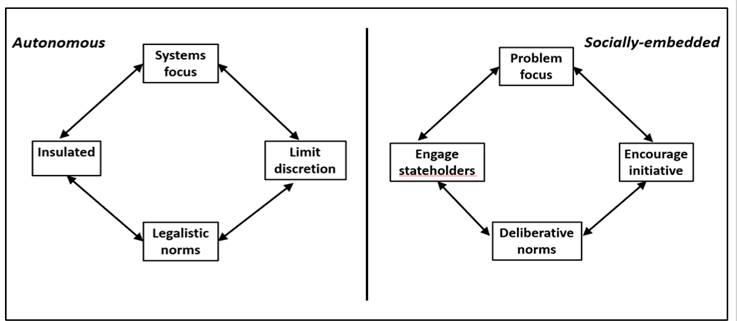
My new research, introduced in this post, focuses on the ways in which interactions between citizens and the public sector shape perceptions of legitimacy – in particular whether “socially-embedded bureaucracy” might help turn around disillusion with the public domain. As defined here (and elaborated in this accompanying paper) a socially-embedded bureaucracy (SEB) is characterized by:
“problem-focused relationships of co-operation between staff within public bureaucracies and stakeholders outside of government, including governance arrangements that support such co-operation”.
At least on the surface, initiatives that strengthen SEB seemingly have the potential to help renew the legitimacy of the public domain by cultivating trust – and thereby reinvigorate society’s capacity to achieve win-win outcomes to mixed motive bargaining challenges – not only at the micro-level, but systemically as well.
Notwithstanding its surface plausibility, the case for championing SEB is far from open-and-shut. On the one hand, among protagonists of SEB, enthusiasm all-too-easily outruns both the empirical evidence and conceptual clarity. On the other, SEB is inconsistent with mainstream conceptions of public sector governance; as a result its potential is all-too-easily dismissed. My new work aims to help put the empirical and (especially) conceptual platform of SEB discourse on a sounder footing. The work addresses two inter-related questions:
At the micro-level: Can SEB help improve public sector performance?
At the systemic level: Insofar as SEB indeed can help improve public sector performance, might it also transform perceptions more broadly, and in particular help renew the perceived legitimacy of the public domain?
To begin with the micro-level, as the figure below highlights, the contrast is stark between SEB and conventional notions of how public bureaucracies should be governed. In the conventional view, governance is organized hierarchically, with a focus on ‘getting the systems right’ Citizens engage upstream in the chain via their selection of political representatives who oversee both policymaking and implementation. The tasks of public officials are defined by legalistic, rule-bound processes, which also insulate public bureaucracy from political interference. Civil society’s governance role is to bring pressure from the demand-side to help ‘hold government to account’. By contrast, SEB is problem- rather than systems-oriented; it incorporates horizontal as well as hierarchical governance arrangements; interactions (both within the bureaucracy and at the interface with civil society) are less legalistic and more adaptive, oriented towards deliberation and fostering initiative.
These distinctive characteristics potentially enable SEB to improve public sector performance via three channels which are unavailable to insulated bureaucratic hierarchies:
SEBs potentially can foster synergistic gains from co-operation between public bureaucracies and non-governmental actors;
SEBs potentially can transform the governance arrangements for monitoring and enforcement from a morass of red tape to trust-building interactions between public officials and service recipients; and
SEB potentially supports developmental alliances among reform-oriented public officials and civil society actors – thereby enabling an unambiguous focus on the (developmental) public purpose, while obviating the risk of capture.
The above is not intended to imply that SEB necessarily is superior. Social embeddedness risks adding messiness in contexts where the priority task is to enhance bureaucratic coherence; it risks enabling new modes of predatory capture of public resources. But, as recent syntheses of the empirical evidence underscore, it does suggest that it is, at the least, premature to be dismissive of SEB’s possibilities. Don’t risk throwing out the baby with the bathwater.
At the systemic-level, a very different (and again controversial) case for SEB emerges. As the background paper explores, social learning and an associated cultivation of ‘pro-sociality’ is central to the micro-level argument. Might such learning cascade upwards to the systemic level, and help buttress citizens’ perceptions of the legitimacy of the public domain? Answering this question calls for careful unbundling of interactions between public effectiveness, trust, trustworthiness, social cohesion and legitimacy – a task I will take on in a subsequent blog (and accompanying background paper). For now, what can suffice to make the key point is to contrast two contributions, fifteen years apart, by Margaret Levi, former president of the American Political Science Association.
In 2007, Levi (with co-authors Karen Cook and Russell Hardin) argued that a pre-occupation with relationships of trust between civil society and public bureaucracy is at best a distraction – and at worst a way of weakening rule-boundedness and increasing the risk of capture. Their critique is captured vividly in the title of their book, Co-operation Without Trust. Championing institutionalism, they determinedly push back against a too-easy extrapolation from micro-level success stories of co-operation to the systemic level:
“When we are assessing the reliability of governments and politicians, what we ultimately put our confidence in is the quality of the institutional arrangements within which they operate…. At the personal level, relational trust makes our day-to-day lives richer and more manageable. More often, however, and in many varied contexts, we co-operate without trust.”
The above argument is eminently plausible in contexts where institutions are strong and stable. It holds up less well, however, in contexts where a downward spiral of accelerating distrust in the public domain is underway, with institutions increasingly under threat. For one thing, institutional guardrails have turned out to be more fragile than many (myself included) might have hoped. Further, as I explore in a forthcoming paper with South Africancivil society activist Mark Heywood, in contexts of declining state capability a pre-occupation with ‘holding government to account’ can have the unintended consequence of making public officials feel increasingly beleaguered and reluctant to experiment, while fueling civic disillusion.
Once disillusion and institutional decay have taken hold, the necessary first step in fostering reversal is not yet-another -round of institutional engineering, but rather to find ways to renew hope in the possibility and desirability of achieving collective gains through co-operation,. In that spirit, and in contrast to the 2007 book, here is what Levi and Zachary Ugolnik argued in 2023 in the lead article of an ambitious 2023 exploration of pathways to “creating a new moral political economy”:
“A new moral political economy….[will be centered around]….some form of sociality and cooperation….It demands attention to the governance arrangements that facilitate, even generate, prosocial behavior”.
There are, to be sure, many ways to foster pro-sociality that have little to do with the interface between public officials and non-governmental actors; nothing in Levi and Ugolnik’s 2023 argument makes an explicit case for SEB. But, especially in light of the micro-level positive potential of SEB, the notion that sustained efforts to foster pro-sociality at micro-level might cascade upwards into systemic change should, at the very least, not be dismissed out of hand. At the systemic level, too, it is premature to throw out the proverbial baby with the bathwater.
Finally, returning to the two questions posed earlier, insofar as the answer to both is “yes” – “yes, SEB improves public sector effectiveness” and “yes, SEB can also buttress systemic-level legitimacy” – a third question naturally arises: Might problem-level SEB provide a platform for a systemic-level transformation of the interface between citizens and public officials? Here (as a prelude to further work, some already underway…..) are four places where one might look for answers:
Bottom-up: The accretion of experience and learning at the problem-level might inspire others to initiate similar initiatives. Over time, multiple small initiatives might add up to more than the sum of their parts, with a new set of ideas, offering a new vision of what is possible, taking hold. (I plan to explore this via a new round of empirical research, focused on responses to the twin affordable housing and homelessness crises in Los Angeles County.)
Inside-out: Fostering deliberation and SEB within bureaucracies by championing changes in overly-rigid and overly-hierarchical rules, and in organizational culture. (Efforts to foster relational governance within the rigidly hierarchical bureaucracy of South Africa’s Western Cape province comprises an intriguing example.)
Outside-in: While some civil society activists might respond skeptically to SEB as counter to a perceived mission of holding government to account, others might shift from a confrontational to a more co-operative vision, centered around building cross-cutting problem-solving-oriented coalitions, including with reform-minded public officials. (The forthcoming paper with Mark Heywood explores this possibility.)
Top-down – via political and social mobilization, with micro-level SEB successes preparing the ground for new transformational acts of both social and political leadership.
Might forward-looking political leaders embrace an electoral and governance platform centered around a vision of partnership between the public sector and non-governmental actors? And what are the prospects for myriad concrete, deliberative and problem-focused civil society initiatives serving as potential building blocks for a broader social movement? Mobilization centered around deliberative problem-solving would be a radical departure from contemporary pressure-cooker discourses which thrive on raising rather than reducing the temperature. But, as Robert Putnam explored in his 2020 book, The Upswing, it has happened before, and might happen again:
“A distinct feature of the Progressive Era was the translation of outrage and moral awakening into active citizenship…Progressive Era innovations were a response – seeking to reclaim individuals’ agency and reinvigorate democratic citizenship as the only reliable antidotes to overwhelming anxiety……[Similarly], our current problems are mutually reinforcing. Rather than siloed reform efforts, an upswing will require ‘immense collaboration’, [leveraging] the latent power of collective action not just to protest, but to rebuild….”
Recognition that ‘context matters’ for development policymaking and implementation has become commonplace, almost to the point of cliché – but going beyond the general nostrum to something practically useful continues to challenge. This post draws on a set of ambitious new case studies of the politics of policymaking in education to illustrate the practical potential of an approach that takes seriously the ways in which power and institutions shape context, and thus reform opportunities and constraints. (A companion post lays out the approach’s theoretical underpinnings.)
On the surface, global gains in educating children have been remarkable. Access has expanded enormously. So, too, has education-sector-specific knowledge about how students learn and successful teachers teach. Yet the combination of access and knowledge has not translated into broad-based gains in learning outcomes. Why?
To better understand the reasons for this disconnect, and to help uncover new ways of improving learning outcomes, the ambitious, decade-long RISE program championed broad-ranging research on systems of education. As part of this effort, it sponsored a set of country studies of the politics of education policy adoption. In early 2022, I was commissioned by RISE to write a synthesis (available here) of the individual studies. The synthesis paper provided an opportunity to explore further some questions left over from an earlier round of research in the education sector.
Back in 2012, I launched an in-depth research project on the politics and governance of basic education, centered around case studies in two provinces of South Africa. The project built on decades of work as a researcher-practitioner at the interface between governance and economic development across a wide range of sectors (though never before on education), I came away from the research enormously impressed by the rigor of specialized, education-sector scholarship and, more broadly, by the knowledge and commitment of many in the education-sector-focused policy and research community. But I was also struck by how little progress has been made in linking this knowledge to broader findings on interactions between governance, policymaking and implementation.
In seeking to account for this disconnect, a useful point of departure is the 2018 Learning World Development Report’s distinction between proximate and underlying causes of learning shortfalls. Proximate causes include the skills and motivations of teachers, the quality of school management, the available of other inputs used in schools, and the extent to which learners come to school prepared to learn. Underlying these are the governance arrangements through which these inputs are deployed. Specialist knowledge on the relation between the proximate causes and learning outcomes can straightforwardly be applied in countries where governance works well. However, as the RISE political economy case studies detail vividly, in countries where the broader governance context is less supportive, specialist sector-specific interventions to support learning are less likely to add value.
How to move forward in the latter contexts? “Focus not only on sector-specific technical interventions, but also on improving governance” is a seemingly obvious answer. That answer is not wholly wrong – but it can all-too-readily be interpreted in ways that lead reformers down counterproductive dead-ends. To see why, consider the definition of governance offered by an influential World Bank report:
“Governance is the process through which state and nonstate actors interact to design and implement policies within a set of formal and informal rules [institutions] that shape and are shaped by power”.
As this definition signals, governance processes are embedded within broader contexts shaped by power and institutions. Further, as voluminous research has shown (see here, here, and here), over the medium-term (in most countries, most of the time) these broader contexts change only on relatively small margins. Viewed from the perspective of sector-level decision-makers, the broader political context is exogenous. What can be done to improve outcomes in messy governance contexts?
One useful way to move forward is to construct a typology, organized around a small number of distinct contexts, each characterized by distinctive configurations of power and distinctive institutional forms – and thus distinctive patterns of incentive and constraint (and possibilities for improving development outcomes) within which sectoral governance plays out. With a set of distinct types in hand, a key next step is to find ‘good fit’ ways forward, by identifying a variety of potential entry points for improving outcomes, and clarifying how they align with the different contexts.
This piece and its companion are organized around three distinct (heuristic) political-institutional types, each resonant with a familiar ‘real-world’ pattern. The three are:
Context A (‘dominant’)– in which power is highly concentrated, and exercised top-down.
Context B (‘personalized competitive’) – in which authority is fragmented, with multiple centers of power, limited capacity for co-operation, and limited compliance with formal rules.
Context C (‘impersonal competitive’), characterized by strong formal ‘rules of the game’ that are intended to provide a platform for resolving conflict among stakeholders and their goals, and for implementation – but, insofar as political contestation remains unresolved, can result in a combination of exaggerated rule compliance and/or isomorphic mimicry.
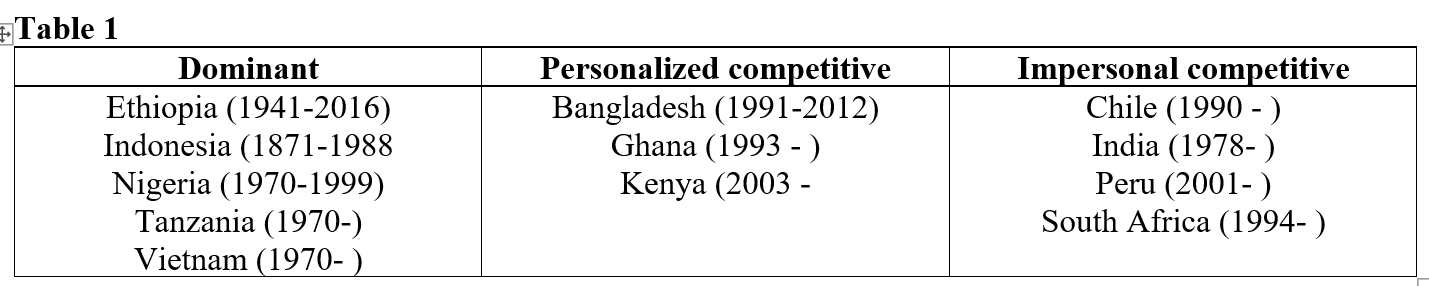
The companion blog lays out the theoretical rationale for focusing on these three heuristic political-institutional contexts. This piece (and the RISE synthesis paper) uses this three-fold typology to organize, and analyze comparatively, the country cases studies on the politics of education policy. As an initial step, the case study countries were grouped into the three types. This was done using three V-DEM governance indicators – the extent of electoral democracy, the quality of the rule of law, and the pervasiveness of clientelism. The resulting categorization is shown in Table 1 below. (See the synthesis paper for details).
The synthesis paper builds on the individual case studies to lay out some distinctive, within-type patterns of education sector governance:
In dominant contexts, with power centered around a political leader and a hierarchical governance structure, the education sector’s goals are largely shaped by the leaders. As the Vietnam case details, top-down leadership potentially can provide a robust platform for improving learning outcomes. However, as the case studies of Ethiopia, Indonesia, Nigeria and Tanzania illustrate, all-too-often dominant leaders’ goals vis-à-vis the education sector can veer in other directions.
In impersonal competitive contexts, a combination of strong formal institutions and effective processes of resolving disagreements can, on occasion, result in a shared commitment among powerful interests to improve learning outcomes – but in none of the case studies was this outcome evident. Instead (as discussed further below), the case studies a combination of unresolved political contestation over the education sector’s goals, exaggerated rule compliance and performative isomorphic mimicry.
Personalized competitive contexts such as Bangladesh, Ghana and Kenya lack the seeming strengths of either their dominant or their impersonal competitive counterparts; there are multiple politically-influential groups and multiple, competing goals – but no credible framework of rules to bring coherence either to political competition or to the education bureaucracy.
As the case studies detail, these political and institutional realities rendered ineffective many specialized sectoral interventions intended to improve learning outcomes.
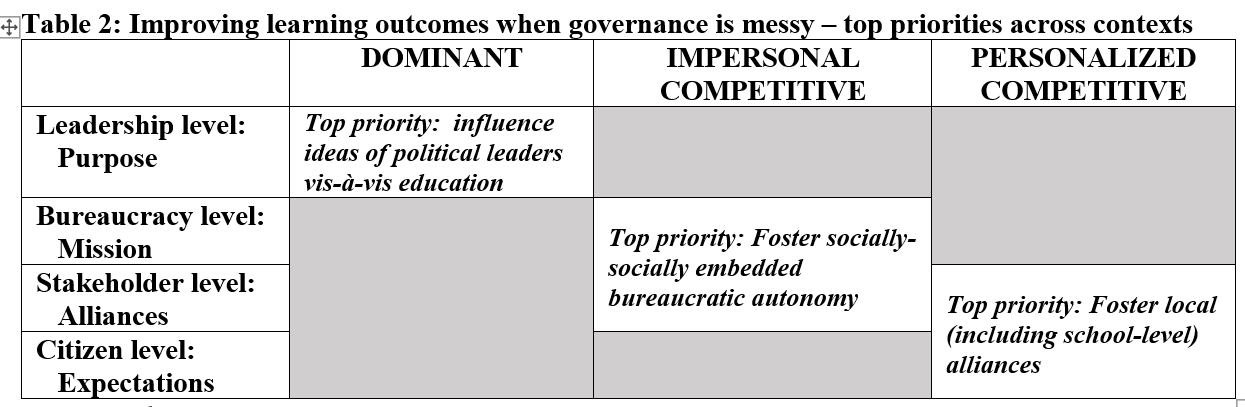
What might be some context-aligned entry points for improving learning outcomes in the midst of this messiness? Key is to open up space in a way that enables sector professionals to bring their specialist knowledge to bear. The rows in Table 2 highlight four ‘soft governance’ entry points with space-expanding potential. Each entry point is (loosely) aligned with a distinct level in a chain of governance processes that link politicians, policymakers, public officials and citizens:
The leadership level – purpose: What are the goals of the education system? How to strengthen leaders’ orientation towards learning?
The bureaucracy level – mission: How to empower mission-oriented public officials within the education system?
The stakeholder level – alliances: Which influential stakeholders champion learning? How to foster co-operation among these stakeholders, thereby strengthening their collective influence?
The citizen-level – expectations: How do the expectations of parents, communities and citizens influence the extent to which the education sector is learning-oriented? How might learning-oriented influences be strengthened?
As the cells in Table 2 suggest, and the paragraphs below detail, the potential for each of these ‘soft governance’ entry points to improve learning outcomes varies systematically across the three types. (The paragraphs that follow are a summary of a more comprehensive treatment in my February 2023 RISE insight note.)
For dominant contexts, the top ‘soft governance’ priority is to engage with leaders as to the purpose of education. As noted earlier, Vietnam was alone among the case studies of dominant countries in consistently having improvements in learning outcomes as the sector’s principal goal. In Indonesia and Tanzania the principal goal was to aligning education with a distinctive set of ideas about the nation and its collective identity; in Ethiopia under the military Derg regime (and in Nigeria, too, at least for a time) it was to expand access to historically excluded groups, with little attention to quality. (How) can leaders be persuaded to prioritize learning, and to take the steps needed to improve learning outcomes?
For personalized competitive contexts, contestation among stakeholders invariably leads to policy incoherence, bureaucratic fragmentation, and high risks of predation – and thus little prospect that efforts to strengthen public systems can gain traction. Yet as Table 2 suggests (and as analyses of Bangladesh and Ghana detail), fragmentation can have a silver lining – it can create space for alliances of developmental stakeholders to successfully push back against predatory pressures, and eke out islands of effectiveness at local levels (sometimes even as localized as an individual school). More ambitiously, insofar as a societal expectation of “all for education” can take hold – that parents and communities, especially, have an active role to play in supporting a learning-oriented education system – then, even in personalized competitive contexts, far-reaching national gains in learning outcomes can be achieved. As the synthesis paper details, Kenya offers an example of what is possible.
In impersonal competitive contexts, there is (as noted earlier) a clear normative vision of how a learning-oriented education system should function. In practice, however, things fall short of that vision in all four of the impersonal competitive case study countries:
In Peru, there was ongoing conflict over purpose between politicians on the one hand, and sectoral stakeholders and experts on the other.
In India, there was a large disconnect between (national) policymakers and (state-level) implementers.
In Chile and South Africa, there was an ongoing pre-occupation with formal systems, with correspondingly less de facto attention on how to improve learning.
A comparison of the Chilean and Peruvian case studies offers some striking insights as to both the challenges confronting impersonal competitive contexts, and a promising way forward. In Chile, interactions among stakeholders largely were top-down and systematically managed. Peru, by contrast, was characterized by ongoing back-and-forth jockeying among stakeholders, messy compromises with the teachers union, and multiple policy reversals. Insofar as better-aligned institutional arrangements and systematic, consistent policies are likely to be more effective than ‘messier’ ones, learning outcomes would be expected to show more improvement over time in Chile than in Peru. Yet, as the synthesis study details, between 2000 and 2018 Peru achieved very large gains in learning outcomes, while the gains in Chile were modest. Why?
The Chilean approach to sector governance was, from a technocratic perspective of governance, “best practice”. Yet the (not yet published) case study concludes that:
“Good intentions to improve educational quality, resources and carrots and sticks have not been enough to move the Chilean educational system in the direction that its political authorities wanted…. The top down character of Chilean educational policy making and the insufficient use of institutional voice mechanisms might backfire as the mounting social tensions and the 2019 social movement casts some doubts about its survival” (p.47)
By contrast, Peru’s messier, less formalistic and more iterative process of policy formulation and adaptation helped build broad legitimacy among stakeholders – importantly including strengthening trust in the technocrats and professionals responsible for its formulation – thereby enhancing their ability to push back against idiosyncratic initiatives proposed by political appointees. As the Peru country case study put it:
“ Civil society organizations – NGOs, universities, think tanks and research centers – have also played a key role in defining policy agendas [and….] in the development of education policies and reforms. Though not always able to contain either technocrats’ or other policy makers – agreements are often ignored by ministerial administrations and political parties – they have certainly contributed to the continuity of agendas and to the advancement, through piecemeal, of reforms.”
The contrasting trajectories of Chile and Peru point to the importance, in impersonal competitive contexts, of not seeking to govern education solely within the strictures of an autonomous bureaucracy, but rather to open up space by embracing “social embeddedness”, working to build developmental alliances with a sense of shared purpose. Indeed, the point applies broadly. Across the range of less-than-perfect governance contexts, rather than focus narrowly on technocratic (governance or sector-specialized) initiatives, foreground attention to the question of ‘commitment to learning’. Especially in competitive contexts (both personalized and impersonal) cultivate the idea that improving learning outcomes is everybody’s business, and create opportunities for engagement – invite citizens to become active participants in a shared endeavor to equip coming generations with the capabilities they will need be part of a vibrant, thriving society.
Ambiguity has its uses – but only up to a point. Its limitations became evident in an early 2016 research retreat to take stock of progress in research on ‘political settlements’. The retreat (sponsored by the Effective States and Inclusive Development research programme) revealed that, beneath a shared, enthusiastic embrace of the transformative potential of political settlements analysis for development practice, were very disparate understandings of the term. Some researchers explored political settlements through the lens of power; others through the lens of institutions; others moved ambiguously between the two.
Work over the subsequent six years has, in my view, decisively resolved the ambiguity. Reflecting the intellectual evolution, this piece explores conceptually how power and institutions interact to shape a variety of distinctive contexts for development policymaking and implementation. A companion blog summarizes how the resulting typology was applied in a recent comparative evaluation of the political economy of education systems and their reform in a dozen countries, prepared for the RISE research programme.
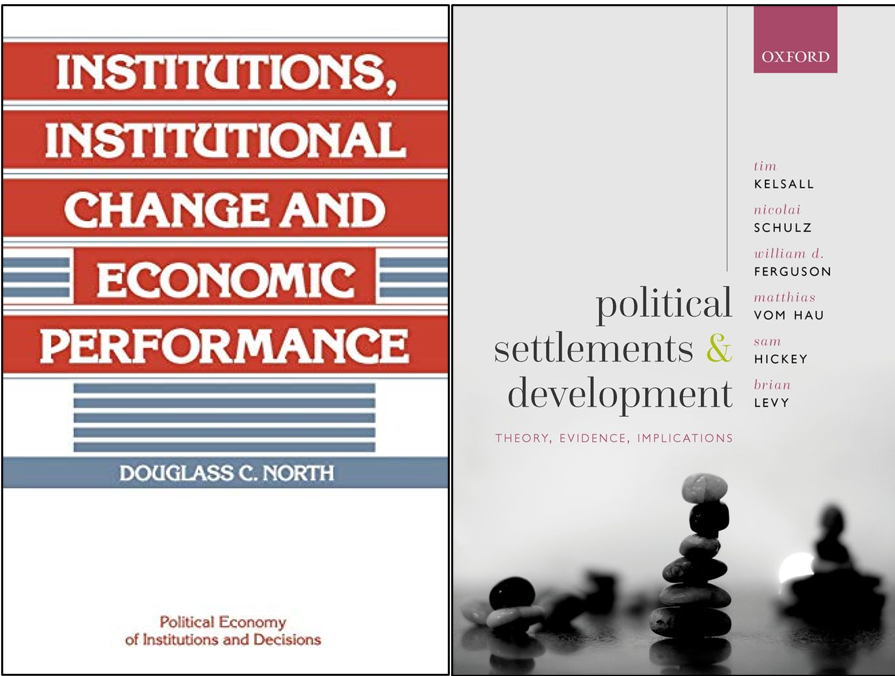
Typologies provide a useful way of drawing sharp distinctions among a small number of heuristic patterns that, considered together, delineate a variety of contexts along which many real world polities might be aligned. My 2014 book Working with the Grain built a typology around cross-country variations in institutional characteristics. The typology laid out in the 2022 book Political Settlements and Development: Theory, Evidence, Implicationsgives primacy to variations in the configuration of power. (The book was a multi-author effort led by Tim Kelsall; I was one of the co-authors.) This piece integrates the two approaches, using the four variables included in Figure 1.
Kelsall et. al’s definition of a political settlement provides a useful point of departure for clarifying the relationship between power and institutions. It defines a settlement as:
“An ongoing agreement (or acquiescence) among a society’s most powerful groups over a set of political and economic institutions expected to generate for them a minimally acceptable level of benefits, which thereby ends or prevents generalized civil war and/or political and economic disorder”
While both power and institutions feature in the above definition – a settlement is reached when powerful groups agree on the ‘rules of the game’ (i.e. the institutions) that govern the settlement – the 2022 book focuses principally on the delineation of power, and its consequences. It carefully defines two aspects of power:
The social foundation (SF) characterizes who is powerful – the included socially salient groups (insiders, groups to which policy must somehow respond) as opposed to the excluded (outsiders)…along a spectrum that extends from broad (nearly all social salient groups belong) to narrow (most are excluded).
The concentration of power (PC) characterizes the extent of power – the extent of coherence in the allocation of decision-making procedures and authority among insiders, ranging from concentrated (highly coherent) to dispersed (lacking in coherence).
The book reports measures of each of PC and SF over time in forty-two countries in the global South, and uses these measures to explore statistically the causal influence of each on development. Higher levels of PC turn out to be associated with more rapid economic growth, and higher levels of SF with broad-based gains in social indicators.
Considering SF and PC from a more disaggregated perspective yields additional insights. The SF variable underscores the importance for inclusive growth of empowering excluded actors– both at an aggregate level and at more micro-levels by giving ‘voice’ to beneficiaries who are intended to benefit from social programs. The PC variable directs attention to the roles of three sets of drivers – distributional, ideational and institutional – in shaping the balance between co-operation and conflict in a country’s polity:
Distributional drivers. As per the definition of a political settlement, a necessary condition for a high PC (and thus rapid growth) is that the breadth of the SF and the distribution of economic benefits are aligned with each other. (Note that both broad SF/inclusive growth and narrow SF/unequal growth are consistent with this condition, at least in the short-to-medium term.) A loss of alignment between the distribution of power and of economic benefits is likely to result in a decline in PC, with an associated slowdown in economic growth, and rise in political polarization. (See here and here.)
Ideational drivers. As the 2022 book details (building on Ferguson 2020) political settlements can usefully be understood through the lens of collective action. Shared ideas can provide a basis for achieving co-operative outcomes to mixed-motive bargaining challenges (and thus a high PC); ideational political entrepreneurs (populist or otherwise) can destabilize a previously stable settlement. (See here and here.)
Institutional drivers. As per the definition of a political settlement, institutions (‘the rules of the game’) provide the container for a political settlement. The institutional arrangements can take a variety of distinct forms, each of which shapes interactions among stakeholders in a distinctive way. Attention to institutions is thus key to addressing a central question confronting practitioners: Given the incentives and constraints prevailing in a specific context, what might be some tractable, context-aligned entry points for improving development outcomes?
This last question brings us to the two institutional variables identified in Figure 1.
Variable #3 in Figure 1 can usefully be interpreted as a continuum between wholly top-down (principal-agent) governance and peer-to-peer governance among multiple principals. As its location at the power-institutions intersection in Figure 1 suggests, this continuum can be interpreted both from the perspective of institutions and of power:
As institutions, both principal-agent and multi-principal governance have been the focus of a voluminous literature (for example here, here, and here).
As power, each depicts a very different relationship among stakeholders – unequal power in the former, and interactions among relative equals in the latter. At all levels – from the micro (families; firms) to the meso (communities) to the national – horizontal governance between peers plays out very differently than hierarchical governance arrangements that link those who are powerful with those who are not.
As variable #3 suggests, high PC can thus be achieved via two distinct institutional forms – top-down, hierarchical command-and-control, or peer-to-peer resolution of horizontal challenges of collective action.
Variable #4 distinguishes among institutions according to and whether the rules of the game take the form of personized deals or impersonal rules. This distinction is given only limited attention in analyses of power (including the 2022 volume), but it is central to the contributions of Douglass North and colleagues (see here, here and here), yet. As North and colleagues argue persuasively, impersonal institutions cannot be created by fiat; they emerge as a facet of long-run processes of political, economic and social changes.
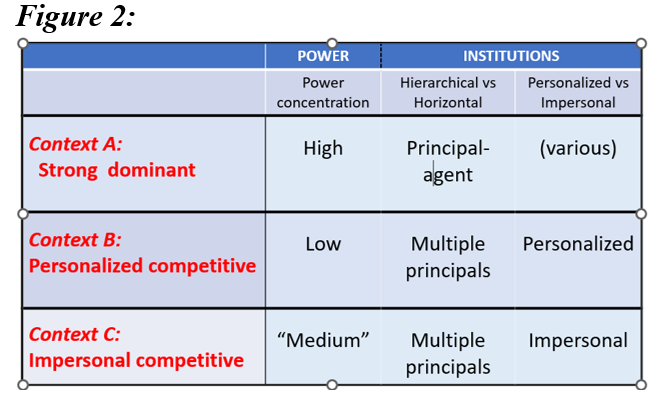
Considered together, variables #2, #3 and #4 provide the basis for a typology that distinguishes among a variety of political settlements, each with distinct institutional forms, and thus distinct, context-aligned entry points for improving development outcomes. Logically, with three variables, each aligned along a continuum, the number of possible types is large. The goal, though is not comprehensiveness, but to focus attention on a few core contexts – radically different from each other, each resonant with a familiar ‘real-world’ pattern, and each characterized by distinctive patterns of incentive and constraint, and thus distinctive entry points for improving outcomes. Figure 2 below identifies three types that meet these criteria. (In applying this framework, I have found that many countries can be interpreted as hybrid combinations of the three – but I have not come upon a fourth type that meets the tests of both real-world resonance and enough qualitative distinctiveness that it warrants inclusion as an additional category.) The paragraphs that follow elaborate on each of the types, drawing on the companion blog on education systems to signal their practical relevance.
In context A (strong dominance), power is highly concentrated, and exercised top-down – with all of the strengths of decisiveness, and the pathologies of hubris and demotivation of subordinates that can accompany this institutional mode of exercising power. The political economy of education case studies for Indonesia, Ethiopia, Nigeria, Tanzania and Vietnam illustrate some of the ways in which dominance plays out in practice. As the education research details, key to achieving gains in these contexts is to engage top-level leadership around purposes.
Context B (personalized competition) is characterized by fragmented authority: multiple centers of power, limited capacity for co-operation, and limited compliance with formal rules (including the rules necessary for the functioning of a formal bureaucracy). In this context, as education case studies for Bangladesh, Ghana, Kenya and South Africa’s Eastern Cape province illustrate – and as a broader literature has explored in depth (see here, here and here) – entry points for achieving gains come not from efforts at systems reform, but from more focused efforts to strengthen islands/pockets of effectiveness.
Context C (impersonal competition) is characterized by strong formal ‘rules of the game’ intended to provide a platform both for resolving conflict among stakeholders and their goals, and for implementation. In successful, mature democracies this platform can indeed result in a shared commitment among powerful interests to craft win-win resolutions of collective action problems, and in the effective operation of public bureaucracy. However, as the education case studies of Chile, Peru, India and South Africa illustrate, the all-too-common result is instead a combination of unresolved political contestation over goals (and thus, as per Figure 2, a ‘medium-level of PC), exaggerated rule compliance and/or performative isomorphic mimicry.
More broadly, as many democracies (even seemingly mature ones) are demonstrating, polarized discourse renders impersonal competitive contexts increasingly vulnerable to a cumulative delegitimization of the public domain, and a downward spiral of institutional decay. Reversing downward spirals is a central challenge of our time. At a micro/sectoral level, as I summarize in the companion blog, the education studies offer some interesting insights as to how this might be achieved across the different contexts. At a broader level, I explored some possibilities in a comparative analysis of interactions between inequality and polarization in South Africa and the United States. Extending this analysis into a broader exploration of what it will take to turn from rage to renewal will be a central focus of my work going forward.
Building public sector capability is again rising on the agenda, in South Africa and elsewhere. The topic has been a longstanding pre-occupation of mine – as practitioner, as researcher, and in my teaching. I’ve especially emphasized the importance of looking beyond proximate causes (eg weak ‘capacity’ and institutional forms) – and to focus (also) on underlying causes (“public sectors are embedded in politics”) and reform initiatives that can effectively address these underlying causes. Here’s a mouthful that will guide my research agenda in this area going forward “socially-embedded bureaucratic autonomy”.
Fueled by hope, I spent the 2010s travelling back-and-forth between South Africa and the USA, sharing an optimistic approach to integrating governance and development strategies with mid-career practitioners at both SAIS and the Mandela School. But the subsequent decade unfolded in unexpectedly toxic ways in both countries. It felt important to complement with-the-grain pragmatism with an exploration of underlying challenges. A 2021 co-authored paper explored why things turned rancid in South Africa. My new paper – How Inequality and Polarization Interact: America’s Challenges Through a South African Lens, also published by the Carnegie Endowment for International Peace – takes a comparative perspective. This post lays out five personal take-aways from the comparison. (Here’s a link to the paper’s executive summary).
Take-away #1:Far more than is the case for contemporary South Africa, America’s current wounds – increases in inequality since the 1980s, and their attendant social and political correlates – have been self-inflicted.
Back in the 1970s, I had been drawn to the USA by its openness, its commitment to freedom, equal dignity and equal justice for all – everything that the South Africa I left behind was not. With its 1990s ‘rainbow miracle’ transformation from apartheid to constitutional democracy, South Africa became a new beacon of possibility for people around the world who value democratic governance and inclusive societies. However, the country’s subsequent reversals were not wholly unexpected. Three decades after the end of apartheid, South Africa remains among the world’s most unequal countries, and its fraught racial history continues to fester – though the rawness and relative recency of the anti-apartheid struggle perhaps continues to offer some immunization against a further-accelerating downward spiral.
For the United States, however, the converse may be true. In the decades subsequent to World War II, the combination of an equitably growing economy and a vibrant civil rights movement had fostered the hope of deepening economic and social inclusion. But beginning in the 1980s, the benefits of growth became increasingly skewed, and ‘culture wars’ became increasingly virulent. Complacency bred of long stability may have lulled America into political recklessness at the inequality-ethnicity intersection – a recklessness that risks plunging the country into disaster.
Take-away #2: In both South Africa and the USA, the drivers of polarization have been multiple and mutually reinforcing; essentialist explanations that focus narrowly only on a single dimension – economic, institutional, cultural or racial – and ignore the others are, at best, seriously incomplete.
The Carnegie paper distinguishes between polarization’s demand-side and its supply-side. The demand-side comprises the way citizens engage politically – as shaped by power, by their perceptions of the fairness of economic outcomes, and by whether they frame identity in inclusive or in us/them ways. The supply-side comprises political entrepreneurs and the ideas they champion – ideas about how the world works; ideas about identity. Mutually-reinforcing interactions between the demand- and supply-sides can become increasingly toxic – potentially even to the point of a doom loop that destroys constitutional democracy.
Take-away #3: Both South Africa and the USA need to be more pro-active in renewing economic inclusion – but making the shift from an inequality-fueling to an inclusion-supporting economy is less daunting than it might seem.
When considered through the lens of the interaction between inequality and ideas, pro-inclusion policies are less important as ends in themselves than for how they affect the willingness of citizens to accept the rules of the game (including the distribution of economic outcomes) as broadly legitimate. As South Africa’s rainbow miracle turnaround in the 1990s and early 2000s shows, a turn from anger to hope does not need a comprehensive package of pro-equity reforms. Rather, reforms that foster “good-enough inclusion”—some immediate gains that signal that things have changed, combined with credible signals that longer-term structural change is underway—can set in motion a virtuous spiral, which can be sustained as long as the momentum of positive policy change continues to unfold over time.
Take-away #4: The influence of economic elites, though often obscured beneath the headlines, has been central in both countries – for both good and ill.
In South Africa, as Alan Hirsch and I explored in depth, South Africa’s business establishment played a leading role in helping to midwife negotiations between the white minority government and the ANC. In the USA, organized business was an important part of the elite consensus that fueled three decades of inclusive economic growth subsequent to World War II. In recent decades however, a segment of the elite has actively financed political entrepreneurs who have skillfully championed a combination of polarizing cultural discourse and distributionally regressive economic policies. This is a classic example of elite capture, a phenomenon familiar to scholars of comparative politics. Paralleling what happened in 1980s South Africa, might America’s economic elites wake up to these risks and become more open to inclusive renewal?
Take-away #5: In settings that are open politically, turnaround will be achieved less by directly engaging polarization’s most toxic champions, than by working around them.
Mass political mobilization was pivotal to South Africa’s shaking loose the shackles of apartheid – and new calls to the barricades might seem to be the obvious response to current political and governmental dysfunction. However, different times and different challenges call for different responses. Currently, both the South African and U.S. governments are, at least aspirationally, committed not to accelerating polarization but to strengthening both inclusion and the institutional foundations of democracy. In such contexts, some compelling research suggests that what is called for is not fighting polarization with more polarization but lowering the temperature by fostering deliberative discourse, focused on positive, hope-evoking options. As happened once before in the USA, the aim would be for a myriad of collaborative, problem-focused grassroots initiatives to serve as potential building blocks for a twenty-first-century social movement– a movement that views cooperation in pursuit of win-win possibilities not as weakness but as key to the sustainability of thriving, open, and inclusive societies.
This is the executive summary of my new paper published by the Carnegie Endowment for International Piece. For my more personal take on the parallels between South Africa and the USA, and their implications, click HERE.
Over the past decade, toxic interactions between persistent inequality, racial tensions, and political polarization have undercut the promise of South Africa’s so-called rainbow miracle transition from apartheid to democracy. South Africa’s recent history sheds light on the United States’ recent political travails. It illustrates how interactions between inclusion and inequality on the one hand and political ideas and entrepreneurship on the other can fuel positive spirals of hope, economic dynamism, and political legitimacy—but can also trigger vicious, downward spirals of disillusion, anger, and political polarization.
Polarization has both a demand-side and a supply-side. The demand-side comprises the way citizens engage politically – as shaped by power, by their perceptions of the fairness of economic outcomes, and by whether they frame identity in inclusive or in us/them ways. The supply-side comprises political entrepreneurs and the ideas they champion – ideas about how the world works; ideas about identity. In both South Africa and the USA, the demand- and supply-sides of polarization have been mutually-reinforcing.
South Africa was able to transition from a society structured around racial oppression into a nonracial democracy whose new government promised “a better life for all.” Especially remarkable was the speed with which one set of national ideas appeared to give way to its polar opposite. From a society marked by racial dominance and oppression, there emerged the aspiration to build an inclusive, cooperative social order, underpinned by the principles of equal dignity and shared citizenship.
In the initial glow of transition, South Africa’s citizens could hope for a better life for themselves and their children. In time, though, the promise wore thin. It became increasingly evident that the economic deck would continue to be stacked, and that the possibility of upward mobility would remain quite limited. Fueled by massive continuing inequities in wealth, income, and opportunity, South Africans increasingly turned from hope to anger.
In the United States, a steady and equitably growing economy and a vibrant civil rights movement had fostered the hope of social and economic inclusion. But that hope turned to anger as the benefits of growth became increasingly skewed from the 1980s onward. In 2019, the U.S. economy was more unequal than it had been since the 1920s. Younger generations could no longer expect that their lives would be better than those of their parents. Such economic adversity and associated status anxiety can trigger a heightened propensity for us-versus-them ways of engaging the world.
In both South Africa and the United States, polarization was fueled by divisive political entrepreneurs, and in both countries, these entrepreneurs leveraged inequality in ways that added fuel to the fire. In the 2010s, South Africa went through a new ideational reckoning, in part to correct the view that the transition to democracy had washed the country’s apartheid history clean. But opportunistic political entrepreneurs also pushed an increasingly polarized and re-racialized political discourse and pressure on public institutions, with predictable economic consequences. South Africa’s economy slid into sustained stagnation.
Paralleling South Africa, America’s political entrepreneurs also cultivated an us-versus-them divisiveness. However, unlike in South Africa, political entrepreneurs and economic elites in the United States also used their divisive rhetoric as a way to persuade voters to embrace inequality-increasing policies that might otherwise not have won support. By the late 2010s, the risks were palpable in both South Africa and the United States of an accelerating breakdown of the norms and institutions that sustain inclusive political settlements.
But lessons can be overlearned. Mass political mobilization was pivotal to South Africa’s shaking loose the shackles of apartheid—and new calls to the barricades might seem to be the obvious response to current political and governmental dysfunction. However, different times and different challenges call for different responses. In both contemporary South Africa and contemporary America, the frontier challenge is not to overthrow an unjust polit[1]ical order but to renew preexisting formal commitments to the idea that citizenship implies some shared purpose. Renewal of this kind might best be realized not by confrontation but rather by a social movement centered around a vision of shared citizenship, a movement that views cooperation in pursuit of win-win possibilities not as weakness but as the key to the sustainability of thriving, open, and inclusive societies.
Fueled by hope, I spent the 2010s travelling back-and-forth between South Africa and the USA, sharing an optimistic approach to integrating governance and development strategies with mid-career practitioners at both SAIS and the Mandela School. But the subsequent decade unfolded in unexpectedly toxic ways in both countries. It felt important to complement with-the-grain pragmatism with an exploration of underlying challenges. A 2021 co-authored paper explored why things turned rancid in South Africa. My new paper – How Inequality and Polarization Interact: America’s Challenges Through a South African Lens, also published by the Carnegie Endowment for International Peace – takes a comparative perspective. This post lays out five personal take-aways from the comparison. (Here’s a link to the paper’s executive summary).
Take-away #1:Far more than is the case for contemporary South Africa, America’s current wounds – increases in inequality since the 1980s, and their attendant social and political correlates – have been self-inflicted.
Back in the 1970s, I had been drawn to the USA by its openness, its commitment to freedom, equal dignity and equal justice for all – everything that the South Africa I left behind was not. With its 1990s ‘rainbow miracle’ transformation from apartheid to constitutional democracy, South Africa became a new beacon of possibility for people around the world who value democratic governance and inclusive societies. However, the country’s subsequent reversals were not wholly unexpected. Three decades after the end of apartheid, South Africa remains among the world’s most unequal countries, and its fraught racial history continues to fester – though the rawness and relative recency of the anti-apartheid struggle perhaps continues to offer some immunization against a further-accelerating downward spiral.
For the United States, however, the converse may be true. In the decades subsequent to World War II, the combination of an equitably growing economy and a vibrant civil rights movement had fostered the hope of deepening economic and social inclusion. But beginning in the 1980s, the benefits of growth became increasingly skewed, and ‘culture wars’ became increasingly virulent. Complacency bred of long stability may have lulled America into political recklessness at the inequality-ethnicity intersection – a recklessness that risks plunging the country into disaster.
Take-away #2: In both South Africa and the USA, the drivers of polarization have been multiple and mutually reinforcing; essentialist explanations that focus narrowly only on a single dimension – economic, institutional, cultural or racial – and ignore the others are, at best, seriously incomplete.
The Carnegie paper distinguishes between polarization’s demand-side and its supply-side. The demand-side comprises the way citizens engage politically – as shaped by power, by their perceptions of the fairness of economic outcomes, and by whether they frame identity in inclusive or in us/them ways. The supply-side comprises political entrepreneurs and the ideas they champion – ideas about how the world works; ideas about identity. Mutually-reinforcing interactions between the demand- and supply-sides can become increasingly toxic – potentially even to the point of a doom loop that destroys constitutional democracy.
Take-away #3: Both South Africa and the USA need to be more pro-active in renewing economic inclusion – but making the shift from an inequality-fueling to an inclusion-supporting economy is less daunting than it might seem.
When considered through the lens of the interaction between inequality and ideas, pro-inclusion policies are less important as ends in themselves than for how they affect the willingness of citizens to accept the rules of the game (including the distribution of economic outcomes) as broadly legitimate. As South Africa’s rainbow miracle turnaround in the 1990s and early 2000s shows, a turn from anger to hope does not need a comprehensive package of pro-equity reforms. Rather, reforms that foster “good-enough inclusion”—some immediate gains that signal that things have changed, combined with credible signals that longer-term structural change is underway—can set in motion a virtuous spiral, which can be sustained as long as the momentum of positive policy change continues to unfold over time.
Take-away #4: The influence of economic elites, though often obscured beneath the headlines, has been central in both countries – for both good and ill.
In South Africa, as Alan Hirsch and I explored in depth, South Africa’s business establishment played a leading role in helping to midwife negotiations between the white minority government and the ANC. In the USA, organized business was an important part of the elite consensus that fueled three decades of inclusive economic growth subsequent to World War II. In recent decades however, a segment of the elite has actively financed political entrepreneurs who have skillfully championed a combination of polarizing cultural discourse and distributionally regressive economic policies. This is a classic example of elite capture, a phenomenon familiar to scholars of comparative politics. Paralleling what happened in 1980s South Africa, might America’s economic elites wake up to these risks and become more open to inclusive renewal?
Take-away #5: In settings that are open politically, turnaround will be achieved less by directly engaging polarization’s most toxic champions, than by working around them.
Mass political mobilization was pivotal to South Africa’s shaking loose the shackles of apartheid – and new calls to the barricades might seem to be the obvious response to current political and governmental dysfunction. However, different times and different challenges call for different responses. Currently, both the South African and U.S. governments are, at least aspirationally, committed not to accelerating polarization but to strengthening both inclusion and the institutional foundations of democracy. In such contexts, some compelling research suggests that what is called for is not fighting polarization with more polarization but lowering the temperature by fostering deliberative discourse, focused on positive, hope-evoking options. As happened once before in the USA, the aim would be for a myriad of collaborative, problem-focused grassroots initiatives to serve as potential building blocks for a twenty-first-century social movement– a movement that views cooperation in pursuit of win-win possibilities not as weakness but as key to the sustainability of thriving, open, and inclusive societies.
What will it take to shake loose the distemper of our times, and initiate a virtuous spiral of renewal? In a recent UNU-WIDER webinar, Alan Hirsch and I explored why a narrow focus on growth and good governance will not be enough to get South Africa (and, by analogy, other countries similarly trapped in a vicious cycle of disillusion and despair) back on the path of building a thriving, inclusive society. Conventional policy discourses are well-suited to address circumstances and questions such as these: How to maintain rapid growth, while making it increasingly inclusive? Assuming political and social stability, and taking a medium-to-long-term horizon, what policy and expenditure decisions will best achieve the country’s development goals? These are public policy challenges for a season of hope.
However, South Africa (and numerous other countries) no longer is in a season of hope. Growth has ground to a halt; inequality festers; institutions decay; the threat of accelerating turmoil looms. The frontier challenge is not one of making mid-course adjustments, while sustaining momentum; it is a challenge of renewal, of setting in motion a new virtuous spiral. Addressing this challenge needs a broader approach to crafting a way forward than is provided by the conventional tools – one that goes beyond the technical details of policy, and looks also at policy’s inter-relationship with perceptions, expectations and power. The UNU-WIDER webinar and a background multi-author Carnegie paper “South Africa: When Strong Institutions and Massive Inequalities Collide” use this broader perspective to explore how South Africa might find its way back onto a path of inclusive growth. This post lays out the underlying logic.
Perceptions and power – the ideas that people have about how the world works and their place in it – play a central role in driving the ebb and flow of economic and political momentum. As the figure below highlights, interactions among four drivers are the fuel for virtuous (and vicious) spirals:
Ideational driver #1: whether political and policy choices are perceived as zero-sum, or prioritize a search for win-win, co-operative options;
Ideational driver #2: perceptions across a broad swathe of a country’s citizenry as to the legitimacy and fairness of prevailing political and institutional arrangements;
Ideational driver #3: whether expectations of the future are optimistic or pessimistic.
And (as influenced by each of the above)
The strength of political leadership’s decision-making authority.
Consider ideational driver #1: All-too-often political discourse is framed in zero-sum, ‘my-way-or-the-highway’ terms. This is mistaken. As Bill Ferguson has spelled out in detail, an extraordinarily wide range of public challenges (from budgeting, to the governance of public agencies, to community service provision) are better understood through the lens of co-operation and its challenges.
What shapes the propensity to co-operate? As game theory teaches, one key determinant of whether win-win or more narrowly zero-sum approaches predominate comprises the time horizon of protagonists. Longer time horizons, and thus repeated interactions, support co-operative outcomes. This time horizon is influenced directly by ideational drivers #2 and #3.
Ideational driver #2’s relevance is highlighted by Francis Fukuyama. Perceptions of legitimacy and fairness are foundational for a thriving society, he argues, because:
“Political power is the product not just of the resources and numbers of citizens that a society can command but also the degree to which the legitimacy of leaders and institutions is recognized. Legitimacy means that the people who make up the society recognize the fundamental justice of the system as a whole and are willing to abide by its rules….”
These perceptions are, of course, subject to change. As Albert Hirschman taught us, perceptions of fairness and legitimacy need periodic reinforcement, else hope can all too readily turn to anger – with, as per the figure, the ideational turn cascading throughout society.
Ideational driver #3 was a centerpiece of John Maynard Keynes’ analysis of the influence of expectations of the future (and their volatility) on private investment and economic growth. As Keynes put it:
“[Private] investment depends on judgments about the future which do not rest on an adequate or secure foundation……..Our theory of the future is subject to sudden and violent changes. The practice of calmness and immobility, of certainty and security, suddenly breaks down. New fears and hopes will, without warning, take charge of human conduct…..”
Interactions between expectations and growth on the one hand, and ideational drivers #1 and #2 on the other, are two-way. In one direction: rapid growth (especially when it is inclusive) enhances opportunities, fuels hope and lengthens the time horizons of both emerging elites and non-elites. In the other: a more co-operative orientation among elites and enhanced perceptions of legitimacy and fairness on the part of a broad swathe of society each can bring greater optimism as to what the future may hold, thereby helping to fuel private investment.
The fourth driver – the decision-making authority of political leadership – both fuels and is fueled by the other three. As the figure suggests, political leaders can support a virtuous circle by being decisive in their decision-making. The degree of decisiveness depends, in part, on how a leader chooses to lead. It also depends on the context within which that leader is embedded: Hopeful expectations; commitments among elites to co-operate, despite their differences; and a perception across society that the rules of the game are legitimate and fair – all of these add to the ability of political leaders to effect change.
How to get a virtuous spiral underway? This takes more than understanding the drivers and their interdependencies – the crucial challenge is to identify entry points capable of providing sufficient momentum to kickstart the process. Momentum won’t be shifted by yet another round of pronouncements of policy intent. Their limitation isn’t only one of the unlikelihood of action, there is a chicken-and-egg problem. Even were the standard menu of growth, governance and inclusive reforms to be implemented, it would take some time for them to have a discernible effect on peoples’ lives – but until that effect is evident, the reforms will do little to move the needle on the ideational drivers. And the medium-run on which reform packages focus is unlikely to arrive unless action is sufficiently bold to shift expectations.
One way to rapidly reshape expectations is to address directly the challenge of fairness and legitimacy. How to do so in ways that fuel hope rather than fear, anger, recrimination and pushback by elites threatened by change? Key in the South African context is for reforms along the lines of what we call in the Carnegie paper ‘growth-compatible redress’. Such redress would include initiatives that can make an immediate difference in the lives of the marginalized, complemented (or perhaps even superseded) by approaches to redress that are sustainable and supportive of investment in capabilities over the longer-term, thereby helping to accelerate upward mobility – with the package underpinned by more conventional policy and governance reforms. (Appendix B of the Carnegie paper, pp. 73-76, provides more detail of what such reforms might comprise.)
Expectations might also be shifted in virtuous-circle-initiating ways through action on the leadership and governance fronts. While rebuilding institutional capacity takes time, credible signals that the game has changed can be sent quickly, and can rapidly alter incentives and behavior. Bold actions that leaders might take to signal such a shift could include:
A willingness to work in coalition with rivals – as a potent and highly visible way to strengthen mutual accountability.
A corresponding willingness to break loose from the deadweight of so-called allies stuck in endless stale discourses whose practical consequence is a reproduction of the status quo and a defense of narrow parochial interests. And
A broader invitation for a new kind of active citizenship across a broad range of stakeholders – one that prioritizes co-operation around win-win possibilities.
(Click here for some additional discussion of these options.)
As an economist by training, I know that it can be discomfiting to turn attention away from the seemingly solid ground of technocratic discourse towards the more squishy terrain of perceptions and power. Yet doing the same thing again and again and expecting a different result the next time is not a recipe for success. Can societies stuck in a deep hole of disillusion, anger and despair find the political and policy imagination and moral courage to do things differently?