Breaking the Spell: From Polarization to Renewal

How can we break the spell of a toxic downward spiral? In a piece recently published in Persuasion, I draw out Lessons in Combating Polarization”by reflecting on the USA’s current crisis through the lens of South Africa’s successful reversal of two  polarization-driven downward spirals. This companion blog post has two purposes. First, it situates the Persuasion analysis within a broader framework that explores  what it takes for a downwardly spiraling trajectory of rage first to be interrupted, and then  transformed into a virtuous spiral of renewal.  Second, building on that broader framing, it lays out five propositions that  summarize and extend  the analysis in the Persuasion article. 

Until a decade ago, my focus had been on the tension between a technocratic search for ‘best practices’ and a pragmatic effort to find ‘with the grain’, incremental ways forward.  That work focused primarily on how to make incremental progress in messy, constrained contexts. But  at moments of discontinuous change the constraints themselves shift abruptly – sometimes for better, sometimes for worse. At such times something more than incrementalism is called for.  

I have long drawn inspiration from the work of the great twentieth century social scientist Albert Hirschman. My research on incrementalism was in the spirit of his classic analyses of development in Latin America. In the 1970s, though, the spirit of a Bias for Hope”  collided with what Hirschman described as being   “mugged by [the] reality” of 1970s Latin America’s turn to authoritarianism. His response was to turn his attention to the drivers  of discontinuous change. Here is a flavor of his approach. (Note that  while Hirschman highlights ‘tolerance for inequality’ as the driver of change, the implicit  framework is more general):

“Tolerance for inequality is like a credit that falls due at a certain date. It is extended in the expectation that eventually the disparities will narrow again…. Non-realization of the expectation that my turn will soon come will at some point result in my ‘becoming furious’ that is, in my turning into an enemy of the established order.  No particular outward event sets off this dramatic turnaround.”

Paralleling Hirschman, I also was mugged by reality. Throughout the 2010s, I divided my time between the USA and South Africa – and in each I was witness to a hijack of the institutions of constitutional democracy, with both hijacks characterized by an insidious interpenetration of  rage-evoking ethno-populism and predatory state capture. In an effort to surface some parallels in what had happened across the two countries, I again turned to Hirschman, but now with a focus on his insights into discontinuous change.

For all of the power of Hirschman’s insights, what he did not do – and what is especially central in responding skillfully to the USA’s immediate crisis – was to carefully unbundle the causal mechanisms that drive change. To do so, it is useful to distinguish between  three questions, each addressing a different phase of the journey:

  • Once a downward spiral has taken hold, what does it take to break the spell?
  • Having achieved a pause in the downward spiral of polarization, what does it take to set a journey of renewal in motion?
  • How to sustain that journey once the initial burst of momentum has dissipated?

The Persuasion article focuses on  the first question.

Here is the first of the five propositions that summarize and extend the article’s argument:

  • While leadership matters, it only comes into play once the ground  has been prepared – and this happens through the interplay of civic activism and elite response.

In both of the South African episodes, the spell of us/them polarization was broken via a sequence that began with resistance, and was followed by a reset by a strategically important ‘middle group’ of elites—neither early resisters nor unshakably loyal to the incumbents—who saw where things were heading and became increasingly willing to try and move things in a different direction. Then came a hinge moment where the combined efforts of civic mobilization, action by these semi-insider elites, and leadership unleashed a far-reaching cascade of positive change.

The second proposition applies the first one to the US context:

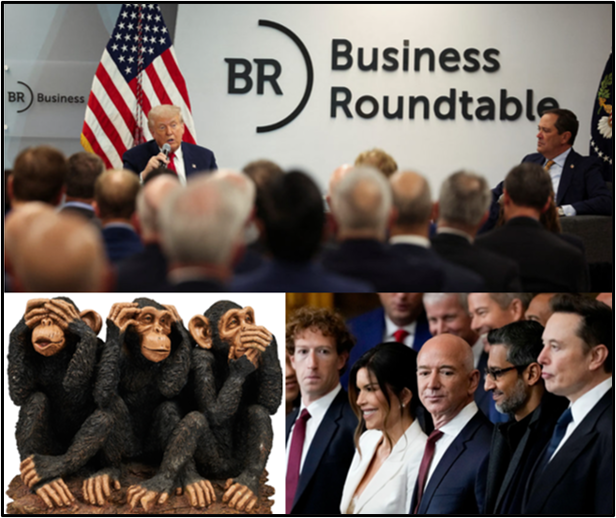
  • The contrast is stark between the response of South African and American elites – so far a crucial subgroup of American elites largely has been missing from action.  

What does it take for a middle group of ambivalent-but-hitherto-acquiescent elites to reset its calculus as to the benefits and costs of inaction, and act accordingly? The American Purpose piece details when, how and why this middle group stepped forward in South Africa.  But in the USA, even in the face of an ongoing, relentless attack on the impersonal, rule-based economic and political institutions that have long underpinned a thriving economy and free, open and (mostly) stable society, a  middle group of corporate elites, wealthy individuals, and right-of-center political insiders has chosen to interpret what is unfolding as politics as usual.  Will this group continue to sleepwalk its way into disaster?

The third proposition locates the USA’s immediate challenge within  a longer time-frame:

  • Breaking the spell is an early step in a much longer journey from rage to renewal – and  what is needed is very different at each phase of the journey.

The USA’s current crisis did not arise from nowhere—any durable reset will require grappling with far-reaching imbalances and frontier challenges that have accumulated over decades. But before any of the deep-seated structural issues can be addressed, the downward spiral needs to end. Keeping the phases of the journey distinct helps clarify –  both analytically and for purposes of  activism – both the  immediate challenges  and what must follow if any initial gains are to prove durable.

Thinking in time is especially crucial  for civic activists. As the fourth proposition highlights:

  • Civic mobilization is key to reshaping the broader societal calculus – especially among ambivalent elites – in a way that  sets in motion a journey of renewal. This will require a ‘big tent’ approach centered around building broad-based alliances.

Addressing economic and social imbalances will not be easy – but for that exploration to be a journey of hope, the spell of a  downward spiral of polarization must first be broken.  Resistance that seeks to  fight fire with fire would almost by definition accelerate polarization, further weaken the center –  and  risk nudging ambivalent elites towards acquiescing to so-called “strongmen” promising stability.  (The Persuasion article illustrates using the example of early 1930s Weimar Germany.)  What is called for from the start – and throughout –  is an inclusive approach to activism, one that skillfully balances urgency and hope.

Fifth, and finally: a critical juncture is fast approaching in the USA:

  • The upcoming USA midterm elections offer a focal point for breaking the spell.

The midterms matter not only as an electoral contest, but as a potential focal point around which expectations, behaviors, and elite calculations can shift. As we have seen in country after country, when those who fuel polarization also control the levers of state power, electoral contestation can all-too-readily be accompanied by an accelerating downward spiral of efforts to  undermine the election – subverting access to the polls, disputing the results, and  fueling street violence. And all of this could culminate in the siren song of a call for decisive state action to restore order.   But (as Hungary’s recent election has revealed) an opposite outcome – an electoral escape route from the downward spiral – is also possible, if  a critical mass of hitherto ambivalent-but-acquiescent elites put their weight behind free and fair midterm electoral processes, and voters go on to decisively repudiate us/them politics.

To be sure,  as South Africa’s difficult experience in recent years reveals,  even after the spell is broken,  many challenges lie ahead.  But South Africa also teaches that first things need to come first. The immediate task is to break the spell of polarization. Across America’s political spectrum, there is a choice to make:  pay the price of letting go of comfortable illusions now—or pay a far greater price later. Which is it to be?

Between South Africa’s frying pan and America’s fire

Fueled by hope, I spent the 2010s travelling back-and-forth between South Africa and the USA, sharing  an optimistic approach to integrating governance and development strategies with mid-career practitioners at both SAIS and the Mandela School. But the subsequent decade unfolded in unexpectedly toxic ways in both countries. It felt important to complement with-the-grain pragmatism with an exploration of underlying challenges. A 2021 co-authored paper explored why things turned rancid in South Africa.  My new paper –  How Inequality and Polarization Interact: America’s Challenges Through a South African Lensalso published by the Carnegie Endowment for International Peace – takes a comparative perspective.  This post lays out five personal take-aways from the comparison. (Here’s a link to the paper’s executive summary).

Take-away #1:  Far more than is the case for contemporary South Africa,  America’s current wounds – increases in inequality since the 1980s, and their attendant social and political correlates –   have been self-inflicted.

Back in the 1970s, I had been  drawn to the USA by its openness, its commitment to freedom, equal dignity and equal justice for all – everything that the South Africa I left behind was not.  With its 1990s ‘rainbow miracle’ transformation from apartheid to constitutional democracy, South Africa became a new  beacon of possibility for people around the world who value democratic governance and inclusive societies. However,  the country’s subsequent reversals were not wholly unexpected. Three decades after the end of apartheid,  South Africa remains among the world’s most unequal countries, and its fraught racial history continues to fester – though the rawness and relative recency of the anti-apartheid struggle perhaps continues to offer some immunization against a further-accelerating downward spiral.   

For the United States, however, the converse may be true. In the decades subsequent to World War II, the combination of an equitably growing economy and a vibrant civil rights movement had fostered the hope of deepening economic and social inclusion. But  beginning in the 1980s, the benefits of growth became increasingly skewed, and  ‘culture wars’ became increasingly virulent. Complacency bred of long stability may have lulled America  into  political recklessness at the inequality-ethnicity intersection – a recklessness that risks plunging the country into disaster.

Take-away #2:  In both South Africa and the USA, the drivers of polarization have been multiple and mutually reinforcing; essentialist explanations that focus narrowly only on a single dimension –  economic, institutional,  cultural or racial  – and ignore the others are, at best, seriously incomplete.

The Carnegie paper distinguishes between polarization’s demand-side and its supply-side.  The demand-side comprises the way citizens engage politically – as shaped by power, by their perceptions of the fairness of economic outcomes, and by whether they frame identity  in inclusive or in us/them ways.  The supply-side comprises political entrepreneurs and the ideas they champion –  ideas about how the world works; ideas about identity. Mutually-reinforcing interactions between the demand- and supply-sides can become increasingly toxic – potentially even to the point of a doom loop that destroys constitutional democracy.

Take-away #3: Both South Africa and the USA need to be more pro-active in renewing economic inclusion  – but  making the shift from an inequality-fueling to an inclusion-supporting economy is less daunting than it might seem.

When considered through the lens of the interaction between inequality and ideas, pro-inclusion policies are less important as ends in themselves than for how they affect the willingness  of citizens to accept the rules of the game (including the distribution of economic outcomes) as broadly legitimate.  As South Africa’s rainbow miracle turnaround in the 1990s and early 2000s shows, a turn from anger to hope does not need a comprehensive package of pro-equity reforms. Rather, reforms that foster “good-enough inclusion”—some immediate gains that signal that things have changed, combined with credible signals that longer-term structural change is underway—can set in motion a virtuous spiral, which can be sustained as long as the momentum of  positive policy change continues to unfold over time.

Take-away #4: The influence of economic elites, though often obscured beneath the headlines,  has been central in both countries – for both good and ill. 

In South Africa, as Alan Hirsch and I explored in depth,  South Africa’s business establishment played a leading role in helping to midwife negotiations between the white minority government and the ANC.  In the USA, organized business was an important part of the elite consensus that fueled three decades of inclusive economic growth subsequent to World War II. In recent decades however, a segment of the elite  has actively financed  political entrepreneurs who have skillfully championed a combination of polarizing cultural discourse and distributionally regressive economic policies. This is a classic example of elite capture, a phenomenon familiar to scholars of comparative politics.  Paralleling what happened in 1980s South Africa, might America’s economic elites wake up to these risks and become more open to inclusive renewal?

Take-away #5: In settings that are open politically, turnaround will be achieved less by directly engaging  polarization’s most toxic champions, than by working around them.

Mass political mobilization was pivotal to South Africa’s shaking loose the shackles of apartheid – and new calls to the barricades might seem to be the obvious response to current political and governmental dysfunction.   However,  different times and different challenges call for different responses.  Currently, both the South African and U.S. governments are, at least aspirationally, committed not to accelerating polarization but to strengthening both inclusion and the institutional foundations of democracy. In such contexts, some compelling research suggests that what is called for is not fighting polarization with more polarization but lowering the temperature by fostering deliberative discourse, focused on positive, hope-evoking options. As happened once before in the USA,  the aim would be for a myriad of collaborative, problem-focused grassroots initiatives  to serve as potential building blocks for  a twenty-first-century social movement– a  movement that views cooperation in pursuit of win-win possibilities not as weakness but as key to the sustainability of thriving, open, and inclusive societies.

Between South Africa’s frying pan and America’s fire

Fueled by hope, I spent the 2010s travelling back-and-forth between South Africa and the USA, sharing  an optimistic approach to integrating governance and development strategies with mid-career practitioners at both SAIS and the Mandela School. But the subsequent decade unfolded in unexpectedly toxic ways in both countries. It felt important to complement with-the-grain pragmatism with an exploration of underlying challenges. A 2021 co-authored paper explored why things turned rancid in South Africa.  My new paper –  How Inequality and Polarization Interact: America’s Challenges Through a South African Lens, also published by the Carnegie Endowment for International Peace – takes a comparative perspective.  This post lays out five personal take-aways from the comparison. (Here’s a link to the paper’s executive summary).

Take-away #1:  Far more than is the case for contemporary South Africa,  America’s current wounds – increases in inequality since the 1980s, and their attendant social and political correlates –   have been self-inflicted.

Back in the 1970s, I had been  drawn to the USA by its openness, its commitment to freedom, equal dignity and equal justice for all – everything that the South Africa I left behind was not.  With its 1990s ‘rainbow miracle’ transformation from apartheid to constitutional democracy, South Africa became a new  beacon of possibility for people around the world who value democratic governance and inclusive societies. However,  the country’s subsequent reversals were not wholly unexpected. Three decades after the end of apartheid,  South Africa remains among the world’s most unequal countries, and its fraught racial history continues to fester – though the rawness and relative recency of the anti-apartheid struggle perhaps continues to offer some immunization against a further-accelerating downward spiral.   

For the United States, however, the converse may be true. In the decades subsequent to World War II, the combination of an equitably growing economy and a vibrant civil rights movement had fostered the hope of deepening economic and social inclusion. But  beginning in the 1980s, the benefits of growth became increasingly skewed, and  ‘culture wars’ became increasingly virulent. Complacency bred of long stability may have lulled America  into  political recklessness at the inequality-ethnicity intersection – a recklessness that risks plunging the country into disaster.

Take-away #2:  In both South Africa and the USA, the drivers of polarization have been multiple and mutually reinforcing; essentialist explanations that focus narrowly only on a single dimension –  economic, institutional,  cultural or racial  – and ignore the others are, at best, seriously incomplete.

The Carnegie paper distinguishes between polarization’s demand-side and its supply-side.  The demand-side comprises the way citizens engage politically – as shaped by power, by their perceptions of the fairness of economic outcomes, and by whether they frame identity  in inclusive or in us/them ways.  The supply-side comprises political entrepreneurs and the ideas they champion –  ideas about how the world works; ideas about identity. Mutually-reinforcing interactions between the demand- and supply-sides can become increasingly toxic – potentially even to the point of a doom loop that destroys constitutional democracy.

Take-away #3: Both South Africa and the USA need to be more pro-active in renewing economic inclusion  – but  making the shift from an inequality-fueling to an inclusion-supporting economy is less daunting than it might seem.

When considered through the lens of the interaction between inequality and ideas, pro-inclusion policies are less important as ends in themselves than for how they affect the willingness  of citizens to accept the rules of the game (including the distribution of economic outcomes) as broadly legitimate.  As South Africa’s rainbow miracle turnaround in the 1990s and early 2000s shows, a turn from anger to hope does not need a comprehensive package of pro-equity reforms. Rather, reforms that foster “good-enough inclusion”—some immediate gains that signal that things have changed, combined with credible signals that longer-term structural change is underway—can set in motion a virtuous spiral, which can be sustained as long as the momentum of  positive policy change continues to unfold over time.

Take-away #4: The influence of economic elites, though often obscured beneath the headlines,  has been central in both countries – for both good and ill. 

In South Africa, as Alan Hirsch and I explored in depth,  South Africa’s business establishment played a leading role in helping to midwife negotiations between the white minority government and the ANC.  In the USA, organized business was an important part of the elite consensus that fueled three decades of inclusive economic growth subsequent to World War II. In recent decades however, a segment of the elite  has actively financed  political entrepreneurs who have skillfully championed a combination of polarizing cultural discourse and distributionally regressive economic policies. This is a classic example of elite capture, a phenomenon familiar to scholars of comparative politics.  Paralleling what happened in 1980s South Africa, might America’s economic elites wake up to these risks and become more open to inclusive renewal?

Take-away #5: In settings that are open politically, turnaround will be achieved less by directly engaging  polarization’s most toxic champions, than by working around them.

Mass political mobilization was pivotal to South Africa’s shaking loose the shackles of apartheid – and new calls to the barricades might seem to be the obvious response to current political and governmental dysfunction.   However,  different times and different challenges call for different responses.  Currently, both the South African and U.S. governments are, at least aspirationally, committed not to accelerating polarization but to strengthening both inclusion and the institutional foundations of democracy. In such contexts, some compelling research suggests that what is called for is not fighting polarization with more polarization but lowering the temperature by fostering deliberative discourse, focused on positive, hope-evoking options. As happened once before in the USA,  the aim would be for a myriad of collaborative, problem-focused grassroots initiatives  to serve as potential building blocks for  a twenty-first-century social movement– a  movement that views cooperation in pursuit of win-win possibilities not as weakness but as key to the sustainability of thriving, open, and inclusive societies.