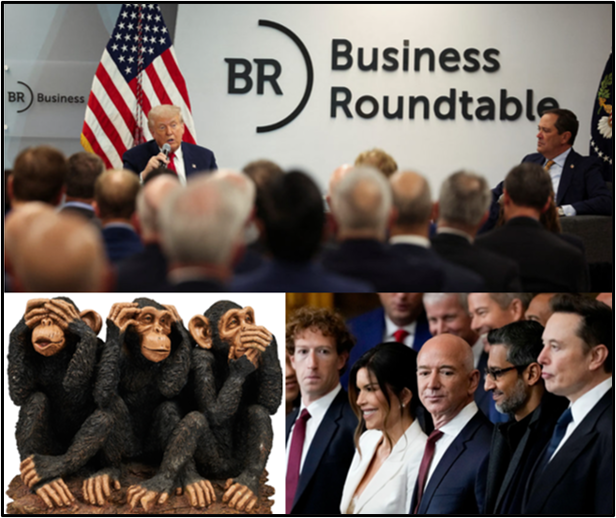
What will it take for business to wake up to the reality that the times no longer call for business as usual – and act before the house burns to the point that its institutional foundations are destroyed? This question is taking on increasing urgency as, day after day, the drumbeat of words and actions heighten concern as to how the Trump administration and its supporters will respond to the prospect of progressively losing power in the upcoming midterm elections and beyond.
This post explores whether organized American business might again come to see itself as having responsibilities that extend beyond defending its immediate interests. Why does the response of organized business matter so much? Because experience elsewhere suggests that resistance alone is unlikely to be decisive in halting an accelerating downward spiral of us/them polarization.
To be sure, resistance is vital in sounding the alarm. Indeed, civic activism has taken hold across the USA – in the courts, in the streets of Minneapolis, in thousands of “No Kings” protests across the USA. But as I explored in a recent article in Persuasion, how things subsequently play out depends crucially on the interplay between civic activism on the one hand and, on the other, the response of a strategically important ‘middle group’ of elites. In Weimar Germany, the corporate sector fueled polarization, and disaster followed. By contrast, in late apartheid South Africa, key segments of the country’s business elite looked squarely at the unfolding reality, reset their calculus as to the benefits and costs of inaction, and acted boldly in ways that helped head off disaster.
While recent decades give cause for concern that the American corporate sector may be sleepwalking into disaster, a longer view (and an eyes-wide-open assessment of where things could lead, and what that might mean for the corporate sector……) offers a perhaps more hopeful perspective. Jacob Hacker and Paul Pierson’s 2017 book, American Amnesia, sets the stage.
A useful place to begin is with their discussion of the Committee for Economic Development.
“Established in 1942, the CED was built to advance big business priorities….. In contrast to other pre-existing business associations, it was not a lobbying organization. Its leaders insisted that while business leaders were prominent in its ranks, it was not even a business organization…..Its internal structure and public pronouncements emphasized the need to find common solutions rather than advance the interests of any particular group….” (p. 141)
This corporatist – business-government-organized labor – ‘power elite’ dynamic continued into the administration of Richard Nixon, described by Hacker and Pierson as “one of the last Republican leaders to embrace the mixed economy.” (p.152)
Subsequently, though, as is evident in the actions of two umbrella business organizations that continue to be linchpins of organized corporate engagement with politics, the preoccupations of organized business narrowed:
“In October 1972, a select group of the nation’s leading CEOs agreed to form a new organization, the Business Roundtable…..Membership was by invitation only; by 1975, the BRT had 160 members, including 70 from the Fortune 100….. The Roundtable had one primary goal: to defend its members from what they saw as a concerted assault on corporate profits and prerogatives… The BRT blamed their difficulties mainly on two easily confronted culprits: the federal government’s expanded regulatory role and the demand of organized labor for more union-friendly policies….” (pp. 202-3)
Hacker and Pierson interpret this narrowing of the business agenda as, in important part, a consequence of- the shift of big business center of gravity from manufacturing to finance.
Turning to the second organization, the U.S. Chamber of Commerce (established back in 1912) was, for a brief period in the 1940s part of the CED-inspired broader corporatist civic culture – but for decades thereafter it was less in the limelight. Reflecting the broad base of its membership (well over 100,000 affiliated businesses in the 1970s), it remained largely in the moderate center. But things changed decisively once a new CEO took over in 1997:
“By all accounts, [the new CEO] Tom Donahue is fairly nonideological…Yet he led the Chamber to a series of increasingly extreme positions and replaced its previous aversion to partisan politics with an intimate collaboration with the Republican Party……..Donahue’s strategy reflects a shrewd adaptation to the new realities of Washington….he calculated that a formula combining policy extremism and open partisanship would attract increased support from the nation’s biggest companies.” (p.218)
Fast forward four decades to 2026 and the consequences of the long narrowing of corporate America’s political vision emerge starkly. The current challenge is of an entirely different order from the short-term, often zero-sum concerns that have dominated corporate engagement with politics for decades. It cuts to core institutional foundations of America’s political economy – but organized business has not yet come up with a response that meets the moment.
On January 25, 2026, the Minnesota Chamber of Commerce posted an open letter (signed by more than 60 leading companies, including CEOs of at least five Fortune 500 companies headquartered in Minneapolis). At first sight, the letter seems like a landmark moment – a return to a more expansive political posture. But a closer reading suggests something less dramatic. As author and Los Angeles Times business columnist Michael Hiltzik observed, while the statement referred to “the recent challenges facing our state” that had caused “widespread disruption and tragic loss of life”, it was strikingly vague about both causes and remedies. It emphasized that business leaders had been “working every day behind the scenes with federal, state and local officials to advance real solutions” and called for an “immediate de-escalation of tensions”. Yet it offered little indication of what those solutions might be, or what actions would bring about de-escalation. Hiltzik’s conclusion was telling: the letter suggested that the tide may be turning, but that corporate America remained reluctant to confront Trump directly.
Hiltzik quotes Jeffrey Sonnenfeld, founder and president of Yale’s Chief Executive Leadership Institute, and perhaps America’s best-connected observer of Fortune 500 CEOs: “The [corporate non-response to ICE raids]……. ‘shows the greatest cowardice in the history of the Business Roundtable,’ says Sonnenfeld, referring to the organization of corporate chief executives that should carry the flag of backlash against Trump’s actions.”
The shortsightedness underlying the silence of the corporate sector is consistent with the decades-long evolution described above, but it startles nonetheless. A central lesson of modern political economy is that the underpinnings of a thriving economy and an inclusive society go way beyond the short-term pre-occupations that currently dominate business concerns. What matters are predictable rules, impersonal law, open markets, and an open political system. Indeed, the centrality of these institutional foundations comprises the core insight that runs through the writings of a phalanx of winners of the Nobel Prize in economics – Douglass North, Oliver Williamson, Daron Acemoglu, Simon Johnson and James Robinson. Economically, impersonal law enables complex contracting, specialization and creative destruction. Politically, open politics – plus a public sector with the capability to respond to broader civic concerns – provides the platform for sustaining legitimacy and social stability, correcting excess before instability takes hold.
All of the above is crucial to the continuing health of America’s private sector, and all of it is now under threat – yet none of it seems to have even registered in the priorities of organized business. Unless this changes, what comes next may yet go down in the annals of history as a perhaps uniquely disastrous example of how pre-occupation with parochial, short-sighted concerns – and a hubristic obliviousness to the larger drivers of prosperity and poverty – can blind elites to their own long-run interests, to the point that they sleepwalk their way into disaster.
Tech titans – including two of the four richest people in the world – take this shortsightedness to another level. Jeff Bezos recently opined that “I think Donald Trump is a more mature, more disciplined version of himself than he was in his first term.” And then there’s Elon Musk, who suggested on the Joe Rogan show that “the fundamental weakness of Western civilization is empathy,.” That worldview was reflected in his approach to the Trump administration’s DOGE reform: “I think we need to delete entire agencies, as opposed to leave part of them behind… If we don’t remove the roots of the weed, then it’s easy for the weed to grow back.” What astounds and sickens is not only the hubris and unconcern for loss of life – but also the apparent obliviousness to the institutional foundations on which modern prosperity depends.
As Fareed Zakaria put it in responding to Bezos, “the starkest difference between Trump 1.0 and Trump 2.0 is not policy. It is enrichment — its scale, its brazenness, its open contempt for restraint.” It remains all-too-likely that this descent into impunity has not yet run its course. Will America’s corporate leadership lift its gaze beyond immediate interests, hubris and shortsightedness, and help avert a continuing downward spiral from crisis to catastrophe?
 WORKING WITH THE GRAIN: Integrating governance and growth
Brian, you’re absolutely right. Grassroots “civic” pushback of the kind Sanders and AOC represent is essential, but some elites need to step up as well. Your Minnesota Chamber example shows how hesitant many still are – too focused on short‑term risk and too afraid of losing contracts or political access. It’s easier to hope the storm passes than to take a principled stand.
There’s a parallel with the U.S. Senate in the 2021 impeachment trial. Seven Republicans voted to convict, but ten more would have been needed. I often wonder how many now regret their votes that day. It felt like a classic collective‑action problem: “What if I vote to convict and the others back out, and I’m the one who gets punished?”
In the U.S. business world, do you see any examples of genuine collective action? The cases you cite – South Africa, Chile, Israel – are all outside the U.S., which is telling. The U.S. Chamber of Commerce doesn’t reflect the broader business community; it has aligned itself with a narrow conservative economic agenda. The US Council on Competitiveness has a much better agenda, but they’ve shrunk since their heyday in the 1990’s and their budget is about 2% the size of the US Chamber. And while I’ve seen some promising efforts at the state level, overall business coordination here seems much weaker than in Europe, where I’ve seen private‑sector coalitions take bold positions.
It’s our cowboy myth of rugged individualism that’s holding us back, I’m afraid. And right now, we’ve got some bad-ass cowboys shooting up the town, but the sheriff has been fired and the townsfolk are too intimidated to shoot back!