LA homelessness: Setting the stage for painful choices – an empirical (re-)framing

In 2023, I began a program of research on some innovative governance arrangements for addressing homelessness that  LA’s political, civic, bureaucratic and private sector leaders put in place as part of a determined effort  to finally come to grips with a long-festering crisis (see here and here).  Over the past two years, the tide of  Los Angeles’  homelessness seemed to turn. However, as highlighted by some extraordinarily forthright and stark presentations  (available here) at a  recent meeting  of one of the new bodies –  the multistakeholder Leadership Table for Regional Homeless Alignment –   new budgetary and economic pressures threaten reversal.

In coming months I plan to track how the  governance arrangements respond to this new trial by fire. This piece (and an accompanying  technical note)  sets the stage for that work by laying out –  from an empirical and ‘technocratic’ rather than a governance perspective –  how I have come to understand LA’s homelessness crisis.  The analysis builds on some recent innovative applications of  systems analysis (here and here)  that  frame  homelessness  as a “flow”, rather than only as a “stock”.  As the systems approach suggests, framing homelessness as a flow both helps surface some perhaps under-recognized aspects of LA’s homelessness challenge, and directs attention to some potentially important questions vis-à-vis the policy response to the new, straitened circumstances.

Figure 1: Homelessness in LA – inflows and outflows (2023)

Source:  Leadership Table

At first sight, Los Angeles’ challenge  seems straightforward: end homelessness for the 70,000 or so people  -roughly  50,000 of whom live on the streets –  identified as homeless in recent iterations of the region’s annual point-in-time (PIT)  count. However, as Figure 1 illustrates for 2023, the PIT count (a “stock”)  captures only a moment in an ongoing and much larger flow: in that year 103,000 people accessed  LA County’s homeless services. [Note that, while the analysis that follows draws principally on data from 2022/23, newly released data reports a 30% (!!!) increase to 133,000 in the number accessing these services in 2024/25.] Between 2020 and 2024, close to 300,000 people (3% of LA County’s population of 10 million) accessed the county’s homeless services at least once.

Viewed through a structural lens, the evidence is compelling that over time the aggregate number of people who enter into homelessness is driven by metropolitan-area level interactions between the cost of housing and income (both wages and safety net support) at the bottom end of the economy. As I summarize here, for many decades LA’s trends have been dismal vis-à-vis both housing and median-and-below wages . However, these structural drivers can only be reversed over the medium- and longer-term. In the near-term, the challenge is to make better use of existing resources.

How,  at a time when the regional economy is turning soft, the safety net is under threat, and funds to combat homelessness are set to contract, might available fiscal resources be more effectively deployed? The empirically-anchored analytical framework laid out in this piece might  hopefully  help address this near-term challenge.

Considered as a flow, homelessness is daunting in its complexity. Multiple drivers  lead to homelessness; there are multiple pathways through homelessness;  and multiple ways to exit. One way to cut through the complexity is to group the challenges posed by homelessness into three distinct ‘clusters’: 

  • Short-term homelessness –  those who enter and then exit homelessness within 6-12 month  (including initiatives to identify and pre-emptively support those most at risk of becoming homeless). 
  • ‘Slippery slope’ homelessness – those who lack/miss the ‘lifeboat’ of early exit and risk a deepening downward spiral.
  • ‘Chronic’ homelessness – those who have lived on the street for long enough and/or have personal vulnerabilities of a kind that render them unable to exit homelessness and live independently without sustained support.

The paragraphs that follow consider each of these, beginning with the last.

Many in LA view homelessness and chronic homelessness as synonymous. As the cluster framework signals,  this view is mistaken – though chronic homelessness indeed comprises the most highly visible aspect of homelessness,  and its magnitude  is large. (As the technical note details, the numbers vary depending on the definition used. According to LAHSA’s highly-granular  definition, in 2024 about 32,000 people were chronically homeless. Other estimates range widely –  from about  20-42,000 –   with the specifics varying according to the definition used.)

Careful micro-level research has shown that “housing first” (more precisely,  the provision of permanent supportive housing)  is the most effective and cost effective way of helping people who have been chronically homeless to live a stably housed life. Perhaps surprisingly to some, in recent years, LA has had an effective large-scale program of placing homeless people into permanent housing – about 20,000 annually, amounting to over 130,000 since 2017.  But permanent housing (especially with the necessary support services) does not come cheap; as of 2025, the LA region was spending well over $300 million annually on its PSH program.  

A central reason why implementing “housing first” is so costly is, of course, LA’s massive undersupply of affordable (and other) housing.  But this undersupply can only be addressed over the medium and longer-term – a narrow focus on “housing first” thus has little to offer vis-à-vis  the urgent immediate challenge of  how  best to deploy scarce fiscal resources to mitigate the damage to come.  Recognizing this brings to the fore   the two earlier stages in the homelessness “flow” –  short-term and slippery-slope homelessness. 

Estimates of the number of people who are homeless only for a short time vary widely. As the technical note details, “stock” estimates derived from the early-2024 PIT count range from 16-26,000, depending on how the cut-off duration is defined. This number is way below the 58,000 that, as per Figure 1, newly accessed homeless services over the course of 2023. [In 2024/25, the number newly accessing homeless services increased to 81,000.] A moment’s reflection will point to the reason for the disconnect –  most short-term homeless enter into and then exit from homelessness between  counts. As the companion technical note explores in detail, for most people  a spell of homelessness is relatively short: about 40% of those who become homeless exit within six months; an  additional 30% or so exit over the subsequent eighteen-month period; and a further 20% over the subsequent three years.  (Note that at the rates of exit just cited, nine out of ten people who become homeless  exit  over the subsequent five years – projecting forward this would imply that of the  60,000 people who became homeless in 2023, about 6,000 would remain so in 2028.)   

For at least three reasons, these seemingly rapid rates of exit should not be mis-interpreted as implying that homelessness is in large part self-correcting, with policy mattering little for how it evolves.  For one thing, the current rapid rates of exit are based on LA’s prevailing ambitious (and fiscally costly) efforts to reduce homelessness. In the coming period, as the presentations to the Leadership Table highlighted, budget cuts will undo a quite substantial part of this effort: entry into homelessness will accelerate;  rates of exit will slow.  For another, the number of people homeless at any point in time is the accumulated  total of those remaining homeless after initially becoming homeless in some prior year.  Increases are likely in the number of people who become newly homeless, the numbers will add up rapidly. Perhaps most fundamentally, the challenges of providing support and facilitating exit are not static –  what all-too-often happens to those who remain on the streets converts crisis into tragedy.  This last  brings us to the third ‘cluster – slippery slope homelessness.

As even casual observation of people living on the street reveals, there is a close association between homelessness and personal vulnerability. The background technical note details this association vis-a-vis  five sets of vulnerabilities: mental health (MH); substance abuse (SA); physical vulnerabilities, and vulnerabilities associated with prior experience  of prior foster care or incarceration.  As detailed there, an estimated 57% of an entering homeless cohort have at least one of the five vulnerabilities;  43% have none. (Note that while the impact of economic vulnerability is not analyzed directly, its role is implicit in the relatively  large share of  ‘none of the above’. )

Figure 2: Mental health and substance abuse among a (representative)  100 person homeless cohort  – change over  the course of  three years.

Crucially for policy, as Figure 2 above illustrates,  the homelessness-vulnerability association is not static  – the incidence of vulnerabilities among the continuing-homeless cohort changes with the passage of time. Why? Because mental health and substance abuse are both causes and consequences of homelessness.   Figure 2  provides specific estimates of the magnitudes by which  MH/SA challenges compound as a result of homelessness. (See the background note for details on how these “flow” parameters were estimated.) Forty of a representative cohort of  100 homeless people  had struggled with MH/SA issues prior to becoming homeless; for 17 of the 40, symptoms become more complex over the course of three homeless years. Even starker are the trends  among the 60 people who entered homelessness with no MH/SA challenges: After three years of homelessness, 35 of the 60 have MH/SA symptoms, including 12  who wrestle with complex MH/SA challenges.

Stepping back from the details, how might the three-cluster framework help address some urgent, looming policy challenges confronting LA’s efforts to address homelessness? At its recent meeting, the Leadership Table was put on notice that in the coming year, spending to address homelessness would need to be cut by about one-third (!!), even as the number of people becoming newly homeless would continue to rise. An obvious first step is to look for efficiency gains – how well are resources being used to deliver on programs already underway? But belt-tightening can only go so far. When the required cuts are large, attention also needs to be given to effectiveness – are we doing the right things? The three-cluster framework potentially offers some insights vis-à-vis the latter question.

Viewed as a “stock” the policy challenge is seemingly the relatively straightforward one of reducing numbers, with each person newly-housed (via, say, “housing first”) moving things closer to the goal, with priority for the chronically homeless. By contrast, viewing homelessness as a flow directs attention to the ‘short-term’ and ‘slippery-slope’ clusters –  and thus to the value of intervening  as early as possible in a person’s homelessness journey – the earlier the exit from homelessness, the lower are its personal, fiscal and social costs.   

Considering priorities through this latter lens, a variety of questions arise:   Are there cost effective ways of forestalling homelessness for those who are at greatest risk?    What facilitates rapid exit from homelessness?  For those for whom homelessness has begun to take hold, what can be done to reduce the risk of journeying all the way down the slippery slide to disaster?  

None of the above questions are new to those who have long labored to reduce homelessness.  Even so, at this moment of fiscal stringency when it is urgent to look again at how resources are being used, perhaps the empirical lens laid out in this note contributes in a small way to taking a more expansive view of the options available –  one that not only focuses on how to minimize damage to ongoing programs but also assesses comparatively  the cost effectiveness of a broad range of possibilities for  addressing our region’s homelessness crisis.

From crisis to renewal? Affordable housing and homelessness in Los Angeles

In dark times, I take inspiration from the great social scientist Albert Hirschman’s commitment to  the search for ‘a bias for hope’, for  “avenues of escape from exaggerated notions of absolute obstacles…. avenues in  which the inventiveness of history  and a ‘passion for the possible’ are admitted as vital actors”. Viewed from this perspective, the point of departure for effective action is not some idealized vision of how things should be, but  clarity  as to how things actually are – with this clarity providing the basis for a search for practical entry points capable of setting far-reaching cumulative change in motion.  This passion for the possible has inspired my research and practice for almost a half century; it is the guiding spirit of a new  cycle of research on the Los Angeles’ region’s twin crises of homelessness and scarcity of affordable housing (AHHLA)  that I introduce in this piece.

Los Angeles’ AHHLA crisis startles. LA County is among the world’s affluent locales, with a  2023 per capita income of over $78,000, well above the American average. Yet that same year about 55,000 people were living on LA’s streets, and over 30,000 of them had been there for more than one year.  Even more startling, every year about 60,000 people become newly homeless –  a cumulative total over five years of almost 3 percent of LA County’s population of 10 million.  For those who live in Los Angeles (among whom, having moved here in 2023, I now count myself) the AHHLA crisis is existential. But its significance goes beyond the local.

As recent books by Ezra Klein and Derek Thompson (2025) and Marc Dunkelman (2025) explore in depth, a broad national reckoning is underway to assess both how failures of progressive governance contributed to the rise of toxic populism, and what might be the contours of a renewed and effective progressivism.  AHHLA is ground zero of this broader crisis of contemporary American progressivism. In what ways did decades of progressive good intentions gone wrong fuel LA’s current crisis? Are there hopeful lessons to be learned from recent efforts to address AHHLA about how progressive approaches to governance can become part of the solution?

Here, to set the stage for addressing the above questions,  is AHHLA’s economic backdrop:

  • Over the past four decades, even as the affluent have thrived,  earnings have been stagnant for the poorer half of LA’s population. As of the early 2020s, 16.6 percent of LA residents lived below baseline (rent-adjusted) measures of absolute poverty – the highest percentage among California’s regions. (California is the state with the highest percentage in the USA.) In the absence of the public safety net, the LA percentage would be 26%.
  • Beginning in the 1990s, a combination of population growth, the end of the extensive margin and slow growth environmentalism/NIMBYism has resulted in an increasingly severe shortage of housing. Between 1960 and 1990, about  200,000 housing units were built each decade; between 1990 and 2020,  the decadal average was below 75,000 units. In 2023, 45 percent of the households that earn below LA County’s median income paid more than half their income in rent.
  • The unit costs of building publicly-subsidized affordable housing in Los Angeles are almost two and a half times the equivalent costs in Colorado and Texas; startlingly, within LA the total development costs per square foot are 50 percent higher for publicly-subsidized  than for unsubsidized, market rate housing built for private (self-pay) buyers.

Considered together, the combination of stagnant incomes, rising unit costs and a near cessation of new housing construction (except at the more affluent end of the market) was to make accommodation increasingly unaffordable for lower-income Angelenos. In important part, and as per the title of an influential book, Homelessness is a Housing Problem. More on all of this in coming weeks and months.

LA’s fragmented  governance arrangements have enabled the AHHLA crisis to fester. This fragmentation  is especially ill-suited to addressing homelessness – a multi-faceted ‘wicked’ problem  that calls for a multi-sectoral, multi-jurisdictional and multistakeholder  response. The roots of LA’s fragmented governance can be traced back (at least in part; racial ‘redlining’ also played a role….) to a century-long aspiration to avoid centralized, urban machine politics and cultivate instead more localized, small-town-like governance.  Some tasks are the responsibility of LA County government, and others are diffused among the County’s 88 municipalities, of which the City of LA (with a population of four million) is the largest. This fragmentation has been exacerbated by deepening commitment over the past half-century to open, often legally-mandated public deliberative processes in advance of any action, which further complicates local government’s decision-making.  

Moving towards more top-down governance (of varying degrees of draconianism) offers one possible response to fragmentation.  But widening the distance between citizens and local government risks worsening what already is a crisis of civic alienation from government in many countries (not least of which the USA) the world over. Might there be a third way, one that finesses the traps of top-down governance accompanied by citizen alienation, or civic participation plus ineffectual governance? 

In recent conceptual work (see here for an introductory overview), I have explored the potential and limits of this third way. The articles delineate three distinct channels through which ‘socially-embedded’ approaches to public governance might simultaneously  counter fragmentation, encourage participation  and enhance effectiveness:

  • A collective effort to enhance clarity as to goals;
  • Streamlined, transparent  and participatory approaches to performance monitoring; and
  • Collaborative, multistakeholder arrangements for service provision.

Recent initiatives in LA to reduce homelessness incorporate all three channels. Why these initiatives were adopted,, and whether they will continue to unfold in ways that contribute to reducing homelessness is the focus of an ongoing research project in collaboration with  the University of Southern California’s Professor Yan Tang (an eminent scholar in the tradition of Elinor Ostrom’s work on collective action). As our research will explore, one key to success is whether the protagonists in the LA efforts will be able to craft a credible way of sharing gains and burdens within a framework that can advance the collective interest. What follows will hopefully whet the reader’s appetite for the research project.  

Strikingly, at least since the early 2010s,  momentum for scaling-up and reshaping how LA responds to its homelessness crisis has come less from government than from civil society. The efforts have unfolded in two phases. In a first phase, political and civic leaders championed a series of ballot measures that successfully raised billions of dollars to address AHHLA. However, by the late 2010s, there was a dawning realization that the magnitude of the challenge went way beyond earlier perceptions. Not only was further financing required, effectively addressing the twin crises called for better  co-operation among multiple stakeholders – something that the region’s fragmented institutions were not well placed to achieve.  A 2021 report commissioned by civil society champions took stock of the governance challenges, and proposed a menu of reforms. Partly in response to this report, Los Angeles County’s Board of Supervisors  established a Blue Ribbon Commission on Homelessness Governance  and subsequently adopted its recommendations.

Since mid-2024, there has been an extraordinary burst of energy and  reform aimed at aligning LA’s multiple stakeholders  around a coherent governance platform for reducing homelessness. Major initiatives include:

  • The creation by LA County’s Board of Supervisors of a robust, formally-empowered multistakeholder platform, with a mandate to “help align the region’s approach to homelessness and provide critical accountability and oversight to ensure more meaningful results”.  
  • The  development and official adoption of specific, measurable targets for reducing  homelessness.  
  • The initiation of work by  the Los Angeles County Affordable Housing Solutions Agency (LACAHSA), established in a 2022 resolution of the California State Senate to increase the availability and affordability of housing in LA.
  • A radical restructuring (currently at an early stage, but on an accelerated timetable)  of the lead public  LA County and City agencies responsible for overseeing and implementing the LA region’s response.
  • A new effort to specify performance standards for each of the many elements that go into the homelessness response – as a necessary basis for both resource allocation and accountability.

The hope is that the above initiatives will together finally provide the coherence and momentum needed to make real inroads into  homelessness – and thereby  break a longstanding corrosive cycle of overpromising and then underdelivering.  Whether this will happen remains uncertain,  but if it does  LA could go from being seen as a notorious example of the failure of well-intentioned progressivism to effectively address urgent social challenges, to  becoming an exemplar of a renewed, legitimate and effective 21st century progressivism. What happens next thus matters well beyond LA itself.  Watch this space for further updates. 

The public domain and the quest for renewal

Changing times bring changing questions. For decades, my work has focused on incremental ways to improve development and governance  in the midst of messiness. Now, though, in many countries these are times of decay and rage.  When and how the fever will break is unknowable. So for now I choose to look beyond incrementalism  and explore the broader challenge of better understanding – and fostering – renewal.

In exploring renewal, I take inspiration from the work of the great twentieth century social scientist Albert Hirschman. (See here,  here and here.) Hirschman   identified  three distinct phases in a (repeating) cycle of political, social and economic change:  a phase of vibrancy, underpinned by hope;  a phase of disillusion, anger and conflict; followed (if a continually deepening downward spiral can be averted) by  a phase of renewal. In  recent papers, I explored how this Hirschman cycle has played out in recent decades in South Africa and in  the USA. In both countries, the cycle was driven by changes in two sets of  perceptions – in the tolerance for inequality, and in perceptions as to the legitimacy of the public domain. Citizens  have become increasingly skeptical as to the public sector’s effectiveness, and increasingly question whether the purposes the public sector pursues are ones for which it has a mandate, and are in the national interest. 

My new research, introduced in this post,  focuses on the ways in which interactions between citizens and the public sector shape perceptions of legitimacy – in particular whether  “socially-embedded bureaucracy” might help turn around disillusion with the public domain.  As defined here (and elaborated in this accompanying paper)  a socially-embedded bureaucracy (SEB) is characterized by:   

“problem-focused relationships of co-operation between staff within public bureaucracies and stakeholders outside of government, including governance arrangements  that support such co-operation”.   

At least on the surface, initiatives that strengthen SEB seemingly have the potential to help renew the legitimacy of the public domain by cultivating trust – and thereby reinvigorate society’s capacity to  achieve win-win outcomes to mixed motive bargaining challenges – not only at the micro-level, but systemically as well.  

Notwithstanding its surface plausibility, the case for championing SEB is far from open-and-shut.  On the one hand, among protagonists of SEB, enthusiasm all-too-easily outruns both the empirical evidence and conceptual clarity. On the other, SEB is inconsistent with mainstream conceptions of public sector governance; as a result  its potential is all-too-easily dismissed.  My new work  aims to help put the empirical and (especially) conceptual platform of SEB discourse on a sounder footing. The work addresses two inter-related questions:

  • At the micro-level: Can SEB help improve public sector performance?
  • At the systemic level: Insofar as SEB indeed can help improve public sector performance, might it also transform perceptions more broadly, and in particular help renew the perceived legitimacy of the public domain?

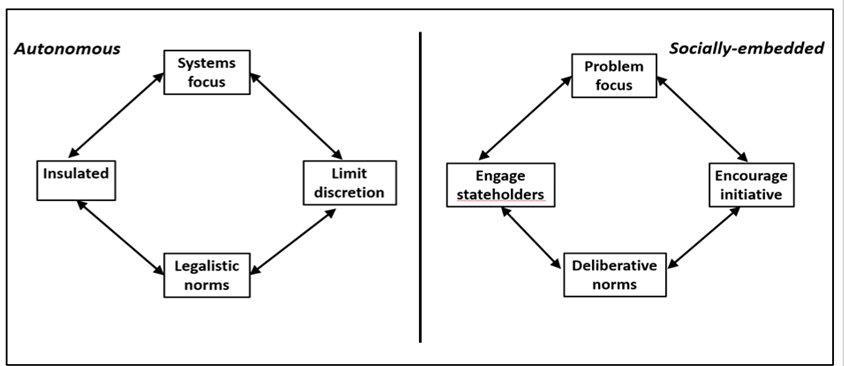
To begin with the micro-level,  as the figure below highlights, the contrast is stark between SEB and conventional notions of  how public bureaucracies should be governed.  In the conventional view, governance is organized hierarchically, with a focus on ‘getting the systems right’  Citizens engage upstream in the chain via their selection of political representatives who oversee both policymaking and implementation. The tasks of public officials are defined by legalistic, rule-bound processes, which also insulate public bureaucracy from political interference. Civil society’s  governance role is to bring pressure from the demand-side to help ‘hold government to account’.  By contrast, SEB is problem- rather than systems-oriented; it incorporates horizontal as well as hierarchical governance arrangements; interactions (both within the bureaucracy and at the interface with civil society) are less legalistic and more adaptive, oriented towards  deliberation and fostering initiative.

These distinctive characteristics potentially enable SEB to improve public sector performance via three channels which are unavailable to insulated bureaucratic hierarchies:

  • SEBs potentially can foster synergistic gains from co-operation between public bureaucracies and non-governmental actors;
  • SEBs potentially can  transform the governance arrangements for monitoring and enforcement from a morass of red tape to trust-building interactions between public officials and service recipients; and
  • SEB potentially supports developmental alliances among reform-oriented public officials and civil society actors – thereby enabling an unambiguous focus on the (developmental) public purpose, while obviating the risk of capture.  

(See the accompanying ‘microfoundations’  paper for more details.)

The above is not intended to imply that SEB necessarily is superior. Social embeddedness risks  adding messiness in contexts where the priority task is to enhance bureaucratic coherence; it risks enabling new modes of predatory capture of public resources. But, as recent syntheses of the empirical evidence underscore, it does suggest that it is, at the least,  premature to be dismissive of SEB’s possibilities. Don’t risk throwing out the baby with the bathwater.

At the systemic-level,  a very different (and again controversial) case for SEB emerges. As the background paper explores, social learning and an associated cultivation of ‘pro-sociality’ is central to the micro-level argument. Might such learning  cascade upwards to the systemic level, and  help buttress citizens’ perceptions of the legitimacy of the public domain? Answering this question calls for careful unbundling of interactions between public effectiveness, trust, trustworthiness, social cohesion and legitimacy  – a task I will take on in a subsequent blog (and accompanying background paper).   For now, what can suffice to make the key point is to contrast two contributions, fifteen years apart, by Margaret Levi, former president of the American Political Science Association.

In 2007, Levi (with co-authors Karen Cook and Russell Hardin) argued that  a pre-occupation with relationships of  trust between civil society and public bureaucracy is at best a distraction – and  at worst a way of weakening rule-boundedness and increasing the risk of capture. Their critique is captured vividly in the title of their  book, Co-operation Without Trust.  Championing institutionalism, they determinedly push back against a too-easy extrapolation from micro-level success stories of co-operation to the systemic level:

“When we are assessing the reliability of governments and politicians, what we ultimately put our confidence in is the quality of the institutional arrangements within which they operate…. At the personal level, relational trust makes our day-to-day lives richer and more manageable. More often, however, and in many varied contexts, we co-operate without trust.”

The above argument is eminently plausible in contexts where institutions are strong and stable. It holds up less well, however, in contexts where a downward spiral of accelerating distrust in the public domain is underway, with institutions increasingly under threat. For one thing, institutional guardrails have turned out to be more fragile than many (myself included) might have hoped. Further, as I explore in a forthcoming paper with South African civil society activist Mark Heywood,  in contexts of declining state capability a pre-occupation with ‘holding  government to account’ can have the unintended consequence of making public officials feel increasingly beleaguered and reluctant to experiment, while fueling civic disillusion.

Once disillusion and institutional decay have taken hold, the necessary first step in fostering reversal is not yet-another -round of institutional engineering, but rather to find ways to renew hope in the possibility and desirability of achieving collective gains through co-operation,. In that spirit, and in contrast to the 2007 book, here is what Levi and Zachary Ugolnik argued in  2023 in the lead article of an ambitious 2023 exploration of pathways to “creating a new moral political economy”

“A new moral political economy….[will be centered around]….some form of sociality and cooperation….It demands attention to the governance arrangements that facilitate, even generate, prosocial behavior”.

There are, to be sure,  many ways to foster pro-sociality that have little to do with the interface between public officials and non-governmental actors; nothing in Levi and Ugolnik’s  2023 argument makes an explicit case for SEB. But, especially in light of the micro-level positive potential of SEB,  the notion that sustained efforts to foster pro-sociality  at micro-level might cascade upwards into systemic change should,  at the very least, not be dismissed out of hand. At the systemic level, too,   it is premature to throw out the proverbial baby with the bathwater.

Finally, returning to the two questions posed earlier, insofar as the answer to both is “yes” – “yes, SEB improves public sector effectiveness” and “yes, SEB can also buttress systemic-level legitimacy” – a third question naturally arises: Might problem-level SEB provide a platform for a systemic-level transformation of the interface between citizens and public officials? Here (as a prelude to further work, some already underway…..) are four places where one might look for answers:

  • Bottom-up: The accretion of experience and learning at the problem-level might inspire others to initiate similar initiatives. Over time, multiple small initiatives might add up to more than the sum of their parts, with  a new set of ideas, offering a new vision of what is possible, taking hold. (I plan to explore this via a new round of empirical research, focused on responses to the twin affordable housing and homelessness  crises in Los Angeles County.)
  • Inside-out: Fostering deliberation and SEB within bureaucracies by championing changes in overly-rigid and overly-hierarchical rules, and in organizational culture. (Efforts to foster relational governance within the rigidly hierarchical bureaucracy of South Africa’s Western Cape province comprises an intriguing example.)
  • Outside-in: While some civil society activists might respond skeptically to SEB as counter to a perceived mission of holding government to account, others might shift from a confrontational to a more co-operative vision, centered around building cross-cutting problem-solving-oriented coalitions, including with reform-minded public officials. (The forthcoming paper  with Mark Heywood explores this possibility.)
  • Top-down – via political and social mobilization, with  micro-level SEB successes preparing the ground  for new transformational acts of both social and political leadership. 

Might forward-looking political leaders embrace an electoral and governance platform centered around a vision of partnership between the public sector and non-governmental actors?  And what are the prospects for myriad concrete, deliberative and problem-focused civil society initiatives serving as potential building blocks for a broader social movement?  Mobilization centered around deliberative problem-solving would be a radical departure from contemporary pressure-cooker discourses which thrive on raising rather than reducing the temperature. But, as Robert Putnam explored in his 2020 book, The Upswing,  it has happened before, and might happen again:

“A distinct feature of the Progressive Era was the translation of outrage and moral awakening into active citizenship…Progressive Era innovations were a response – seeking to reclaim individuals’ agency and reinvigorate democratic citizenship as the only reliable antidotes to overwhelming anxiety……[Similarly], our current problems are mutually reinforcing. Rather than siloed reform efforts, an upswing will require ‘immense collaboration’,  [leveraging] the latent power of collective action not just to protest, but to rebuild….”

There is work to be done………….

Clear seeing

L_ Superior SunriseHow  can we contribute to a renewal of political discourse? A large hazard for 2016 is that we end up countering  anger, false certainty and hatred with their mirror image, and in so doing fuel a downward spiral. Clear seeing as to the way things actually are offers an antidote to these Gramscian ‘morbid symptoms.

Late last year, spurred on by the truly appalling tone of discourse in the Republican Party’s nomination contest, I wrote three United States-centric blog posts on the ways in which we talk about government. Each of the posts explored one aspect of the theme:

The first post explored the Great-Gatsby-like carelessness of the discourse: “….careless people….. who smashed up things and creatures and then retreated back into their money or their vast carelessness or whatever it was that kept them together, and let other people clean up the mess they had made.”

The second post used the example of the Washington DC Metro to show how carelessness can undermine the performance of public agencies. It described the ways in which  a combination of hubris and inattention resulted in a downward spiral of dysfunction – and offered some thoughts as to how this might be turned around.

The third post used the example of Obamacare to expose the “good governance high standards shuffle” – in which superficially appealing benchmarks of perfection are used cynically to undermine any sense that government can contribute to the public good, even when real gains have been achieved.

(In case you’re interested in a parallel exploration in a different context, in a set of posts earlier in 2015 I detailed how South Africa’s sour, conflict-prone discourse seemingly is destroying Nelson Mandela’s remarkable example of reconciliation and leadership.)

Antonio Gramsci’s famous quote from his Prison Notebooks, written in the 1930s when he was imprisoned by Mussolini’s fascist regime, captures perfectly what seems to be happening in so many parts of our contemporary world:

The crisis consists precisely in the fact that the old is dying and the new cannot be born; in this inter-regnum a great variety of morbid symptoms appear.”

In 2016, may the wisdom that comes from the effort to see clearly help us to turn away from anger and polarization, and thereby renew the possibility of looking to the future with hope, rather than recrimination and despair.

Washington’s Metro — The Costs of Carelessness (WWG implementation series #4)

District of Columbia Fire and Emergency workers at the site of a rush-hour collision between two Metro transit trains in northeast Washington, D.C. Monday, June 22, 2009. (AP Photo/Pablo Martinez Monsivais)

District of Columbia Fire and Emergency workers at the site of a rush-hour collision between two Metro transit trains in northeast Washington, D.C. Monday, June 22, 2009. (AP Photo/Pablo Martinez Monsivais)

For those who are so disposed, finding instances of government dysfunction can be like shooting fish in a barrel. But the resulting back-and-forth cycle of blame, defensiveness and recrimination can be a dangerous distraction from the crucial task of  getting public agencies that play a central role in our daily lives to work better. Take the example of Washington’s Metro.

Each year, as part of my teaching at Johns Hopkins School of Advanced International Studies, I select a ‘live’ example of the challenge of public management. This year, Washington’s Metro seemed to be a good case to choose — barely a week has gone by without one or another crisis of Metro management making it into the headlines.

The Metro case demonstrates vividly the costs of carelessness in our discourse about government. (In a complementary blog post, I drill more deeply into how this ‘Great Gatsby’ government discourse works. ) But it also points to a possible way forward — how  a combination of public entrepreneurship and  active citizenship potentially can be leveraged to foster a sustainable turnaround of performance. (For additional detail on the recent Metro experience, here is a link to an article published in the Washingtonian, a few days after I taught the case at SAIS.)

In the beginning, Metro looked like a success story. It opened its doors to passengers in 1976; its 117 miles of track, over 215 million trips per year (and up-front $9.3 billion capital investment) made it the second largest system in the United States. Washingtonians came to expect a streamlined, comfortable, reliable, and aesthetically pleasing commute. In 1987 and again in 1997, the Washington Metropolitan Area Transit Authority won ‘Outstanding Achievement’ awards from the American Public Transportation Association.

But beneath this success something else was incubating.  By 2001, the key management tasks had become routine operational ones – but Metro’s long-time (1996-2006) general manager, Richard White, was not one to sweat the details. “He was a frequent visitor on Capitol Hill…He drove to work….He was part of the regional dialogue about highways and land use and everything else….[he] didn’t spend much time mingling with the rank and file”. The system began to decay. In 2006, the Metro board terminated his contract, three years early.

Then followed an accelerating downward spiral of deteriorating performance in the management of both financial and safety systems:

  • A 2008 internal audit report raised the red flag on poor controls. Richard Sarles (general manager from 2010 to end-2014) reported that “Metro had poor financial controls when he arrived in 2010 and that he had been working to improve them”. (WP 6/7/15).
  • In 2009, two trains collided, killing nine people, and injuring 80. “What you’re finding, when you look behind the curtain, is that there’s been a lot of neglect to safety priorities coming out of accidents,” said Kitty Higgins, a former member of the National Transportation Safety Board to a Washington Post team investigating the accident. “It really is disheartening.”
  • A 2014 audit by the Federal Transit Administration reported extensive safety concerns, including: understaffing in the central Metro train control center (only 34 of 54 authorized positions were filled; those in position enjoyed massive overtime payments); shortages in keeping maintenance materials in stock (so, for three months, replacement brake pads were cannibalized from out-of-service trains); and the non-repair of tunnel ventilation systems (two fans in Metros deepest tunnel location were out of operation for more than six months awaiting repair). It also found “extensive grant-related mismanagement that had gone on for several years”.
  • In January 2015, passengers were left stranded for a half-hour as their train and tunnel filled with smoke, and Metro officials were paralyzed with indecision as to what to do, resulting in one death.
  • The track defect that caused an August 2015 derailment (no one was injured this time) had been identified as an urgent problem in a safety inspection a month earlier, but with no follow-up. Metro’s chief safety officer resigned a month later.

Underlying these performance shortfalls were weaknesses in governance. Four jurisdictions (the District of Columbia; the states of Maryland and Virginia; and the Federal government) plus multiple sub-jurisdictions all have oversight responsibility for Metro, and are allocated seats on the Metro board of directors. Governance by multiple principals is messy; but it mirrors the spatial geography of Washington’s capital city. However, the consequence has been that none of the jurisdictions has taken a broad strategic view of the organization’s challenge.

Board members focused disproportionately on narrower concerns that are of interest to their constituents: where bus stops would be located; operating and closing times; caps on fee increases in the face of revenue shortfalls. Financial oversight also has been shortsighted. In response to the 2014 audit findings of shortfalls in Metro’s financial management, the FTA imposed new layers of restrictions on Metro’s access to federal funds. Punishing a system in the midst of a downward spiral for its continuing shortfalls might offer some satisfaction for ideologically-inclined politicians – but it also is an almost certain recipe for accelerating the decline.

What, then, is to be done? In the short-to-medium-term there is room for optimism that things will turn around. The attention of the Board (and the areas’ politicians) is there. A new CEO has been appointed. The immediate task, though formidable, seems clear: rebuild confidence in the operation – and renew its mandate and finances.

But how to ensure that the cycle described above – rising confidence, de facto autonomy, and then a slide into dysfunction — doesn’t repeat itself? Key, I would argue, is to look again at how we think about the boundary between the spheres of bureaucracy, of politics, and of civil society. Our standard narrative is Weberian, and extols the virtues of an ‘insulated’ bureaucracy. However, as the experience of the latter 1990s onwards underscores, a lack of insulation from pressure for performance has hardly been Metro’s problem.

The past two years have seen a rise in public focus on Metro.  Coverage by Washington’s media has been forthright, detailed. Metro’s riders, too, have increasingly been on the case. A variety of activist groups of Metro riders have been formed. In October 2015 these came together to form the Washington Metro Riders Union. Viewed through the lens of bureaucratic insulation, journalism, social media and civic activism might seem to be noise in the system. But, as Daniel Carpenter has highlighted, high-performing American public sector organizations took root

“…. not at the expense of democratic participation but in a symbiotic relationship with it….….grounded in multiple networks through which agency entrepreneurs can build program coalitions around the policies they favor….. At their strongest, these ties cut across the established lines of class, partisanship and ideology…and enable officials to ground their agency’s reputation in a broader embedment in society.…. The [contemporary] challenge of American statebuilding may be to reengage state bureaucracies with the very civic organizations and social networks in which they once flourished.”

Robert Putnam makes a similar point in his classic 2000 book, Bowling Alone. “American democracy”, he argued:

 “….evolved historically in an environment unusually rich in social capital….. A politics without face-to-face socializing and organizing….would be heard as a muddle of disembodied voices….. Just as one cannot restart a heart with one’s remote control, one cannot jump-start citizenship without direct, face-to-face participation. Citizenship is not a spectator sport.”

Encouragingly, in his first day on the job, Metro’s newly appointed General Manager, Paul Wiedefeld, went on a listening tour among stakeholders – including a commitment to meet with the Riders Union. Is it really too much to hope that in America’s capital city, a city where more words are spoken in praise of democracy than almost anywhere else on earth, public discourse need not be a toxic battleground – but that instead an activated media and citizenry could become an integral part of the fabric of active, effective governance?


Public sector governance — what we (choose to) see shapes what we get….

storm-rainbowDiscourses on public sector governance, in South Africa and elsewhere, illustrate powerfully the insight of behavioral psychologists that ‘framing’ matters. If our framing is inconsistent with the way things actually are, we are doomed to disappointment and unhappiness. But frame in a way that responds to reality, and opportunities abound for active, worthwhile engagement.

South Africa’s daily headlines and frustrations dispirit – from electricity blackouts, to corruption in the procurement of railway engines (including allegations that the engines purchased did not match the specifications of South Africa’s railway system); to reports that neglect of maintenance could lead to the collapse of water utilities in over half the country’s utilities; and that teaching jobs can be bought (including via threats of violence to ensure that a desired position becomes vacant).

As of 2014, only 34 percent of the country’s citizens reported that they had confidence in their government, down from 66 percent in 2007. While the country is hardly alone in its lurch into pessimism (on average, as of 2014, only 40 percent of citizens in countries the club of high-income democracies, the OECD, had trust in their governments), South Africa’s decline in confidence is among the most rapid anywhere. In a complementary blog post I explore how the country’s current extraordinarily sour, conflict-prone public discourse has its roots in economic and psychological deformations inherited from the apartheid era. This post focuses narrowly on public sector governance.

Notwithstanding the evident challenges, might pessimism about the performance of South Africa’s public sector be overdone? Without wishing away the challenges, might there be alternative ways of framing that point towards creative entry points for strengthening public sector performance?

To answer these questions, it is helpful to disentangle two arguments that often are conflated:

  • that a predatory political leadership can provoke a downward spiral into disaster; and
  • that good governance is necessary for development.

The first argument is straightforward — and, as recent dark prophecies emphasize, all too plausible for South Africa. (I will return to it at the end of this post.) But the broader ‘good governance’ argument does not withstand scrutiny — either empirically or conceptually.

Consider first South Africa’s empirical track record. Aggregate indicators indeed show that government effectiveness in South Africa rates well below high-income countries, with substantial decline between 1996 and 2014. Even so, as shown in the accompanying table of  South Africa’s comparative governance relative to other middle-income countries, as of 2014 South Africa’s government effectiveness rated at the high-end for relevant comparators — on a par with Mexico and Turkey, and well above Brazil and Thailand. In a recent paper for the DFID-funded and University of Manchester led Effective States and Inclusive Development (ESID) research programme, Alan Hirsch, Ingrid Woolard and I documented major gains between 1994 and 2010 in the provision of public services to the poorest 40 percent of the country’s population. And, to further confound the drumbeat of daily headlines, here are some recent examples of public sector effectiveness:

  • The successful procurement from independent power providers of well over 5,000MW of renewable (wind and solar) electricity generation capacity between 2011 and 2013, an investment of over US$15 billion, with very large declines in unit prices over four rounds of competitive bidding (e.g. for solar, from from $0.35c/kilowatt hour in the first round to under 8c/kwh in round four)   – transforming South Africa from a laggard to a leader globally.
  • The leveraging of the Expanded Public Works Programme  to create over one million work opportunities in 2014 (the equivalent of about 400,000 low-income jobs) and to integrate these into ongoing programmes of support for the social sectors (in Limpopo), for rehabilitation and maintenance of rural roads (in the Eastern Cape) and for environmental rehabilitation (via, for example, the internationally renowned Working for Water, Working on Fire, and Working for Wetlands programmes).
  • Ongoing gains in the outcomes of basic education in some provinces (e.g. the Free State), and persistent examples of high-performing public schools even in provinces (such as the Eastern Cape) where the broader environment for educational performance remains weak.
  • High-quality, proactive regional economic development strategies in both of South Africa’s two leading regional economic hubs – the Western Cape and Gauteng. And
  • A four-fold increase between 2009 and 2012 in the number of people receiving anti-retroviral therapy – with over 2 million people receiving life-saving anti-retroviral medications in 2012, delivered through a supply chain that reaches effectively into the most remote parts of the country, and alongside interventions that successfully have lowered rates of HIV-prevalence.

Why, given these results, is the tone of the discourse so unrelievedly negative? Part of the reason is that most South Africans (whether of the political left or right) implicitly conceive of the public sector in top-down, hierarchical terms. Good leaders get the policies right, and then direct the bureaucracy to deliver. Viewed through this lens, all is either won or lost at the top of the hierarchy – ‘a fish rots from the head down’ in the reigning metaphor.

More broadly, the ‘good governance’ paradigm implicitly frames public performance as ‘all’ or ‘nothing’, with little scope for shades of gray. However, as recent landmark contributions by Francis Fukuyama and Douglass North underscore, this pre-occupation with good governance is inconsistent both with the evidence of how results are achieved in many developing countries, and with the historical record of all contemporary high-income countries. (Note, though, that as I explore in an accompanying blog post it can, for some, have a paradoxical ideological function — a seeming embrace of ‘good governance’ can, for those on the political right, offer a marvelous opportunity for ‘crocodile tears’, for seeming to wish that government can do better, but then sorrowfully concluding that it cannot.)

Letting go of a narrowly, top-down framing of how the public sector works opens up space for identifying potential entry points for positive action that can help build a thriving, inclusive society. Developing democracies can indeed thrive – but, as a review of the track record over the past fifteen years underscores,  almost everywhere the process looks very different from a ‘best practice’ vision of how hierarchy is supposed to work .  Rather, in these messy settings results often come via ‘islands of effectiveness’.

Islands of effectiveness emerge when stakeholders take the initiative: from public entrepreneurs within government going to the limits of their formal mandates, and sometimes beyond, in their efforts to make a difference in peoples’ lives; from multistakeholder partnerships capable of trumping predatory pressures . (Working with the Grain explores these processes in depth.) As a landmark study shows, this combination of public entrepreneurship and multistakeholder partnership was key to the gradual, cumulative transformation of the patronage-driven American bureaucracy of the 1880s into (by the early 1920s) a more performance-driven organization. It also has underpinned many of the positive outcomes along the lines of the South African examples listed above.

There is, however, a crucial caveat. Predatory politics and islands of effectiveness can coexist for a while, but not over the long term. Robust coalitions can resist everyday predators, but they cannot indefinitely withstand all-pervasive predation emanating from the top of the political order. Combatting that kind of predation is, ultimately, the task of politics – of the choices political parties make as to their leaders, and of how citizens respond to those choices. It is a task for activists – but it is not the only task. Even in the midst of a messy politics, there is scope for supporting the emergence of initiatives that can make a difference in peoples lives, and for celebrating gains where they are made. Approaches that throw out the baby with the bathwater may or may not be sufficient to get rid of the bathwater – but they will almost surely kill the baby.