Hope in the dark? LA’s bold governance reforms to address homelessness

The drumbeat of dispiriting daily news makes it difficult to look beyond immediate crisis. Where to find hope? Los Angeles’ ongoing homelessness crisis might seem an especially unlikely place to look. As explored in detail here, every night nearly 50,000 people sleep unsheltered on the streets of Los Angeles County, and every year well over 60,000 people become newly homeless   – and the Trump administration’s efforts to shred the safety net threaten to make things much worse, soon.  Even so, as USC professor Yan Tang and I detail in a recent article in the National Civic Review,  a close look at how LA is addressing homelessness offers some unexpectedly good news.

Populists don’t just feed on socio-economic discontent. They feed on ineffective government” Ezra Klein and Derick Thompson argue in their bestselling book, Abundance, quoting two eminent scholars.  Klein and Thompson highlight failures in LA’s response to its twin crises of homelessness and a massive shortfall of affordable housing as exhibit number one in a broader indictment of progressive governance. But things have moved on. [Author’s note: This post was written prior to my recent ‘Achieving Abundance blog series; an updated version that explores in detail the links between homelessness in LA and the arguments laid out in that series will be forthcoming in a few weeks.]

As the Levy-Tang National Civic Review article details, the LA region’s  recent efforts to address homelessness  include some bold,  largely unheralded, but innovative and potentially transformative  governance reforms. These reforms, the article argues,  have the potential to provide a platform for far-reaching improvements in the effectiveness  of the LA region’s efforts to address its homelessness crisis.

Some of the governance reforms aim to bring more top-down coherence to how hierarchical authority is exercised. Others aim to foster greater horizontal alignment across jurisdictions and service providers.  The top-down reforms  are moving forward at breakneck speed – a new, consolidated Los Angeles County Department of Homeless Services and Housing, is scheduled to open on January 1, 2026.  Yet one can readily imagine a scenario in which, rather than embracing the possibilities of the new institutional environment, many of the multiple public and non-profit organizations working to address homelessness outside the umbrella of the new  department could become pre-occupied with fending for themselves.

The “horizontal”  governance reforms – the creation of two new multistakeholder bodies to support better alignment of approaches to homelessness across the LA region – potentially could address the risk of balkanization.   The county-wide adoption earlier this year of a set of top-line goals for reducing homelessness formulated by the two bodies points to their potential. However, unlike the new department, the multistakeholder bodies lack any obvious and established champion. While they are making substantial progress in clarifying and consolidating their roles going forward, the risk remains that the painstakingly constructed shared vision that led to their emergence could all-too-easily be washed away by the crises (and parochial interests) of the moment.

Indeed, if they are to succeed, the new governance arrangements will need to hit the ground running and successfully confront what is shaping up as a potentially massive  fiscal crisis. Addressing homelessness effectively takes resources: resources for support services, resources to help the most vulnerable pay their rents, and resources to expand the supply of affordable housing. In LA,  these costs are exacerbated not only by the number of people who are homeless,  but by decades of income stagnation for the bottom half of its residents on the one hand, and rising rents (fueled by an undersupply of housing) on the other.

A recent ballot initiative approved by voters raises about $1 billion annually (via increases in local sales taxes) to combat homelessness. One third of the resources is earmarked for a new initiative to build more affordable housing. The remaining two-thirds  replenish earlier (now expired) commitments – and are barely enough to sustain existing programs.  Even in the absence of the Trump cuts, the system already was overstretched. Current Trump administration budget proposals (some of which have so far been somewhat restrained by budget committees in the House and Senate)  include billions of dollars of further cuts  in rental assistance, in permanent housing support, in  Medicaid-funded housing for health initiatives, and in food stamps and other safety net programs. In the context of a regional economic slowdown and the already-extreme economic vulnerability of LA’s low-income earners, shredding the safety net could result in a tsunami of new homelessness.

What, then, is the balance between good news and bad news? It seems certain that bad news lies immediately ahead. Recent gains in reducing the number of people living on the streets will almost surely be reversed. Increases in homelessness could be large. Fiscal pressures will worsen. Daunting strategic decisions lie ahead. The new governance arrangements confront a trial by fire, even as they have barely left the starting gate.

But the following also is true: Prior to the recent reforms, LA’s governance arrangements to address homelessness were characterized by low trust, ambiguous authority, and the absence of any coherent ways of fostering co-operation and holding the system to account. As the National Civic Review article explores, the new arrangements address these weaknesses. They may not survive the trial that lies ahead, but they have a fighting chance.  Sometimes, crisis and adversity can focus effort in inspiring ways.  

Coming months will tell. Watch this space for updates.
‘Undocumented’ in LA – some stubborn facts

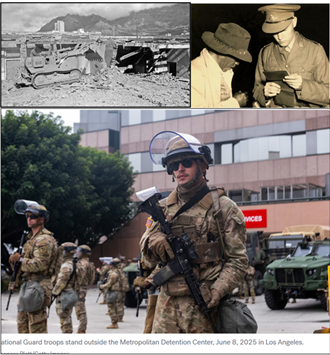
I’ve lived through this before. My first two decades of life were during peak apartheid  in Cape Town, South Africa. Beneath the glistening surface of the city’s sunshine, mountains and ocean was tyranny.  Police cars roamed the street, looking to immediately deport black people who didn’t have the required ‘dompas’ document. Families were forcibly removed from their homes. Informal settlements were bulldozed. Brutalization coarsened life -not only for those who were direct targets, but for everyone.

When I came to the United States in the late 1970s, it was with a sense of relief, hope and possibility – now I was living in a land dedicated to “life, liberty and the pursuit of happiness”, a country that promised, in words engraved above the main entrance to the Supreme Court building,  “equal justice before the law”. And when I moved  to Los Angeles about three years ago, I was thrilled to discover a city that, contrary to East Coast stereotypes, was vibrant, welcoming, and rich in its cultural  diversity. Yet in the days since the Trump administration unleashed Immigration and Customs Enforcement (ICE) and federal troops  on the city I have lain awake at night, shocked and distressed by  the parallels between my early years in Cape Town and what is happening in LA.

As someone committed to exploring how history shapes culture, politics and the economy I am mindful of the many differences between LA and Cape Town, and their implications for policy choices. But in what follows my primary purpose is not to explore nuance, but to assemble some baseline data (taken, except where noted, from  a 2024 California-wide study, centered around 2019 data)  in a way that directs attention to two urgent issues: (i) the catastrophic social and economic consequences for LA  if the Trump administration continues to pursue  its militarized and rhetorically shrill and polarizing approach  to forced removals; and thus (ii) the urgency of crafting a different way forward.  I organize the data around five sets of stubborn facts.

Stubborn Facts I: Undocumented residents  comprise a significant share of of LA’s – and California’s – population.

Stubborn Facts II: Undocumented residents are deeply embedded into Californian society.

  • 31% of California’s  2019 undocumented population  had been resident  in the state for 20 or more years; 41% for 10-19 years; 13% for 5-9 years; and 15% for less than five years.
  • More than half of the undocumented population live in households that include a citizen or permanent resident.
  • 20% of all children  under age 18  in LA County (and 17% across California)  live in a household where at least one person is undocumented.

Stubborn Facts III: The assault on undocumented residents targets especially the state and county’s Latino population

  • 48% of the population of LA County – and 39% of all Californians  –  are Latino.
  • 86% of California’s total Latino population of 15.2 million people are citizens or permanent residents.
  • As of 2019, about 75% of California’s undocumented population was Latino; almost 1.7 million people came from Mexico, and a further 360,000 from El Salvador and Guatemala. An additional 2.3 million Latino citizens of California live in a household where at least one person is undocumented;  4 million people will thus be directly affected by mass deportations.  
  • Across California,  29% of Latino children live in a household where at least one person is undocumented.

Undocumented residents are  intertwined with California’s long-established Latino community – a  community that  cuts across  classes, and localities.  In the vibrant, culturally-diverse Los Angeles County, whose Latino residents are neighbors, friends, and co-workers, targeting the undocumented Latino population for forced removal will be devastating – not only for those immediately affected, but for all of us.

Stubborn Facts IV: Undocumented residents are woven deep into the economic fabric of Los Angeles.

  • As of 2019, over 64% of all California’s undocumented residents above the age of sixteen were employed (as compared with 59% for the working age population as a whole); less than 5 percent   were unemployed.
  • Median 2019 hourly wages  across California were $13 per for undocumented workers, $19 for immigrants and $26 for the US-born population
  • Across California,  52 percent of  undocumented residents have less than a high school education; 22% have a high school diploma; and 26% have at least some college education.
  • Across California, undocumented workers account for approximately half of all employment in  agriculture –  and a similar percentage of child care, home aide, housecleaning and other domestic workers.
  • In LA County, undocumented workers account for about a third of all construction sector employment, 21% of manufacturing employment,  and 17-20% of employment in hospitality, wholesale and retail trades.

Forced removal of undocumented workers will thus have devastating consequences for labor supply at the less skilled end of the labor market, with widespread bankruptcies and cost escalations likely in multiple sectors.  

****

History doesn’t repeat itself, but it rhymes.  South Africa’s forced removals began in the late 1940s. They set in motion a  cascading cycle of decade-long protest, two decades of brutal repression and dehumanization – and then mass civic uprising. Sustained efforts at forced removals in LA will almost surely  be accompanied by a parallel combination of protest and repression – a massive blow to the heart of a great city.

How to avoid catastrophe? To address this question, we need to add a fifth set of stubborn facts to the four laid out above. Between 1970 and 2024, the share of the American population that was foreign born  rose from 4.7% to 15.6%,  with the latter the highest percentage since at least 1850. In the four years of the Biden administration the estimated number of undocumented people living in the United States rose by over 5 million.  If catastrophe is to be avoided, simply ignoring the structural underpinnings of America’s current anti-immigrant fervor is not an option.

But nor is it an option to ignore the far-reaching social and economic consequences of the draconian imposition of immigration policy. The bloodless technocratic advocacy of ‘robust’ enforcement of existing policies (for example, this New York Times  podcast conversation between right-of-center columnist Ross Douthat and the American Enterprise Institute’s Matthew Continetti) is as outrageously detached from any realistic reckoning with consequences as reckless, twitter-fueled  pyromania.

It has been clear for decades where a constructive path might be found – through the hard work of legislative reform.  But instead of  reform,  contestation over immigration policy has become Exhibit Number One of a broken political system.    Back in 1986, Republican-championed immigration reforms, signed into law by then president Ronald Reagan,  provided a path to citizenship for undocumented migrants who had lived and worked in the USA for at least  five years.  By contrast, a 2024 effort at legislative compromise  offered a path to permanent residence and citizenship only for undocumented residents who both  were married to US citizens, and had been in the USA for at least ten years – an astonishingly inadequate proposal when viewed through an LA lens. Even so, it was the opposition of then presidential candidate Donald Trump, not Democratic opposition, that ended the reform effort.)

But the parallel with South Africa does not only provide a cautionary tale of how things could go wrong; it also points to the possibility of something radically different.  The country’s  extraordinary ‘rainbow miracle’ transition to democracy shows that, even for conflicts that seemingly are intractable, a collective commitment to finding a way forward can yield transformational positive change. Has the USA become so incapable of collective, problem-solving deliberation that (to paraphrase the eighteenth century philosopher Samuel Johnon) even the threat of a hanging cannot focus our minds?

Reducing homelessness – the power of achievable ambition

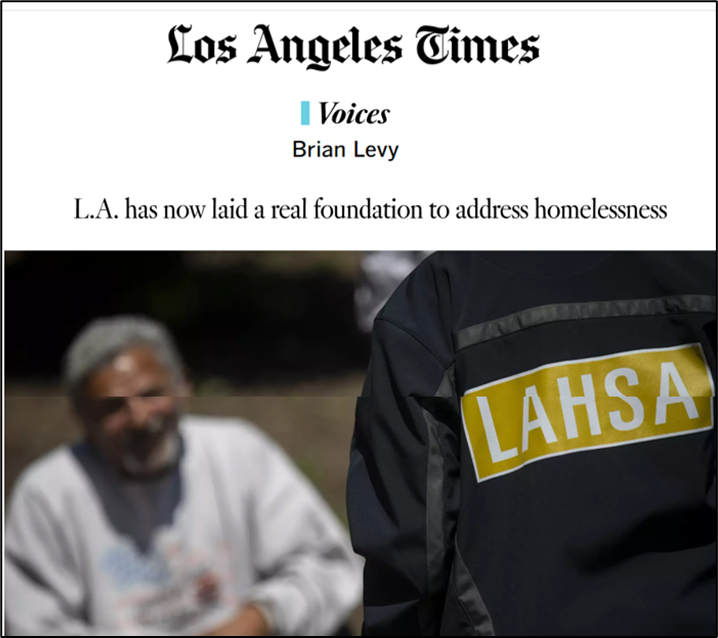
Beneath the surface of Los Angeles’ continuing homelessness crisis, something promising has been underway – a sustained effort by a a committed group of public officials, political and civic leaders from across the region to crafting a set of ambitious and achievable goals that can guide the region’s efforts. As I explore in an Op-Ed piece published today in the Los Angeles Times, “In a fragmented governance environment like L.A.’s — and for a multifaceted problem like homelessness — goal clarification is a vital early step. Clear goals serve as a shared point of reference for setting priorities, helping multiple participants to better align their choices. They provide a platform for institutions to be held accountable by the public.” https://www.latimes.com/opinion/story/2025-05-21/los-angeles-city-county-homelessness-goals

For those who cannot access the piece via the link, see below for the full pre-publication text.

******

“Los Angeles’ continuing struggle to reduce homelessness has become exhibit number one  for a broader critique of the failure of progressive governance. Recent tensions between city and county government over how to organize the provision of homeless services have not helped.  But look a little deeper  and something more promising comes into focus.

For the past nine months,  a committed group of public officials, political and civic leaders from across the LA region have been collaborating to develop a road map for reducing homelessness – and,  in so doing,  to break with  LA’s  longstanding pattern of overpromising and underdelivering.  Central to their endeavors has been the crafting by a multistakeholder  ‘Leadership Table’  of  a set of ambitious and achievable goals that can be a north star guiding the region’s efforts. 

These efforts reached a crucial milestone in late March, when LA County’s Board of Supervisors endorsed three monitorable  top-line goals, including specific targets for 2030.  One goal aims for a 20 percent reduction in the number of people becoming newly homeless each year. Another aims to place 30,000 people into permanent housing—an increase of over 50 percent from current levels. A third targets a reduction in the number of people living on the streets in 2030 by nearly a third. 

I have spent decades exploring comparatively, as both practitioner and scholar, the ways in which participatory approaches can enhance the public sector’s problem-solving ability. That experience shows that, far from being a pie-in-the-sky academic exercise, a focus on goals can yield enormous practical benefits.

In a fragmented governance environment like LA’s – and for a multi-faceted problem like homelessness – goal clarification is a vital early step. Clear goals serve as a point of reference for setting priorities and making difficult choices.  They provide a platform for civic accountability. Further, the combination of goals, their monitorability, and accountability to citizens fosters practicality – sustaining civic support requires that target goals are neither so modest as to cause cynicism, nor so overly-ambitious that they set the stage for failure. Viewed from this perspective, the way in which LA has gone about collaboratively crafting and codifying its top-line goals provides  a basis for cautious optimism that  its homelessness governance system may finally be on a path to sustained gains.

To be sure, at first blush the goal of reducing LA’s unsheltered population by  not-quite a third over five years is hardly headline-worthy. Ending homelessness would be relatively straightforward if the task was simply to find suitable housing for the approximately 50,000 people who currently live on LA County’s streets. Indeed, contrary to the common perception that little is being done, LA’s homelessness support system currently permanently re-houses about 20,000 people each year,  more than any other city in the country.

But the region’s homelessness crisis goes well beyond the number of people on the street at a point in time. Each year, a combination of wage stagnation, an extreme shortage of affordable housing, and other personal hardships results in over 60,000 people becoming newly homeless. Given these realities – plus the likelihood that federal budget cuts will shred the social safety net  – reaching the target of 30 percent less unsheltered homelessness by 2030 would be a major accomplishment. But getting there will require both public officials and civil society to move beyond business-as-usual.

For public officials,  clear, ambitious-and-achievable goals provides the requisite platform to stop endlessly cycling from one seemingly appealing initiative to another, and engage systematically with the dual challenges of improving effectiveness and efficiency.  Effectiveness calls for decisions on how to prioritize scarce resources: Which interventions are most effective in reducing inflow into homelessness? Which services and supports—psychological and social support, rental subsidies, or interim housing—best help homeless people get permanently housed?  And, looming above all of these, how to expand the supply of affordable housing?

Clarity vis-a-vis effectiveness  enables efficiency to move to the front-burner:  For each prioritized intervention, what is a minimum set of acceptable standards?  Do public, private and non-profit providers meet these standards? What will be the mechanisms for improving performance, or clawing back resources, from providers that fall short?

For civil society, an informed embrace of ambitious-and-achievable goals provides a basis for moving beyond exhortation and criticism, and embracing new ways of providing the accountability and oversight  needed to ensure meaningful results. This includes – and goes well beyond –  tracking whether agreed-upon targets are being met.

All-too-often insider interests that stand to lose from reforms that take effectiveness and efficiency seriously will try and protect the status quo. Civil society can bring countervailing pressure. Such pressure might come from  purpose-built multistakeholder arrangements (for example the ‘Leadership Table’ that led the goal-formulation effort) and other local organizing groups and coalitions.  Local officials will also no doubt recognize the risk that if they fail to make progress on these goals, voters may turn against them at the ballot box.

The people of LA identify homelessness as the region’s number one crisis. The successful recent effort to  collaboratively set and adopt ambitious and achievable  goals for 2030 is a major milestone. Success in meeting these goals  could rebuild the  public confidence in local government that has eroded over many years. To be sure, it’s still early days, and there is much uncertainty.  But the stakes couldn’t be higher. If LA’s effort to combat homelessness can stay on track, there would be a golden opportunity  to flip the narrative –  from being a poster child of  the failure of good intentions to address urgent social challenges, to becoming the face  of a renewed and effective 21st century progressivism.

100 DAY UPDATE: Protecting the guardrails of democracy – some lessons from South Africa

In early February, I wrote a blog post that laid out some lessons for today’s USA’s from South Africa’s efforts to protect the guardrails of democracy. Here is a link to the piece.  A hundred days into the Trump administration, how well does the piece stand the test of time? While the four lessons it highlighted (see the end of this post for a summary…..) remain reasonably on target,   for at least three reasons South Africa’s experience turns out to be a more imperfect lens for understanding how to meet the challenges of sustaining democracy in the face of hostile actors than I realized at the time of writing.

First is a fundamental difference between South Africa’s early 1990s struggles to stay on a democratic path and those of the contemporary USA. In South Africa, those in control of the state (FW de Klerk’s National Party), while hesitant, wanted to go down the path of democratic constitutional reform. By contrast, in early 2025 USA,  the levers of government seem unequivocally in the hands of those who have demonstrated no commitment to a constitutional democratic order.

Second, while top-down cronyism aptly describes at least part of Jacob Zuma’s South Africa, and Donald Trump’s USA, its consequences depend in important part on the character and commitment of  the leaders. I won’t try to parse which of the two is more corrupt. But what does seem clear is that Jacob  Zuma – whose life had been shaped by the African National Congress and its struggle against apartheid (including ten years’ imprisonment with Nelson Mandela on Robben Island)  – was committed in at least some part of his identity  to the ANC’s aspirations and values. These values included longstanding, deeply-rooted commitments to democracy, to non-racialism, and to the rule of law. These commitments required Zuma to at least think twice before acting in ways that were directly contrary to these values.  Donald Trump shows no evidence of any similar commitment and associated restraint.  

Third is the relentless ideological zeal of at least parts of the Trump administration. An anti-government discourse has long been part of the Republican Party’s DNA. Even so,  I have been startled by the (Musk-ian) recklessness with which agencies have been dismantled, heedless of consequences in the real world. Delving further into the  ideological pedigree of the ideas held by another part of Trump’s unwieldy (but unfailingly loyal) coalition has left me feeling even more shaken and (a little) vulnerable.

Beneath the sometimes genteel language of political philosophy is the stuff of nightmares. To illustrate, here is a quote from Patrick Deneen (whose intellectual pedigree passes through Princeton, Georgetown, and currently the University of Notre Dame, and who both JD Vance and Pete Hegseth have found inspirational):

What is needed, in short, is regime change – the peaceful but vigorous overthrow of a corrupt and corrupting liberal ruling class and the creation of a postliberal order…..Where necessary, those who currently occupy positions of economic, cultural and political power must be constrained and disciplined by the assertion of popular power…… The power sought is not merely to balance the current elite, but to replace it…..The aim should not be a form of ‘democratic pluralism’ that imagines a successful regime comprised of checks and balances, but rather the creation of a new elite that is aligned with the values and needs of ordinary working people”.

For those of us who know history’s catastrophes  deep in our bones, these words are chilling. Perhaps the one silver lining is that, as of this time of writing, the agenda has been laid bare, its execution has been chaotic, and it is (perhaps) being stopped in its tracks by increasingly mobilized resistance. So, as with so much of my work these days, I’ll end by taking inspiration from Albert Hirschman’s bias for hope – in this instance the hope that, as per the first lesson of the February post, American democracy can indeed make it intact to the November 2026 mid-term elections.

*****

Here are the four “lessons from South Africa” laid out in the February piece:

Lesson #1: For the next 21 months,  the unwavering navigational north star is to get  to the  November, 2026 midterms with the machinery of electoral democracy still fully functional – avoid being knocked off course by even the most venal provocations.

Lesson #2: Leveraging checks and balances  lays important, necessary ground for victory in the struggle against tyranny – but its victories are not in themselves decisive.

Lesson #3: Keeping democratic space open requires a coalition that is broader than the usual fault lines of political partisanship –   a  sense of urgency and willingness to act not only from ‘natural’  opponents but from elite actors for whom it is more expedient to stay silent.

Lesson #4:  A vision of democratic renewal is key to a decisive victory against encroaching tyranny – more than short- and medium-term band aids are needed.

From crisis to renewal? Affordable housing and homelessness in Los Angeles

In dark times, I take inspiration from the great social scientist Albert Hirschman’s commitment to  the search for ‘a bias for hope’, for  “avenues of escape from exaggerated notions of absolute obstacles…. avenues in  which the inventiveness of history  and a ‘passion for the possible’ are admitted as vital actors”. Viewed from this perspective, the point of departure for effective action is not some idealized vision of how things should be, but  clarity  as to how things actually are – with this clarity providing the basis for a search for practical entry points capable of setting far-reaching cumulative change in motion.  This passion for the possible has inspired my research and practice for almost a half century; it is the guiding spirit of a new  cycle of research on the Los Angeles’ region’s twin crises of homelessness and scarcity of affordable housing (AHHLA)  that I introduce in this piece.

Los Angeles’ AHHLA crisis startles. LA County is among the world’s affluent locales, with a  2023 per capita income of over $78,000, well above the American average. Yet that same year about 55,000 people were living on LA’s streets, and over 30,000 of them had been there for more than one year.  Even more startling, every year about 60,000 people become newly homeless –  a cumulative total over five years of almost 3 percent of LA County’s population of 10 million.  For those who live in Los Angeles (among whom, having moved here in 2023, I now count myself) the AHHLA crisis is existential. But its significance goes beyond the local.

As recent books by Ezra Klein and Derek Thompson (2025) and Marc Dunkelman (2025) explore in depth, a broad national reckoning is underway to assess both how failures of progressive governance contributed to the rise of toxic populism, and what might be the contours of a renewed and effective progressivism.  AHHLA is ground zero of this broader crisis of contemporary American progressivism. In what ways did decades of progressive good intentions gone wrong fuel LA’s current crisis? Are there hopeful lessons to be learned from recent efforts to address AHHLA about how progressive approaches to governance can become part of the solution?

Here, to set the stage for addressing the above questions,  is AHHLA’s economic backdrop:

  • Over the past four decades, even as the affluent have thrived,  earnings have been stagnant for the poorer half of LA’s population. As of the early 2020s, 16.6 percent of LA residents lived below baseline (rent-adjusted) measures of absolute poverty – the highest percentage among California’s regions. (California is the state with the highest percentage in the USA.) In the absence of the public safety net, the LA percentage would be 26%.
  • Beginning in the 1990s, a combination of population growth, the end of the extensive margin and slow growth environmentalism/NIMBYism has resulted in an increasingly severe shortage of housing. Between 1960 and 1990, about  200,000 housing units were built each decade; between 1990 and 2020,  the decadal average was below 75,000 units. In 2023, 45 percent of the households that earn below LA County’s median income paid more than half their income in rent.
  • The unit costs of building publicly-subsidized affordable housing in Los Angeles are almost two and a half times the equivalent costs in Colorado and Texas; startlingly, within LA the total development costs per square foot are 50 percent higher for publicly-subsidized  than for unsubsidized, market rate housing built for private (self-pay) buyers.

Considered together, the combination of stagnant incomes, rising unit costs and a near cessation of new housing construction (except at the more affluent end of the market) was to make accommodation increasingly unaffordable for lower-income Angelenos. In important part, and as per the title of an influential book, Homelessness is a Housing Problem. More on all of this in coming weeks and months.

LA’s fragmented  governance arrangements have enabled the AHHLA crisis to fester. This fragmentation  is especially ill-suited to addressing homelessness – a multi-faceted ‘wicked’ problem  that calls for a multi-sectoral, multi-jurisdictional and multistakeholder  response. The roots of LA’s fragmented governance can be traced back (at least in part; racial ‘redlining’ also played a role….) to a century-long aspiration to avoid centralized, urban machine politics and cultivate instead more localized, small-town-like governance.  Some tasks are the responsibility of LA County government, and others are diffused among the County’s 88 municipalities, of which the City of LA (with a population of four million) is the largest. This fragmentation has been exacerbated by deepening commitment over the past half-century to open, often legally-mandated public deliberative processes in advance of any action, which further complicates local government’s decision-making.  

Moving towards more top-down governance (of varying degrees of draconianism) offers one possible response to fragmentation.  But widening the distance between citizens and local government risks worsening what already is a crisis of civic alienation from government in many countries (not least of which the USA) the world over. Might there be a third way, one that finesses the traps of top-down governance accompanied by citizen alienation, or civic participation plus ineffectual governance? 

In recent conceptual work (see here for an introductory overview), I have explored the potential and limits of this third way. The articles delineate three distinct channels through which ‘socially-embedded’ approaches to public governance might simultaneously  counter fragmentation, encourage participation  and enhance effectiveness:

  • A collective effort to enhance clarity as to goals;
  • Streamlined, transparent  and participatory approaches to performance monitoring; and
  • Collaborative, multistakeholder arrangements for service provision.

Recent initiatives in LA to reduce homelessness incorporate all three channels. Why these initiatives were adopted,, and whether they will continue to unfold in ways that contribute to reducing homelessness is the focus of an ongoing research project in collaboration with  the University of Southern California’s Professor Yan Tang (an eminent scholar in the tradition of Elinor Ostrom’s work on collective action). As our research will explore, one key to success is whether the protagonists in the LA efforts will be able to craft a credible way of sharing gains and burdens within a framework that can advance the collective interest. What follows will hopefully whet the reader’s appetite for the research project.  

Strikingly, at least since the early 2010s,  momentum for scaling-up and reshaping how LA responds to its homelessness crisis has come less from government than from civil society. The efforts have unfolded in two phases. In a first phase, political and civic leaders championed a series of ballot measures that successfully raised billions of dollars to address AHHLA. However, by the late 2010s, there was a dawning realization that the magnitude of the challenge went way beyond earlier perceptions. Not only was further financing required, effectively addressing the twin crises called for better  co-operation among multiple stakeholders – something that the region’s fragmented institutions were not well placed to achieve.  A 2021 report commissioned by civil society champions took stock of the governance challenges, and proposed a menu of reforms. Partly in response to this report, Los Angeles County’s Board of Supervisors  established a Blue Ribbon Commission on Homelessness Governance  and subsequently adopted its recommendations.

Since mid-2024, there has been an extraordinary burst of energy and  reform aimed at aligning LA’s multiple stakeholders  around a coherent governance platform for reducing homelessness. Major initiatives include:

  • The creation by LA County’s Board of Supervisors of a robust, formally-empowered multistakeholder platform, with a mandate to “help align the region’s approach to homelessness and provide critical accountability and oversight to ensure more meaningful results”.  
  • The  development and official adoption of specific, measurable targets for reducing  homelessness.  
  • The initiation of work by  the Los Angeles County Affordable Housing Solutions Agency (LACAHSA), established in a 2022 resolution of the California State Senate to increase the availability and affordability of housing in LA.
  • A radical restructuring (currently at an early stage, but on an accelerated timetable)  of the lead public  LA County and City agencies responsible for overseeing and implementing the LA region’s response.
  • A new effort to specify performance standards for each of the many elements that go into the homelessness response – as a necessary basis for both resource allocation and accountability.

The hope is that the above initiatives will together finally provide the coherence and momentum needed to make real inroads into  homelessness – and thereby  break a longstanding corrosive cycle of overpromising and then underdelivering.  Whether this will happen remains uncertain,  but if it does  LA could go from being seen as a notorious example of the failure of well-intentioned progressivism to effectively address urgent social challenges, to  becoming an exemplar of a renewed, legitimate and effective 21st century progressivism. What happens next thus matters well beyond LA itself.  Watch this space for further updates. 

Protecting the guardrails of America’s democracy –  some lessons from South Africa

Now what? Four weeks into the Trump administration, a wrecking ball threatens to wreak havoc with millions of peoples’ lives. A  sense of urgency is in the air. Indeed, we urgently need to bear witness to the emerging scale of disaster.  But holding open the door to a hopeful future needs more than urgency.  It needs  clarity of goals, tactics and  strategy – plus a longer-term vision that looks beyond the immediate crisis. To help bring clarity, it can be helpful to make comparisons.  

In seeking to understand America’s challenges,  I have long looked to South Africa’s decades-long struggle to establish and sustain its own democracy. A recent effort contrasted how polarization and inequality interacted. My task here is  the more immediate one of seeking fresh insight into how a democracy can respond to a wrecking ball taking aim at its institutions. The search yielded  four lessons of relevance to America’s current moment. First:

  • For the next 21 months,  the unwavering navigational north star is to get  to the  November, 2026 midterms with the machinery of electoral democracy still fully functional – avoid being knocked off course by even the most venal provocations. 

In April 1993, a team of far-right assassins that included a former member of the white apartheid parliament murdered Chris Hani,  a  popular, senior leader of the ANC’s left-wing.  At the time, South Africa’s  recently unbanned African National Congress was in the midst of fraught, on-and-off  negotiations to  end apartheid – but until a new constitution could be agreed on, power remained in the hands of the apartheid-era National Party. When news of the assassination broke, the country erupted in rage; the stage was set for crackdown.  Instead, in a masterful display of statesmanship, Nelson Mandela went on national television and successfully redirected attention to the journey ahead. The country’s first democratic elections, held in April 1994,  resulted in a massive ANC victory, with Mandela sworn in as national president.

Decades after its inspiring transition from apartheid to democracy, South Africa confronted a new challenge to its constitutional order – and again demonstrated the centrality of  the electoral process to its defense.  Jacob  Zuma, the ANC leader who acceded to the presidency in 2009,  was increasingly using state power in personalized and often corrupt ways, under the guise of a populist anti-elite agenda. Given the ANC’s continuing electoral dominance, defeating Zuma’s successor in a national election (Zuma himself was term-limited….)  was not a plausible strategy.  In selecting a successor,  the ANC itself had to decide whether to re-embrace the democratic constitutional order. This it did. Cyril Ramaphosa, a central protagonist in the crafting of the constitution in the 1990s,  won the November 2017 (intra-party) electoral contest to become Zuma’s successor by a hairs-breadth –   and then decisively won the 2019 national elections.   Ramaphosa’s victory not only underscores the centrality of elections in pushing back against tyranny, how he won underscores the relevance of the second and third lessons.

The second lesson is largely familiar:

  • Leveraging checks and balances  lays important, necessary ground for victory in the struggle against tyranny – but its victories are not in themselves decisive.

In the 2010s, South Africa’s defenders of democracy brilliantly used checks and balances institutions to push back against state capture. The pushback included brave, determined inquiry from the ‘Public Protector’, an official, but arms-length  agency with a mandate to investigate abuse of power; investigative journalism, underpinned by university-based researchers whose efforts added to the credibility of efforts to document what was happening; and a high-profile  public inquiry led by the Deputy Chief Justice of the country’s supreme court.  Four weeks into the Trump administration, similar momentum is building in the United States. The courts are intervening; elected Democrats in the House and Senate are becoming increasingly emboldened and forceful in mobilizing resistance; citizens are spontaneously coming out in support.  But experience in South Africa and elsewhere shows that more is needed.

The result of a too-narrow pre-occupation with tactical victories can all-too-easily be to win many battles, but lose the broader war.   Hence the third lesson:

  • Keeping democratic space open requires a coalition that is broader than the usual fault lines of political partisanship –   a  sense of urgency and willingness to act not only from ‘natural’  opponents but from elite actors for whom it is more expedient to stay silent.

It takes courage to override expediency and party loyalty and lead with principle. In 1930s Germany, expedient silence (indeed, often, tacit support)  on the center-right opened the door for Adolf Hitler, and all that followed. 2010s South Africa, by contrast, saw some inspiring examples of courage. Veteran leaders of the ANC (including Pravin Gordhan; Ahmed Kathrada;  and  Mavuso Msimang to name just a few) were willing to override lifetimes of loyalty and take a high-profile principled stand against state capture in favor of constitutional democracy.  In the USA, principled Republican leaders  who took a stand against Richard Nixon in the early 1970s showed similar courage. But in today’s United States, aside from a few lonely voices, the silence from the center-right is deafening.

The combination of a multi-front effort to leverage checks and balances institutions and mobilization of a broad coalition may be enough to eke out an electoral victory – but it has not been enough to decisively turn the tide. Both the 2019 South African and 2020 U.S.,  elections enabled a temporary pause in attacks on constitutionalism. But more than a pause was needed. Hence the fourth lesson:

  • A vision of democratic renewal is key to a decisive victory against encroaching tyranny – more than short- and medium-term band aids are needed.

On offer in South Africa’s 1990s “rainbow miracle” was not only formal constitutional change, but hope – “a better life for all” as per the African National Congress’s campaign slogan. Indeed, after decades of stagnation, the first fifteen years of democracy witnessed a steady acceleration of economic growth, and a reduction in the incidence of extreme poverty. But by the time Zuma acceded to the presidency, the promise had reached its sell-by date. Ramaphosa promised only a return to the earlier formula, and his presidency has turned out to be a time of muddling through. Viewed from the vantage point of 2025, parallels with the Biden presidency are clear.

For an electoral victory to result in a decisive political realignment, it needs to build credibility on two fronts – inclusion, and public governance. South Africa’s early successes centered around an expansive “we” – underpinned by an economic program that addressed many everyday concerns of working people. In the wake of 2024’s electoral shock, the Democratic Party in the U.S.  seems increasingly to be learning the lesson that the cobbling together of multiple disparate parts does not add up to an expansion vision of ‘inclusion’. To  win credibility with the electorate the message needs both  sharpening  and  consistent championing by credible messengers.

As for  the capacity to govern, a distinctively American challenge is to break through the relentless drumbeat of political demonizing of the public sector. But the challenge goes well beyond messaging.  All-too-often,  the result of a progressive vision of governance in which one good thing is added on top of another is way less than the sum of its parts – each good thing is accompanied by a small dose of administrative process, and the cumulative sum of the good things is sclerosis. The Wall Street Journal’s Peggy Noonan makes the point pithily:

“A word to Democrats trying to figure out how to save their party…. Most of all, make something work. You run nearly every great city in the nation. Make one work—clean it up, control crime, smash corruption, educate the kids. You want everyone in the country to know who you are? Save a city.”

In 1860 when Abraham Lincoln became president, he described America as “the world’s last best hope”. That is how it felt to me when I came to this country almost five decades ago. Is the vision of America as a beacon to the world coming to an end? Is there no alternative to angry, chauvinist isolationism? Making it through the present moment without deepening disaster requires tactical resistance – but it also calls for more.   We also need to raise our sights. What kind of country do we want the United States of America to be?

Now what? – Strategic and unstrategic ways forward

Two days into DT’s second presidency, it is clear that constitutional democracy has (re-) entered into a time of extreme, urgent danger. Despair, complacency and (un-strategic) resistance traps abound. What, then, are ‘strategic’ ways forward? From the vantage point of January 2025, the crucial point is that the USA continues to be a democracy – and it is only 21 months until the next round of House and Senate elections. The overriding strategic goal is to act , between now and then, in ways that increase the odds that control of both shift back to the only political party in the USA that remains committed to constitutional democracy – the Democratic Party (and perhaps also to encourage any brave Republicans who run on a constitutional democracy platform in their party’s primaries).

Much follows from this point of departure, way more than can be said here. But (though the speed and ruthlessness are now much greater….) we were at a parallel point at the outset of DT’s first term. Back then, I wrote a piece, “hope in the dark”, that suggested some ways forward. What follows updates that earlier piece. [While I have added some new themes, and changed some emphases, much of what I said then remains relevant, and is quoted directly. Subsequent work, linked below, elaborates on some key themes. And here is a link to the original piece.]

*****

When power shifts and the presumptions that have underpinned our way of engaging the world no longer hold, what then? For the past quarter century, many of us engaged in policy analysis and implementation have worked in the spirit of ‘possibilism’ – seeking entry points for change that, though initially small, have the potential to set in motion far-reaching, positive consequences. But more than we perhaps had realized, our work has presupposed that the center broadly holds.

We have presumed that there is a reasonably stable ‘outer’ concentric circle within which experimentation plays out, facilitating an evolution-like process — momentum for initiatives that add value, and dead-ends for bad ideas.  But with the election of Donald Trump (henceforth DT) in the USA (and similar elsewhere, though in this piece I will write principally from a US perspective) we find ourselves in a world where the stability of the outer circle, the container, has itself been put into question. How, now, are we to engage?

In an earlier effort to explore possible pathways of development for messy democracies, I distinguished between long-run vision, medium-run strategy, and short run process. The vision as to what comprises the core elements of a flourishing democracy remains intact. However,  when confronting a risk of reversal of the magnitude which is possible under a DT presidency, strategy and tactics need to shift profoundly. But how?

The air is filled with talk of resistance, of the necessity of not normalizing  a DT administration. The urgency of the moment is clear, and I do not want to lessen it. So what follows might perhaps usefully be viewed as a complement rather than an alternative to this sense of urgency.  How can we act in ways that not only respond to the short-term imperatives, but also help incubate a platform for a reinvigorated politics and society?  Here (adapting some with the grain approaches for the current moment) are some  potential entry points.

First, checks and balances institutions – for societies endowed with them, these comprise the first, and crucial, line of defense against the erosion of freedom and democracy.

Second, protect the electoral process – and win elections. As per the opening of this blog, the 2026 midterm elections are only 21 months away. Those opposed to democracy will look to ways to fuel the flames of polarization in advance. [Think: “Reichstag fire” – on which, see more here.] Resist their provocations. Stay relentlessly focused on what it will take to win votes. Political parties are THE crucial actors.

Third, cultivate alliances. Beyond checks and balances institutions and programmatic political parties, the sustainability of democracy rests on a broad societal consensus in favor of democracy and the rule-of-law. This consensus has been America’s ‘civil religion’, one reason why it is so startling that so many voted for DT [in 2016 – and again in 2024]. But it is wildly premature to conclude that a short-term expression of discontent reflects a broader abandonment of America’s core principles. Defense of democracy requires a coalition that reaches across the traditional left-right ideological spectrum. Thus, rather than responding in kind to anger and polarization, opposition to DT needs to capture the higher ground of America’s political center.

Fourth, embrace a democracy-friendly discourse —  one which, as per Albert Hirschman, “moves beyond extreme, intransigent postures, with the hope that participants engage in meaningful discussion, ready to modify initially held opinions in the light of other arguments and new information”. DT’s discourse has, of course, been the exact opposite – an embrace of whatever might help to arouse supporters, with zero regard for its truth value.  But the breakdown in discourse goes beyond DT.

Openness to evidence comprises the bedrock foundation, the necessary condition, for civilization to thrive; yet we find ourselves in a world where the arbiters of the truth value of claims are losing their legitimacy. This can be explained, in our era of rapid change, by the power of cognitive dissonance to override inconvenient evidence.  But explaining is not enough. We urgently need to rebuild mutual confidence, a consensus across society as to the legitimacy, indeed the necessity, of fact-based discourse – else (if it is not already too late) all will be lost.

Fifth, focus on the consequences for inclusion and equity of the coming tsunami of policy initiatives from the DT administration. DT’s success is a (perverse) consequence of the accelerating dualism of American society – major gains at the top, stagnation for everyone else. In his campaign, DT promised to make things ‘great again’ for the struggling (predominantly white) middle. But the reality is (again) likely to be the opposite. Here are a few  examples:

Sixth, cultivate islands of effectiveness. Developmental forces continue to be present throughout society – within civil society, at state and local level, within public bureaucracies. As I explored in depth in my earlier work, in politically contested environments developmental actors can achieve valuable victories by focusing on specific initiatives, acting collectively, and building coalitions capable of fending off destructive, predatory influences. (Here is a link that introduces some new 2024/5 work that explores the possibilities of cross-cutting alliances between the public sector and civil society.) Not all space has closed. In a generally dispiriting time, showing what is possible continues to matter — both as antidote to despair and as inspiration, pointing the way towards a more hopeful future.

Some of the entry points I have highlighted above might seem inadequate to the moment. But it seems to me crucial that we look beyond a politics that offers nothing beyond deepening polarization. German politics in the interwar Weimar years of 1918-1933 provides a cautionary tale. As a white South African inspired by the fall of apartheid, as a Jew who has refused to be defined by history, the stereotypes of others (or a narrow ethno-nationalist vision of identity….), as a parent with two American children, I continue to believe that the life worth living is one fueled by our hopes and dreams, not our nightmares. The dream that all humans are created equal, with inalienable rights to life, liberty and the pursuit of happiness. The dream of equal dignity. The American dream (perhaps even now in 2025….]. The human dream.