Deconstructing the donor anti-corruption discourse

There’s something strange going on when  protagonists refuse to recognize their own successes. An especially frustrating day spent taking stock of the global anti-corruption movement led Oxfam’s Duncan Green to suggest in a recent blog post,  only half tongue-in-cheek, that “one option would be to stop using the ‘C’ word altogether, because it’s such a terrible starting point”.  This, of course, is neither realistic nor desirable. But insofar as corruption (and the need to combat it) will always be with us, we need to understand better what it is about the discourse which goes beyond  a good faith effort to wrestle with an especially knotty development problem.

Part of the explanation may be a culturally deeply-rooted discomfort with moving beyond Manichean notions of good and evil, and wrestling with development’s shades of gray. Another part may be ideological – evident in the crocodile tears shed by right-of-center politicians and commentators as they conclude that government is irredeemably corrupt, and thus should be kept as small as possible. But a decade spent as part of a team working to mainstream governance and anti-corruption into the World Bank’s development efforts sensitized me to  a third part of the explanation –  namely the way in which the interactions between  discourse on anti-corruption, governance and development and  the organizational incentives and constraints of the World Bank and other development agencies have resulted in a variety of perverse consequences.

The story begins at a high-level meeting in Madrid in 1994, when the incoming president of the World Bank, Jim Wolfensohn, found himself confronted by a chant from demonstrators that “fifty years is enough”. In their view,  a half century after the signing of the Bretton Woods agreements, the world no longer had any use for the institutions it created. Over the next few years, in his inimitable, passionate way, Wolfensohn went on the counteroffensive, signaling  the World Bank’s determination to fight the ‘cancer of corruption’. But the way in which the agenda unfolded sacrificed the effort to address some deeply rooted obstacles to development on the altar of political and organizational imperatives. The result was the embrace of a type of high-mindedness which was unconstrained by difficult realities, and which locked-in  a series of impossible expectations.

The challenges of implementation, accountability and corruption – all governance issues – became increasingly central to the World Bank’s agenda. Weaknesses in implementation had emerged as a popular explanation for weaknesses in the performance of development aid. So ‘fix public management’ was given new priority in the development agenda. But then came the critique  that underlying weaknesses in public management lay weaknesses in accountability –and that underlying these lay weaknesses in the quality of checks and balances institutions. ‘Fix these too’ was the seemingly logical response.  Over the subsequent two decades (including during the tenures as World Bank president of Paul Wolfowitz and Robert Zoellick), corruption became something for which the Bank would have ‘zero tolerance’.

At first sight, ‘zero tolerance for corruption’ is unambiguously the right thing to do. But what exactly does it mean? Certainly it means a determined commitment to the highest standards of probity amongst Bank staff — something for which the organization continues, rightfully, to pride itself. It also means (again appropriately, and an area where the Bank made a major push) a commitment to act on allegations of corruption associated with Bank-funded development projects – and the creation of mechanisms through which suspicions of malfeasance in development operations could easily be reported. It can also mean the incorporation of transparent, third party mechanisms for monitoring the implementation of efforts to improve service provision – something which increasingly has become a mainstream part of practice within the Bank.

But ‘zero tolerance’ can be taken to impossible lengths. In many countries,  personalized deal-making organized around the sharing of rents is central to the logic of political order in many developing countries with weak formal institutions. Does ‘zero tolerance’ imply that the World Bank and other donors should not work in these countries – even though this is where a large proportion of the world’s poor live? Evidently, unless the intent is to end the aid endeavor almost entirely, the answer must be ‘no’.

Holders of the purse-strings of foreign aid – the United States Congress, and parliaments throughout Western Europe, Japan and elsewhere in the democratic, industrialized world – surely recognized the challenging realities. It is hardly as if their countries, where checks and balances institutions are strong, are entirely corruption free. But in the face of widespread skepticism among voters in ‘northern’ countries as to the benefits of aid, they had little appetite for explaining these complexities to their constituents.  On the contrary, in the polarized politics that increasingly prevailed within some donor countries, any effort to address complexity – indeed, any acknowledgement that results might fall short of perfection – risked  playing into the hands of opponents, who were all too ready to characterize aid as wasteful support for ‘corrupt dictators’.

In consequence, instead of an engagement with complexity, the mainstreaming of governance into the development discourse resulted, for the most part, in a ‘doubling down’ on simplistic responses. The response of the development community to governance-related criticisms of its effectiveness was to say ‘yes’:

“Yes – public management will be fixed”.

“Yes – behind shortfalls in public management are weaknesses in accountability, and behind these are failures of checks and balances institutions – good governance will take care of these”. And

“Yes – corruption is a cancer, for which there will be zero tolerance”

Yes: Insofar as there was not already a perfect world, the efforts of the World Bank and other donor organizations (working in partnership with people of goodwill everywhere) would make it so.

In the immediacy of efforts to combat crises which threatened the legitimacy of the aid endeavor, high-minded affirmations serve as a firewall. But in the long-run the consequences have become increasingly corrosive. Development unfolds in difficult environments with weak institutions; the outcomes even of the best efforts are inherently uncertain. Maximalist promises, for all of the immediate relief they provide, are inconsistent with both the substance and spirit of the task at hand.

Development work necessarily involves eyes-wide-open risk taking. However, in the culture which had taken hold within development agencies, mirroring back challenging uncertainties, and confronting fundamental dilemmas and trade-offs, had in practice all-too-often become unacceptable. Viewed from the perspective of the immediate organizational imperatives of donors, what mattered most was the short-term impact on external constituencies of the words surrounding the governance and anti-corruption agenda (‘GAC’, in its unlovely acronym). But against a backdrop of maximalist, unachievable rhetoric, failure becomes the only plausible outcome.

[The above  is a lightly edited extract from chapter 11 of my 2014  book  Working with the Grain. If you’re interested in some more recent reflections on the topic, see my 2015 blog posts “puzzling over anti-corruption” and “Indonesia’s anti-corruption agency – a remarkable island of effectiveness”. Also worth reading is Catherine Weaver’s book, The Hypocrisy Trap.]

This moment of great danger calls for huge vigilance, more than continuing outrage

Is a ‘wag the dog’ crisis around the corner? A few weeks ago I decided not to use this blog as a platform for short-term political commentary. However, from the vantage point of distance (I have been in South Africa for the past few weeks, a place that is hardly without governance crises of its own….), I find myself even more concerned about what is unfolding in the USA than I was when I flew out of Washington DC. So, after reading another of the NYTimes Charles Blow’s articulate expressions of outrage, I find myself compelled to write this piece.

Articulate outrage may not be helping us prepare for the moment of  great danger that may be around the corner. It risks  understating the danger, misdirecting energy — and dulling us to impending crisis  We (Americans, and the world at large) find ourselves in an unprecedented situation, filled with volatility, unertainty, and HUGE risk. As I know from decades of work on challenges of governance worldwide, state capture is (sadly) hardly uncommon. But I can think of no parallel example where the institutions of a seemingly healthy constitutional democracy, in a relatively prosperous era,  have been handed over to a leader with zero respect for these institutions.  We know from many countries how long, slow decay unfolds — and how autocracy and fascism can emerge out of crisis. But we simply do not know how resilient even seemingly strong democratic institutions will prove to be in the face of the unprecedented assault that is now underway.

And I fear that we have not yet seen the worst. Not only is much of the DT agenda not being implemented, the Mueller special-counsel investigation seems likely to uncover more than a little nefarious activity — if not outright electoral collusion then, I suspect, a long history of very, very dubious financial relationships between the Trump (and Kushner?) real estate organizations and Russian oligarchs (New York-based and otherwise). One way to interpret DT’s seemingly increasingly erratic behavior is that he and the most deplorable of his allies (Alex Jones, Steve Bannon, Sean Hannity and the like….) are laying the ground for an assault on institutions and truth in the face of the continuing emergence of increasingly inconvenient truths (on both the political and venality fronts). One classic way for this to unfold is through a ‘wag the dog’ fabricated crisis — though one likely to be tragically more real in its real world consequences than the ‘war with Albania’ in Barry Levinson’s movie.
And so I end with a plea for  huge vigilance – and perhaps fewer emotionally cathartic expressions of outrage.  When the crisis moment comes the role of Republicans will be crucial. How can those of us who are not R’s help prepare the way for the crucial support that we will need from R’s — fellow citizens, congressional representatives, senators? If R’s recognize ‘wag the dog’ for what it is, and we speak together with a unified voice, then a coming moment of extreme danger can end with American institutions in reasonably good shape. But if R’s continue (out of a combination of fear and political opportunism) to enable what is unfolding, then I don’t think that I am overstating things in saying that the result could be the end of the USA’s 240-year experiment with constitutional democracy.

How do they sleep at night — a budget travesty

Here are some of the headlines (with links) describing DT’s budget proposal, taken from  this morning’s and yesterday’s Washington Post.  At a time when the United States is confronted with near-unprecedented increases in inequality, and an accompanying collapse of a sense of common citizenship, proposals like these are a travesty against humanity.  It is time to name names, to hold accountable those responsible for this travesty against our common humanity. I begin below.

“Trump administration is aiming to pare food aid to large American families…..to cut the Supplementary Nutrition Assistance Program (SNAP), better known as food stamps, by $193 billion over ten years”.

“Get to work or lose your benefits”. Budget theme: working to qualify for food stamps and other benefits as part of sweeping anti-poverty programs…..reduce spending on anti-poverty programs by $274 billion over a decade”

“Bipartisan concern for children’s health…. Lower-income children woud have their federal health benefits cut sharply under DTs budget….which could reverse gains that have pushed uninsured rates for this vulnerable population below 5 percent”. …. the budget proposes a 20 percent cut over the next two fiscal years in the Children’s Health Insurance Program”..

“Trump budget seeks huge cuts to science and medical research, disease prevention”. …..the National Cancer Institute would receive $1 billion less, the overall National Institutes of Health budget would drop by $5.8 billion, the National Science Foundation would lose $776 million”

“Budget axes foreign aid: cuts proposed for humanitarian and peacekeeping programs…..with deep cuts in long-term development aid, humanitarian food assistance and peacekeeping missions around the world”.  The proposed reductions include health programs

All of this to pay for massive tax cuts to go disproportionately to the top 1%

The fact that this budget is widely accepted as being ‘dead on arrival’ in Congress is somehow expected to make it OK. It does not. Proposals along these lines violate our shared humanity; we need to hold those involved to account. Here (with quotes) are the names of some of the purveyors of this travesty:

“MICK MULVANEY, director of the Office of Management and Budget  said the spending plan is focused on protecting taxpayer money….. Compassion should be offered not only to the needy who receive government resources, but also to people who pay taxes…..’We need people to go to work…..its not right when you look at it from the perspective of people who pay the taxes…. This is, I think, the first time in a long time an administration has written a budget through the eyes of people who are paying the taxes… ‘

“Secretary of State REX TILLERSON said the proposal reflects DT’s goal of a leaner, more efficient government that prioritizes national security and US economic interests”.

“Deputy Agriculture Secretary MICHAEL YOUNG said the administration is seeking to slash Supplementary Nutrition Assistance Program benefits to another population as well: low-income households of more than six people, the majority of which include young care the names of some of the purveyors of this travesty:

Events are in the saddle, and ride mankind…..

I cannot let a nightmarish seeming coincidence pass without noting it….. (….sounding the alarm?). Dangerous reality is moving at a troubling, troubling speed. Just yesterday,  in writing a quick post on Facebook. I softened a reference to “torchlight processions”, seeing the reference as absurdly alarmist for the present moment — and less than  36 hours later, white supremacist Richard Spencer is reported as leading  a torchlight procession in Charlottesville, Virginia.

My hesitation came while I was writing a FB post linking to a Washington Post article by Alexandra Petri. Here is how my FB post opened: ‘Humor? Surrealism? Reality? A great piece by Alexandra Petri (Germany’s industrialists were confident, too…..) “When the president seized me, stunned me with his venom and covered me with digestive fluid, I was initially taken aback, but I reassured myself with this thought: President Nixon never did that…..The end of the world would be brought about by the other side. The sky would turn red. It would not occur on a Tuesday when I had made other plans.”‘

I was struck by the parallel between Petri’s tone and Sebastian Haffner’s extraordinary depiction of German complacency in 1933  in his brilliant book, Defying Hitler. Here is a quote from Haffner: “The general opinion was that it was not the Nazis who had won, but the bourgeois parties of the right who had captured the Nazis and held all the key positions in the government….. Outwardly also, the day had no revolutionary aspects, unless one considers a torchlight procession or a minor gunfight in the suburbs that night as signs of a revolution…..” p. 105,

 I hesitated in quoting Haffner, partly because I know it is supposed to be counterproductive to refer to Hitler or Nazis — and partly because the quote includes reference to a torchlight procession. (This struck me as almost absurdly alarmist for the current moment.) And, then, less than 36 hours later, I see the story linked above  about torch-bearing protesters in Charlottesville. Theater, perhaps — but Haffner reminds us that this is exactly what enabled many (most?) Germans to be dismissive of the Nazis, until it was too late…..

[ps: this post’s title is a quote from Ralph Waldo Emerson]

Active citizenship when bureaucracies are weak – some school-level lessons from South Africa

Bureaucracies, we have learned, are embedded in politics. How, then, to strengthen public services in messy democracies? In settings where public hierarchies are weak, can participatory governance provide an alternative entry point? Recent results from a research project I have been leading on the politics and governance of basic education in South Africa suggest an intriguing answer. (The research is part of a  broader, global initiative sponsored by the University of Manchester-based Effective States and Inclusive Development (ESID) programme.)

South Africa’s Eastern Cape province provides an ideal setting for exploring these questions. As the ESID approach (laid out here) underscores,  two sets of variables that have a powerful influence on  bureaucracies  are: (i)  the inherited institutional legacy, and (ii) how elites interact with one another. On both counts, as the ESID working paper,  The governance of education in the Eastern Cape, by Zukiswa Kota, Monica Hendricks,  Eric Matambo and Vinothan Naidoo details, the Eastern Cape scores badly. The province’s bureaucracy is a patchwork, built largely around two patronage-riven structures inherited from the apartheid era. Electorally, the ANC was dominant – but in practice it comprised  an overall umbrella under which inter-elite conflict was endemic.

The combination of elite fragmentation and a personalized bureaucratic legacy left the Eastern Cape’s Department of Education (ECDoE) bedevilled by  divergent and competing regional interests, organisational cultures, and patronage ties. The national government tried to intervene, and for a few years it temporarily took over administration of the ECDoE. But this did not stem the crisis. Provincial politics proved too powerful. After a few years, intervention was scaled back, having had only limited impact on the crisis.

This brings us to the question of whether, in weak governance settings,  participatory governance could be an alternative entry point. The 1996 South African Schools Act delegates authority both to provinces and to school governing bodies (SGBs) in which the majority of positions are held by parents. In principle, this governance framework creates the potential for horizontal governance to serve as at least a partial institutional substitute for weaknesses in hierarchies. To explore this possibility,  in a second ESID working paper (School governance in a fragmented political and bureaucratic environment), Lawule Shumane and I explored in depth how governance played out over time  in four  schools in the Eastern Cape’s Butterworth district. In two of the four cases, participatory school-level governance turned out to provide a useful platform for pushing back against bureaucratic dysfunction.

In the first case, the school-level institutional culture was one where all stakeholders – teachers, the SGB, the extended community – felt included.  This inclusive culture provided a powerful platform for managing the recruitment of teachers (and, when the time came for leadership succession, of the school principal) in a way that assured a continuing commitment to the educational mission of the school. One interviewee illustrated how this participatory culture operated with the example of how new staff are inducted into the school’s organisational culture:

“The principal will call newly appointed staff to a meeting and introduce them to everyone. At this meeting the principal will welcome the new staff member to the team and inform them on school culture…. he will often say ‘Mr. or Ms. so and so, at this school we are a family and if we have problems we deal with them openly. If there is unrest, we will know it is you because it has never happened before’.”

The second case is more ambiguous.  The principal who set in motion the school’s long decline was appointed in the late 1980s, and remained in the post for over two decades. In the latter-1990s she purchased and moved to a home in a coastal town 100 kilometres away. From then on, using  one pretext or another, she was, for  much of the time an absentee principal. This continued for about a decade (!!!). The school went into a downward spiral, with the number of students falling from close to 1,000 in the early 1990s, to a low of 341 in 2011.

In 2009, frustration at the principal’s continuing absence finally boiled over. A group of parents and some SGB members met, and jointly reached the view that a new principal was needed. The ECDoE district office was not supportive. In response, the parent community blockaded the school, preventing the principal from entering. The district office kept her on as a displaced teacher, reporting to the district office, until her retirement in 2010. The SGB  subsequently selected as principal an internal candidate who had shown a commitment to try and make the school work during the grim period in its history. All, including the broader community,  worked together to try and turn things around.  Between 2011 and 2015  the number of pupils in the school rose  from 347 to 547.

To be sure, these intriguing cases do not imply that horizontal governance is a panacea in the face of bureaucratic dysfunction. Two of Levy-Shumane’s case study schools seemed trapped in a low-level equilibrium of capture, centred around the principal and teaching staff in the short term, with the collusion of the school governing body  and the broader community, reproduced via a captured process of principal selection – and with low morale, absenteeism by students and teachers and crumbling infrastructure the all-too-common consequences.  More broadly,  systematic analyses show that the impact of efforts the world over to strengthen participatory governance of schools  has been mixed.

But the Eastern Cape school-level case studies offer a key insight into why evaluations yield mixed results – and what might be a way to improve the outcomes. The key differentiator among the cases  is not  ‘capacity’.  Rather, the influence of horizontal governance on performance (for good or ill) depended on the relative influence of developmental and predatory stakeholders. Parents know whether teachers show up, and whether they bring honest effort to their work.  What matters for the efficacy of participatory, school-level governance is power.

This is where active citizenship can come in. The crucial task for initiatives aimed at strengthening horizontal governance is to help empower developmental actors within SGBs, parents and the broader community – helping to build networks that link SGBs with one another as a way of  sharing learning as to ‘good practices’, and potentially providing mutual support in the face of predatory pressures.

Support for school-level governance is no panacea. Children indeed gain when teachers improve their skills, and when schools are better resourced. However, trying to get these things by changing how bureaucracies work is, at best, a slow process. Bureaucracies are embedded in politics;  far-reaching improvements depend on very specific, and very difficult-to-achieve, political conditions.  But there also is abundant evidence that  a non-hierarchical entry point for improving educational outcomes has real potential to achieve gains – not always-and-everywhere, but in some schools, some of the time. Perhaps it is time to complement ongoing efforts to strengthen hierarchy with something different.

A somewhat different version of this piece appeared on the South African online Daily Maverick news and opinion website, under the title, “To help Eastern Cape schools, add a dose of active citizenship”


Pragmatism and its discontents

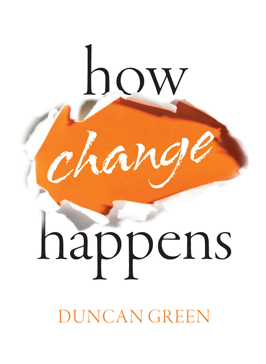
At times in the last few years”, writes Duncan Green in his recent book How Change Happens,  “it has felt like something of a unified field theory of development is emerging”.  As Hegel reminded us, however, the owl of wisdom  flies at dusk. As recently as early 2016 (which is about when he wrote these words) Green’s exuberant enthusiasm was shared by many of us. But a year, we now know, can be an eternity.

How Change Happens  synthesizes a growing body of work that has aimed to move development scholarship and practice away from a pre-occupation with so-called ‘best practice’ solutions. It captures well the  sensibility of the new literature – a paradoxical combination of  the  enthusiasm of a breakthrough and the pragmatism of  seasoned practitioners who have learned the limitations of over-reach, often through bitter experience.  But, as per Hegel,  has our quest for useful insight reached  its destination only to find that a new journey has begun,  a  different and more difficult journey than the one we had planned?

In this review essay, I use the insights of How Change Happens to  explore this question. I unbundle into two broad groups the categories of analysis Green uses to delineate the grand unified theory.  In discussing the first group, I highlight what we got right about the drivers of change; in discussing the second,  what we got wrong. I then suggest possible ways forward.

Dancing with the system

Change, Green suggests, can be understood as shaped by interactions between power, complexity and agency:

  • Power: Green builds on a ‘four powers’ model: ‘power within; power with; power to; and power over’. “A power analysis tells us who holds what power relative to the matter, and what might influence them to change…. Understanding how formal and informal power is distributed, and how that distribution shifts over time are essential tasks for any activist intent on making change happen.” (p.95).
  • Complexity: “In complex systems, change results from the interplay of many diverse and inter-related factors…. Because of the number of relationships and feedback loops, they cannot be reduced to simple chains of cause and effect.”
  • Agency, encompassing grassroots citizen activism, advocacy, and leaders, with “leaders [at all levels] central to any understanding of how change happens….[They] operate at the interface between structure and agency”. (p. 199) 

To link these, Green uses the metaphor of learning to ‘dance with the system’: “Understanding how the state in question evolved, how its decisions are made, how formal and informal power is distributed within it, and how distribution shifts over time – are essential tasks for any activist intent on making change happen.” (p.95).

Insights along the lines of the above have led many of us to adopt a pragmatic approach to policymaking and implementation. In the spirit of working with the grain, of doing development differently, of problem-driven iterative adaptation, of politically smart, locally-led development (I list these buzzwords to signal who I mean in this essay when I speak of “we”), we focused on incremental change — pursuing quite modest gains to address very specific problems, and taking much of the prevailing configuration of power and institutions as given, as constraints on what is achievable. We justified incrementalism along these lines as a way of achieving development gains that were valuable in themselves – and, perhaps, might also be catalysts for a cascade of subsequent opportunities. And then, our pragmatism notwithstanding, we were mugged by reality.

Blind spots

Suddenly and unexpectedly we find ourselves in a different world, the world of Donald Trump  and Brexit, a world with democracy seemingly in retreat in many, many countries, a world where many of the foundational presumptions of the turn to pragmatism can no longer be taken for granted. Blindsided by change we must ask: what did we get wrong in the way we danced with the system? This brings us to Green’s second group of analytical categories – state institutions, political parties, and norms.

To begin with state institutions, “the unsung heroes in the drama of development”, Green suggests, “(are) civil servants who soldier on despite the obstacles, because the stakes are so high – the institution they work within will shape the fates and futures of their peoples. That institution is the state.” (p.79). But the distinctive political, economic and social contexts within which state institutions are  embedded constrain technocratic efforts to improve their performance.  Many of us responded to this messy complexity by embracing the incremental, problem-driven approach described above.  We lulled ourselves into taking a very constricted view of the power (for good and ill) of state institutions.

Political parties were similarly neglected.  As Green notes, “development thinkers pay political parties scant attention, and aid organizations tend to discount their importance. But, however dull…they  are the clutch in the engine of politics, linking citizens to government…[and] carry the potential to achieve changes on an otherwise impossible scale.” (p.113)

India’s National Rural Employment Guarantee Scheme, in what was for me the most compelling example in a book filled with rich examples, illustrates powerfully the difference that political parties can make.

“India’s landmark 2005 National Rural Employee Guarantee Act (NREGA), which guarantees all citizens 100 days of unskilled employment per year on public works programmes, came about due to a combination of determined citizen activism and the fortunes of the Congress Party”. (p.125) By 2015, the NREGA gave employment to 122 million poor people across India. (p. 126). (Read that last sentence twice!!!) Congress embraced the NREGA in 2004 at a time when, the idea had been developed by civil society, and Congress “needed to rapidly cobble together a programme”…and after “a determined campaign involving a fifty-day march across the country’s poorest districts, sit-in protests, direct contacts with politicians, and public hearings.” If Congress had not won the 2004 elections, “the NREGA might well have joined the ranks of good, but failed, civil society initiatives”. (p.126)

Our engagement with norms, the final analytical category in this group, was even more problematic.  “Empathy is critical” Green notes, “if we are to build a bridge to people who see the world very differently from ourselves….” (p.221). However, “we tend to default to working with ‘people like us’, when alliances with unusual suspects can be more effective”. But focusing on norms isn’t only necessary as a way of being more effective in building progressive coalitions.  As  Green notes (in a moment of prescience, but which reads as something of an aside, out of step with the generally optimistic tone of the book),   “the prospect of norm shifts can provoke a violent backlash”. (p. 61) Indeed, it can.

Here, bringing the above pieces together, is what I think happened: While we were looking elsewhere, made complacent perhaps by our conviction  that we were on the side of the justice towards which the moral universe was bending, we allowed ourselves to be trumped.  We ignored the rising counter-reaction – the pushback of powerful (and monied!) interests, the resentment of those whose relative (though not necessarily absolute) standing was being undercut by a changing world, the growing resistance to a progressive (in our terms) change in norms. Crucially, we lost sight of the dynamics of power – specifically of the power of political parties to mobilize on the basis of ideas and incentives which we easily dismissed as reactionary. In so doing, we ceded the terrain of contestation over the largest political prize of all — control over state institutions – to actors and ideas which  we presumed had been consigned to the dustbin of history.

And then, one bleak morning after another, we awoke to discover that the terrain had shifted radically, that control over state institutions was shifting, and that our hard-won incremental gains risked being washed away by tidal waves of reaction.

What is to be done?

What now? On the surface the task is straightforward: we need to learn from the example of the right. As Green puts it, quoting  Milton Friedman, “only a crisis produces real change. When that crisis occurs, the actions taken depend on the ideas that are lying around”. As we also learn from the right, to be  transformational  these ideas need to have broad appeal, to be actively incubated within the framework of a large, resurgent political party. (Please, no fringe parties in the name of purity!).

How Change Happens is stimulating and satisfying in the guidance it offers activists as to ‘how’ to pursue their agendas. But (as per the title) it has almost nothing so say about the ‘what’…. (beyond its subtext, which signals clearly that it shares the values and aspirations of ‘people like us’). This focus on the ‘how’ with inattention to the ‘what’ is shared by much of the literature Green synthesizes (my own work included). Indeed, for many of us, it has been a point of principle to redirect attention away from polarized debates about fanciful ends towards pragmatic exploration of means.

But the times require heightened attention to the vision towards which our many localized efforts are directed; we need a new balance between the ‘what’ and the ‘how’. The broad contours of a progressive vision are clear: that we give our lives meaning by embracing inclusion, mutual solidarity, and stewardship as organizing principles for a thriving society – thereby honoring the highest values inherited from our past, and acting on behalf of future, as well as current generations.  Easily said, but evidently there is much work to be done to give content to inclusion and stewardship in a way that responds effectively to our brave new world of automation and globalization, and that (as per Green’s admonition vis-à-vis norms) builds bridges to people who see the world very differently from ourselves.

When I speak of a ‘new balance’, I am not suggesting abandoning what we have learned over the past decade about wrestling with the ‘how’ of development.  Overcorrection – an endlessly swinging pendulum of fashionable ideas – has long been a chronic, debilitating disease of development theorizing and practice. As I have explored elsewhere, the embrace of pragmatism was itself a response to  a decade of democratic hubris. That hubris was disastrous. It set the stage for disappointment, as it became evident that grand promises could not be met. Worse, in failing from the first to acknowledge (and communicate effectively) the messy complexity of democratic governance, hubris laid the groundwork for an attack from the right. It allowed the critics of government to successfully depict the challenging realities of democratic governance as ‘proof’ of the futility of pro-active public policies, of efforts to work collectively to build a better world.

It is easy (and seductive) to preach Manichean visions of perfection and evil. If one has no real interest in governing effectively (or perhaps has a hidden interest in undermining and then dismantling prevailing patterns of public governance), then there is no reason to exercise restraint. (Of course, should one then find oneself in power – a la DT; the Republican Party; or the champions of Brexit – then the reality of false promises will become evident, hopefully to be followed by comeuppance and discrediting.) But if the goal genuinely is to leverage collective endeavor and the public sphere as a way to build a better life for all, then the challenge is a more demanding one.

We need to communicate two superficially contradictory ideas at the same time: that embracing a vision of inclusion and stewardship in a thriving society offers a pathway to a fulfilling life – and that the quest to realize that vision will be challenging, fraught with obstacles. In the recent past, we have done neither: we have neglected the ‘what’ in favor of the ‘how. And our work on the ‘how’ has become so pre-occupied with addressing very specific problems that we ceded to ideologues of both the right and the left the terrain of discourse as to how the public sphere works, why, what are reasonable expectations, and it should be engaged.

A way to combine hope and pragmatism in a coherent vision  is to underscore that, however challenging and fraught with obstacles, the quest itself can itself be a source of fulfillment. Doing our part;  not everything, but enough to inspire a sense of possibility, and thereby successfully pass the baton to the next generation. That, as per the wisdom of ancestors, “it is not for us to complete the task, but neither is it for us to desist from it.”

South Africa’s crisis — calling things by their true name

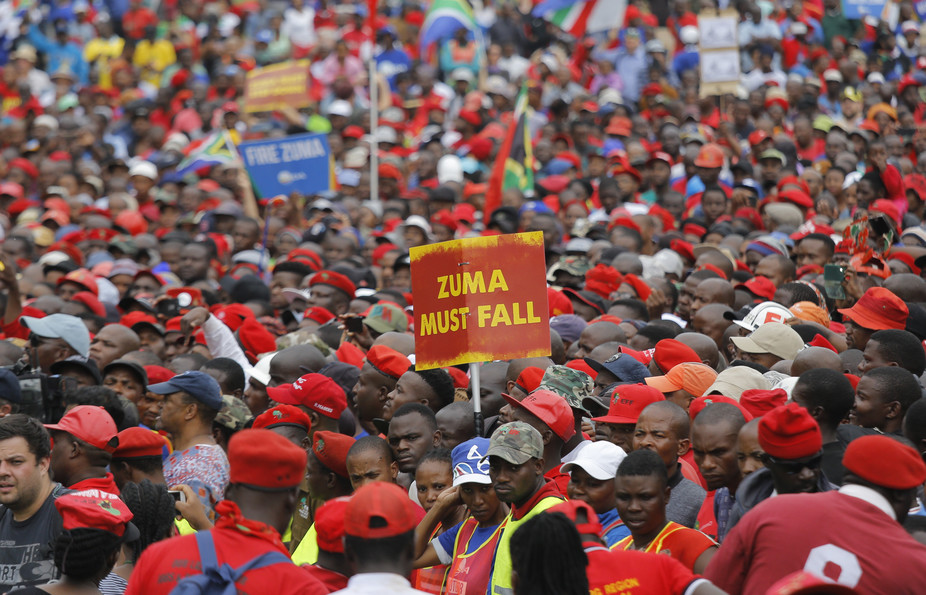
Locking in to binary narratives of ‘good’ vs ‘bad’ governance can blind us to the depths of a crisis when it arrives. As I argued in  a piece (originally published in The Conversation; I extract the full text below), there is a continuum between rule-bounded and patronage governance. At the far end of that continuum lie predatory kleptocracy and institutional breakdown. These last are the threats that South Africa now confronts. Hopefully the crisis can be seen for what it is — and not obscured by the fact that ‘wolf’ has been cried so often in response to South Africa’s typical (and inevitably messy) pattern of middle-income governance. What is happening now is not typical — once predatory kleptocracy takes hold, a downward economic and political spiral can unfold rapidly. The full text of the original piece follows immediately below:

“Frustrated by the promiscuous use of the accusation of “corruption” to cover all sins, in recent days some scholars of contemporary South African politics have offered alternative framings. Indeed, it is helpful to look beyond the details of venality, and identify some deeper patterns. But there is a risk that the result could be to inadvertently and wrongly take the edge off a sense of urgency.

At this moment of crisis, there are two mis-framings in particular that potentially have pernicious consequences. The first is an over-eagerness to describe any and all shortfalls vis-à-vis “good governance” in binary terms – as “proof” that a rule-bounded polity and economy has been entirely overtaken by patronage. The second is a conflation of the distinction between patronage and predatory kleptocracy. Both end up, inadvertently, downplaying the magnitude of what is at stake.

To illustrate the hazards, I will draw on a recent piece by Nic Cheeseman in which he says:

It’s time to look to the rest of the [African] continent for evidence on how the crisis within the country’s ruling African National Congress (ANC) is likely to unfold.

Cheeseman says that South African President Jacob Zuma understands politics through a patrimonial lens. Zuma has “set about entrenching himself in power by promoting loyalists within the party and the state. This while condoning corruption and sacrifice policy for patronage.”

Cheeseman continues:

Putting this process in its historical context is important: it makes it clear that while Zuma has been a disaster, it would be naïve to think that he is the sole source of the ANC’s problems – or that his removal will solve them. It also shows that South Africa is not exceptional, and instead faces similar problems to many other countries on the continent.

And Cheeseman adds:

One small silver lining to this cloud is that we can use the experience of other states to better understand the prospects for South Africa. One thing we know from Kenya and Nigeria is that the kind of politics practised by the president quickly embeds clientelism within key parts of the government and bureaucracy.

A binary framing of the tension between rule-boundedness and patronage along the above lines underplays the differences between the patterns of governance in low-, middle- and high-income settings. It also underrates the ways in which these differences are aligned with systematic differences in the ways in which polities and economies function.

Measured in purchasing power parity, South Africa’s current per capita income is four times that of Kenya. It is twice that of Nigeria, and similar to that of middle income Brazil and Thailand. Also worth noting is that it is less than one quarter that of Australia or the United States.

These differences in income are mirrored in the most robust available estimates of variations in the quality of governance. South Africa’s 2015 scores on both government effectiveness and control over corruption are somewhat above both the global median. The country scores better than middle-income Brazil, Colombia, Mexico, Thailand and Turkey. South Africa’s scores are way higher than those of lower-income Kenya and Nigeria.

Personalised patronage

The point is not simply an empirical one. As Nobel prize-winning economist Douglass North and his colleagues have explored in depth, underlying a continuum in the balance between personalised patronage and impersonal rule-of-law institutions is the reality that political, economic and institutional development co-evolve.

An initial platform of institutional stability provides a basis for economic and political actors to organise. Their greater strength provides in turn a basis for further strengthening of institutions. Over time, polities and economies become increasingly complex, and are underpinned by increasingly complex (and increasingly impersonal) rules.

Unlike the other African countries to which Cheeseman refers, as a middle-income country South Africa’s economy and polity continue to be anchored (albeit imperfectly) in impersonal rules. This relative rule-boundedness is underpinned by three things:

  1. the size of its middle class,
  2. the complexity of its economic organisations, and
  3. (so far) the shared commitment across most of the diverse political spectrum to constitutional mechanisms for resolving conflict.

The forces that can mobilise in support of rule-boundedness are thus far more powerful than they are in Kenya or Nigeria.

In fairness to Cheeseman, it is worth noting that he does identify these differences, though his focus is on similarities between South Africa and other African countries. It is also worth noting that, as I have argued in joint work with Alan Hirsch and Ingrid Woolard, unless South Africa’s extremes of inequality are addressed, the stresses on the country’s institutions will continue to be large.

But one has to recognise that there is a continuum between rule-boundedness and patronage. That underscores that on both the economic and political dimensions South Africa potentially has a long way further to fall from its current messy institutional realities. And for a middle-income country such as South Africa, should the forces committed to rule-boundedness lose out entirely, the downside is much deeper than in lower-income countries.

Jobs for the boys

This brings me to the second dangerous mis-framing – a conflation of the distinction between patronage and kleptocracy. As Harvard’s Merilee Grindle explored in her brave book, Jobs for the Boys, patronage itself functions along a spectrum. Here is how she put it:

Patronage systems are not synonymous with bad governance. Ministers and other high level officials have the capacity to use their appointment power to attract highly qualified staffs to carry out specific policy initiatives … Managers with discretion over hiring have significant opportunities to create islands of excellence. Discretion in hiring can provide means for escaping the rigidity of personnel laws and regulations.

But:

Inherent in the flexibility that makes patronage systems available for a variety of goals is the problem of their instability and politicisation considerable potential for unwise use and the undermining of the public purposes of government. The fatal weakness of patronage systems is that they are capricious, not that they are inevitably incompetent.

At the limit of this capriciousness is predatory kleptocracy.

As I have argued elsewhere, “state capture” goes beyond patronage – both in kind, and in consequence. It involves predation without restraint.

As theorists of grand corruption sometimes like to put it, “a fish rots from the head down”. Once predatory kleptocracy takes hold, a downward economic and political spiral can unfold rapidly. That is why it is so urgent to call what is happening by its true name.

Rule-boundedness and patronage fall along a continuum. Most middle-income countries are located somewhere in the middle. They depend for their functioning not on “good governance” but on complex, “good enough” economic and political institutions.

The tension between rule-boundedness and patronage is a game of inches, one which plays out incrementally over the medium term. But at the far end of the continuum lie predatory kleptocracy and institutional breakdown. If the forces currently struggling to protect South Africa’s imperfect, but functional institutions were to lose to predatory kleptocracy, then watch out below.”

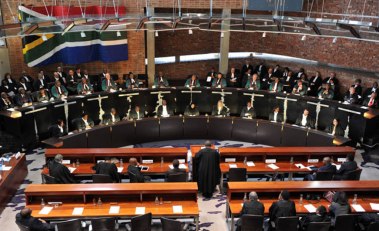
Seventeen million hostages freed — the moral universe can still bend towards justice!

South Africa's constitutional courtGood news!!! – a big victory today for justice and constitutional democracy (in South Africa).  In recent months, cynical politicians and an opportunistic businessman have tried to hold the seventeen million poorest South Africans (who receive social grants as their sole source of livelihood)  hostage for personal and political gain. This morning South Africa’s Constitutional Court demonstrated that the arc of the moral universe can still, sometimes, bend towards justice.

For at least the past year, Bathabile Dlamini, South Africa’s Minister of Social Development (and, appallingly, head of the ANC Women’s league), protected by president JZ, and Serge Belamant (CEO of publicly quoted company Net1, whose major shareholder is Allan Gray) have tried to manufacture a crisis – seemingly with the aim of forcing extortionist terms on South Africa, and holding the poorest in the country as ransom. (See here  for brilliant journalism which provides the background to this plot ) and here for an especially far-reaching, but informed speculation as to what might have been the sinister goals.)

This morning, justice trumped evil. The Constitutional Court’s ruling  included the following:

  • Net1 (through Cash Paymaster Services) has a constitutional obligation, and is required to continue paying social grants for the next twelve months.
  • Any adjustment to CPS contract (with the purpose solely of adjusting for increased costs) would need to be negotiated directly with National Treasury – whose Minister, Pravin Gordhan and staff have been, along with the court, stalwart heroes as South Africa’s political centre fights to push back against predatory kleptocracy).
  • Over the next twelve months, the Social Development department needs to put in place new arrangements for payment of social grants – and needs to report every quarter to the Constitutional Court on its progress in implementing these arrangements.
  • And, in a delicious example of just desserts, minister Bathabile Dlamini, needs to show the court by 31st March why she should not be held personally liable for costs associated with the lawsuit, filed to protect citizens against this cynical, willful act of political predation.

Repealing resource transparency – a shameful descent into collusion with criminality

President Trump Signs Executive Order In Oval Office Of The White House

In a world where anger increasingly rules, I  prefer to avoid outrage – but the vote to repeal transparency for oil and mining companies is unconscionable. How —  Republican members of the House  and Senate who voted on party lines for this repeal, Rex Tillerson (whose 2010 efforts to lobby against the measure have, now that he has become Secretary of State, seen fruition with this repeal) and, of course DT (who gleefully signed into law this license to collude with criminality) —  how do you sleep at night?

 Here, for those who might be unfamiliar with this area, is the background.

For the past forty plus years, there have been bipartisan efforts within the United States – and a global movement – to build a global regime that constrains corruption. The American Foreign Corrupt Practices Act, passed in 1977, was an early landmark moment in the process. American administrations, Republican and Democratic alike,  have moved to strengthen and universalize its impact by supporting the emergence of global pro-transparency and anti-corruption norms and standards.  Governments, civil society, and many private firms the world over have joined in  the effort. As I explore in the piece, innovations-in-globalized-regulation , though much remains to be done, much has been achieved. And now, in an appalling act of hubris, ignorance, entitlement and impunity, all of this is thrown into reverse. Greed is Trumps. Barbarity rules. Again, all who were complicit in this shameful act: how do you sleep at night?

Again, all who were complicit in this shameful act: how do you sleep at night?


This repeal is a murderous dagger. It announces ‘open season’ for the most venal on our planet to collude with one another to predate on the futures of the most vulnerable, hiding in the shadows as they wreak havoc.


For fragile states, resource abundance can be a curse. Mineral and oil resources attract money and power. With a capable state, the resulting windfalls can be a boon for development. But if states are weak, citizens end up gaining little, if anything. Indeed, as  the world learned about Blood Diamonds  (thanks to Leonardo DiCaprio and many others),  at the limit the result can be conflict, warlordism, state collapse, and death.

The Extractive Industries Transparency Initiative has built a powerful multistakeholder coalition to try and mitigate the risks of resource extraction in fragile states. The Chad-Cameroon pipeline project (about which I have also written, sympathetically) was a bold, controversial effort to reconcile massive oil investments with development gains – one in which Rex Tillerson’s Exxon played a pioneering (and, I would judge, constructive) role.


In May, 2011 Republican Senator Richard Lugar proudly introduced  an amendment to   the Dodd-Frank Act, which supported these efforts by requiring foreign and domestic companies listed on US stock exchanges to disclose their payments to governments for oil, gas and mining. This is the provision that Congress has now voted to repeal — and that, on February 14, 2017, in one of many moments that will live in infamy,  DT gleefully signed.  

As Thomas Hobbes taught us, when warlords are in control, life becomes nasty, brutish and short. Again, for all who voted for this repeal, how do you sleep at night?

Two cheers for the 2017 Governance and the Law World Development Report

wdr-governance-and-law-coverThe 2017 WDR  is a landmark document for the development community. Historically, the point of departure for development practitioners (including those within the World Bank) has been to promulgate technocratic, ‘best practice’ solutions to development challenges. For more than two decades, this ‘best practice’ approach has been put into question by a growing avalanche of research on the political, institutional and governance underpinnings of development. The 2017 WDR does an heroic job of assembling and synthesizing this voluminous research into a compelling statement of why ‘best practices’ fail to address some core constraints, and thus do not achieve their intended results.

Some will doubtless critique the report for its  promiscuous use of jargon. But empathy is called for. The WDR team surely confronted some formidable internal political challenges. It needed to frame its argumentation in a way that spoke directly to economists, who remain intellectually hegemonic within the organization. As important, it needed a framing that was politically acceptable across the range of the extraordinarily diverse constituencies that make up the Executive Directors of the Bank – from the United States, to China, to Russia, to the Nordic countries as well as Latin American, African and other Asian and European constituencies. My sense  is that the document has met this challenge. So a first loud cheer to the WDR for successfully, and hopefully irreversibly, consolidating the centrality of politics and institutions in the development discourse.

Turning to my second cheer, the 2017 WDR powerfully makes the case that an ongoing capacity to adapt, both politically and economically, is crucial for sustainable development – and thus that high priority should be given to the continuing cultivation of adaptive policies and institutions. In making this point, the WDR embraces the insistence of Daron Acemoglu & James Robinson in their widely read book, Why Nations Fail, on the centrality of ‘inclusive institutions’ for development success. And, in coming down  from the  Olympian heights of Acemoglu & Robinson’s very-long-run historical analysis, it moves the discourse further. It uses its terminological innovations to direct attention towards the following varieties of entry points:

  • ‘Contestability, preferences, and incentives’ – as key drivers of the possibility of change. (Note: ‘preferences’ is the way economists like to talk about ideas; and ‘incentives’ incorporates the role of institutions in shaping the rules of the game).
  • ‘Exclusion, capture and clientelism’ – as ways in which asymmetries of power can become locked-in, blocking the capacity to adapt.
  • ‘Power sharing, resource redistribution, sanctions and deterrence (agreement-enforcement), and dispute resolution institutions’ as entry points for fostering and sustaining agreements among contending parties. And:
  • ‘Elite bargaining, citizen engagement and international influences’ as key drivers of change.

Especially crucial is the high analytic priority that the WDR  gives to ‘exclusion, capture and clientelism’.  This focuses attention on a potentially tragic dynamic at the heart of development. Development success consolidates economic and political power among a subset of economic and political elites. This gives them both the incentive and the wherewithal to resist challenges from other aspirant elites . The result can be a political economy trap.

Policies that foster political and economic competition  support sustained dynamism.  But these very policies threaten incumbents all-too-human desire to enjoy unchallenged their only recently-acquired affluence and power. The result can be a reversal of  the very policies that are key for sustaining success.   In country after country (including more than a few  ‘Northern’ countries…..) we are witnessing one or another variant of this kind of  counter-reaction.

By putting  the necessity for development of a continuing capacity to adapt —  and the short, medium- and long-run drivers of how this capacity evolves — the 2017 WDR   invites development practitioners to focus on the tension between capture and continuing dynamism. Hence my second cheer. But — and this is why I withhold a third cheer — the document falls short of addressing the crucial question: given the risk of capture, what is to be done?

Addressing the question of what is to be done requires development practitioners to confront difficult dilemmas, and make uncomfortable choices. All too often, practitioners prefer to sweep these dilemmas under the carpet. But  in at least two areas real gains are being made in confronting and finding ways forward vis-a-vis these difficult governance-related development challenges — and the WDR would have been stronger if it had engaged with these areas more explicitly.  T

First, development practitioners across the range of sectors (education, health, environment, infrastructure, social protection and myriad other areas…..) work in contexts where governance is weak, and political constraints are profound. A great deal of work has been undertaken in recent decades (under the rubrics of ‘thinking and working politically’, ‘working with the grain’, ‘doing development differently’ and ‘problem-driven iterative adaptation’) as to how it might be possible to achieve some development gains in difficult governance environments – taking a short-to-medium-term perspective, and without necessarily transforming the broader governance environment. The WDR gives very little time to this class of governance intervention – ones which take the pre-existing governance environment as given, and seek ways of nonetheless achieving some development gains. It would be a development tragedy if the document were to be interpreted as arguing against governance-related initiatives that have real prospects of improving peoples’ lives, even if they don’t add to the capacity to adapt.

Second, and related, there can be a difficult trade-off between governance-related initiatives that yield development gains in the short-to-medium run, but risk creating problems of adaptability over the longer-term. Here are two of many possible examples :

  • In Mozambique, in the aftermath of civil war, should the country have moved rapidly to capitalize on prospects for investment in large-scale mega-projects, thereby cementing elite commitments to stability, but also locking-in rent-based elite bargains, (which is what they did) — or should it have attempted the painstaking and uncertain work of trying to build institutions capable of supporting broad-based growth, and in the interim leaving the political settlement vulnerable to reversal?
  • In Indonesia (in the chaotic aftermath of President Soeharto’s exit) and in Afghanistan (in the immediate aftermath of the international military intervention which overthrew the Taliban) should governments and donors have co-operated on moving finance rapidly to poor citizens through community-driven development initiatives with special-purpose institutional arrangements (which they did), even though these might risk adding to the complexity of later efforts at systematic institutional development?

Mozambique went ahead with its mega-projects, and Indonesia and Afghanistan with their CDD initiatives. These decisions strike me as sensible, though they arguably are inconsistent with the logic of ‘adaptability’ above all.

To underscore: in highlighting these dilemmas, my intent is not to diminish the value of the WDR. Rather it is to point to a key added set of questions that matter for operationalization. In addressing dilemmas along these lines, it is crucial not to become trapped in ‘either/or’ thinking. If we are to make progress with the messy, complex challenges that emerge once we think about development through a governance lens, we need to be especially vigilant to ensure not to throw out babies with bathwater.