LA homelessness: Setting the stage for painful choices – an empirical (re-)framing

In 2023, I began a program of research on some innovative governance arrangements for addressing homelessness that  LA’s political, civic, bureaucratic and private sector leaders put in place as part of a determined effort  to finally come to grips with a long-festering crisis (see here and here).  Over the past two years, the tide of  Los Angeles’  homelessness seemed to turn. However, as highlighted by some extraordinarily forthright and stark presentations  (available here) at a  recent meeting  of one of the new bodies –  the multistakeholder Leadership Table for Regional Homeless Alignment –   new budgetary and economic pressures threaten reversal.

In coming months I plan to track how the  governance arrangements respond to this new trial by fire. This piece (and an accompanying  technical note)  sets the stage for that work by laying out –  from an empirical and ‘technocratic’ rather than a governance perspective –  how I have come to understand LA’s homelessness crisis.  The analysis builds on some recent innovative applications of  systems analysis (here and here)  that  frame  homelessness  as a “flow”, rather than only as a “stock”.  As the systems approach suggests, framing homelessness as a flow both helps surface some perhaps under-recognized aspects of LA’s homelessness challenge, and directs attention to some potentially important questions vis-à-vis the policy response to the new, straitened circumstances.

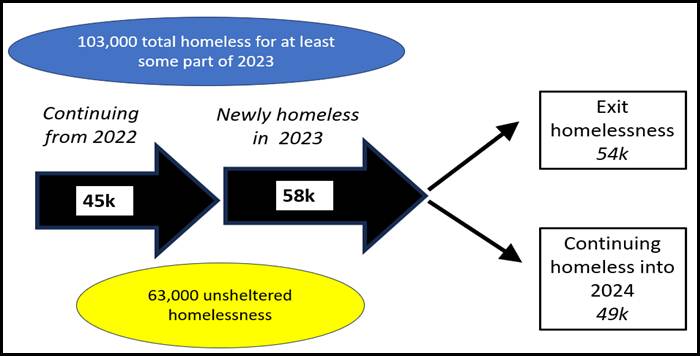
Figure 1: Homelessness in LA – inflows and outflows (2023)
Source:  Leadership Table

At first sight, Los Angeles’ challenge  seems straightforward: end homelessness for the 70,000 or so people  -roughly  50,000 of whom live on the streets –  identified as homeless in recent iterations of the region’s annual point-in-time (PIT)  count. However, as Figure 1 illustrates for 2023, the PIT count (a “stock”)  captures only a moment in an ongoing and much larger flow: in that year 103,000 people accessed  LA County’s homeless services. [Note that, while the analysis that follows draws principally on data from 2022/23, newly released data reports a 30% (!!!) increase to 133,000 in the number accessing these services in 2024/25.] Between 2020 and 2024, close to 300,000 people (3% of LA County’s population of 10 million) accessed the county’s homeless services at least once.

Viewed through a structural lens, the evidence is compelling that over time the aggregate number of people who enter into homelessness is driven by metropolitan-area level interactions between the cost of housing and income (both wages and safety net support) at the bottom end of the economy. As I summarize here, for many decades LA’s trends have been dismal vis-à-vis both housing and median-and-below wages . However, these structural drivers can only be reversed over the medium- and longer-term. In the near-term, the challenge is to make better use of existing resources.

How,  at a time when the regional economy is turning soft, the safety net is under threat, and funds to combat homelessness are set to contract, might available fiscal resources be more effectively deployed? The empirically-anchored analytical framework laid out in this piece might  hopefully  help address this near-term challenge.

Considered as a flow, homelessness is daunting in its complexity. Multiple drivers  lead to homelessness; there are multiple pathways through homelessness;  and multiple ways to exit. One way to cut through the complexity is to group the challenges posed by homelessness into three distinct ‘clusters’: 

  • Short-term homelessness –  those who enter and then exit homelessness within 6-12 month  (including initiatives to identify and pre-emptively support those most at risk of becoming homeless). 
  • ‘Slippery slope’ homelessness – those who lack/miss the ‘lifeboat’ of early exit and risk a deepening downward spiral.
  • ‘Chronic’ homelessness – those who have lived on the street for long enough and/or have personal vulnerabilities of a kind that render them unable to exit homelessness and live independently without sustained support.

The paragraphs that follow consider each of these, beginning with the last.

Many in LA view homelessness and chronic homelessness as synonymous. As the cluster framework signals,  this view is mistaken – though chronic homelessness indeed comprises the most highly visible aspect of homelessness,  and its magnitude  is large. (As the technical note details, the numbers vary depending on the definition used. According to LAHSA’s highly-granular  definition, in 2024 about 32,000 people were chronically homeless. Other estimates range widely –  from about  20-42,000 –   with the specifics varying according to the definition used.)

Careful micro-level research has shown that “housing first” (more precisely,  the provision of permanent supportive housing)  is the most effective and cost effective way of helping people who have been chronically homeless to live a stably housed life. Perhaps surprisingly to some, in recent years, LA has had an effective large-scale program of placing homeless people into permanent housing – about 20,000 annually, amounting to over 130,000 since 2017.  But permanent housing (especially with the necessary support services) does not come cheap; as of 2025, the LA region was spending well over $300 million annually on its PSH program.  

A central reason why implementing “housing first” is so costly is, of course, LA’s massive undersupply of affordable (and other) housing.  But this undersupply can only be addressed over the medium and longer-term – a narrow focus on “housing first” thus has little to offer vis-à-vis  the urgent immediate challenge of  how  best to deploy scarce fiscal resources to mitigate the damage to come.  Recognizing this brings to the fore   the two earlier stages in the homelessness “flow” –  short-term and slippery-slope homelessness. 

Estimates of the number of people who are homeless only for a short time vary widely. As the technical note details, “stock” estimates derived from the early-2024 PIT count range from 16-26,000, depending on how the cut-off duration is defined. This number is way below the 58,000 that, as per Figure 1, newly accessed homeless services over the course of 2023. [In 2024/25, the number newly accessing homeless services increased to 81,000.] A moment’s reflection will point to the reason for the disconnect –  most short-term homeless enter into and then exit from homelessness between  counts. As the companion technical note explores in detail, for most people  a spell of homelessness is relatively short: about 40% of those who become homeless exit within six months; an  additional 30% or so exit over the subsequent eighteen-month period; and a further 20% over the subsequent three years.  (Note that at the rates of exit just cited, nine out of ten people who become homeless  exit  over the subsequent five years – projecting forward this would imply that of the  60,000 people who became homeless in 2023, about 6,000 would remain so in 2028.)   

For at least three reasons, these seemingly rapid rates of exit should not be mis-interpreted as implying that homelessness is in large part self-correcting, with policy mattering little for how it evolves.  For one thing, the current rapid rates of exit are based on LA’s prevailing ambitious (and fiscally costly) efforts to reduce homelessness. In the coming period, as the presentations to the Leadership Table highlighted, budget cuts will undo a quite substantial part of this effort: entry into homelessness will accelerate;  rates of exit will slow.  For another, the number of people homeless at any point in time is the accumulated  total of those remaining homeless after initially becoming homeless in some prior year.  Increases are likely in the number of people who become newly homeless, the numbers will add up rapidly. Perhaps most fundamentally, the challenges of providing support and facilitating exit are not static –  what all-too-often happens to those who remain on the streets converts crisis into tragedy.  This last  brings us to the third ‘cluster – slippery slope homelessness.

As even casual observation of people living on the street reveals, there is a close association between homelessness and personal vulnerability. The background technical note details this association vis-a-vis  five sets of vulnerabilities: mental health (MH); substance abuse (SA); physical vulnerabilities, and vulnerabilities associated with prior experience  of prior foster care or incarceration.  As detailed there, an estimated 57% of an entering homeless cohort have at least one of the five vulnerabilities;  43% have none. (Note that while the impact of economic vulnerability is not analyzed directly, its role is implicit in the relatively  large share of  ‘none of the above’. )

Figure 2: Mental health and substance abuse among a (representative)  100 person homeless cohort  – change over  the course of  three years.
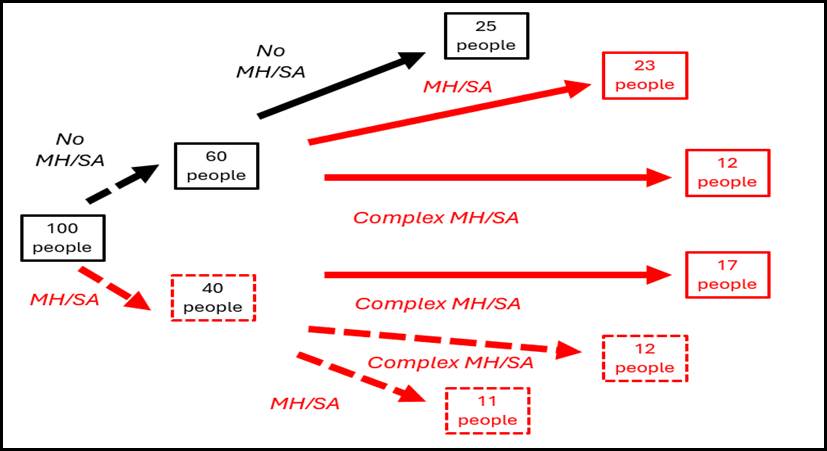
Crucially for policy, as Figure 2 above illustrates,  the homelessness-vulnerability association is not static  – the incidence of vulnerabilities among the continuing-homeless cohort changes with the passage of time. Why? Because mental health and substance abuse are both causes and consequences of homelessness.   Figure 2  provides specific estimates of the magnitudes by which  MH/SA challenges compound as a result of homelessness. (See the background note for details on how these “flow” parameters were estimated.) Forty of a representative cohort of  100 homeless people  had struggled with MH/SA issues prior to becoming homeless; for 17 of the 40, symptoms become more complex over the course of three homeless years. Even starker are the trends  among the 60 people who entered homelessness with no MH/SA challenges: After three years of homelessness, 35 of the 60 have MH/SA symptoms, including 12  who wrestle with complex MH/SA challenges.

Stepping back from the details, how might the three-cluster framework help address some urgent, looming policy challenges confronting LA’s efforts to address homelessness? At its recent meeting, the Leadership Table was put on notice that in the coming year, spending to address homelessness would need to be cut by about one-third (!!), even as the number of people becoming newly homeless would continue to rise. An obvious first step is to look for efficiency gains – how well are resources being used to deliver on programs already underway? But belt-tightening can only go so far. When the required cuts are large, attention also needs to be given to effectiveness – are we doing the right things? The three-cluster framework potentially offers some insights vis-à-vis the latter question.

Viewed as a “stock” the policy challenge is seemingly the relatively straightforward one of reducing numbers, with each person newly-housed (via, say, “housing first”) moving things closer to the goal, with priority for the chronically homeless. By contrast, viewing homelessness as a flow directs attention to the ‘short-term’ and ‘slippery-slope’ clusters –  and thus to the value of intervening  as early as possible in a person’s homelessness journey – the earlier the exit from homelessness, the lower are its personal, fiscal and social costs.   

Considering priorities through this latter lens, a variety of questions arise:   Are there cost effective ways of forestalling homelessness for those who are at greatest risk?    What facilitates rapid exit from homelessness?  For those for whom homelessness has begun to take hold, what can be done to reduce the risk of journeying all the way down the slippery slide to disaster?  

None of the above questions are new to those who have long labored to reduce homelessness.  Even so, at this moment of fiscal stringency when it is urgent to look again at how resources are being used, perhaps the empirical lens laid out in this note contributes in a small way to taking a more expansive view of the options available –  one that not only focuses on how to minimize damage to ongoing programs but also assesses comparatively  the cost effectiveness of a broad range of possibilities for  addressing our region’s homelessness crisis.
Hope in the dark? LA’s bold governance reforms to address homelessness

The drumbeat of dispiriting daily news makes it difficult to look beyond immediate crisis. Where to find hope? Los Angeles’ ongoing homelessness crisis might seem an especially unlikely place to look. As explored in detail here, every night nearly 50,000 people sleep unsheltered on the streets of Los Angeles County, and every year well over 60,000 people become newly homeless   – and the Trump administration’s efforts to shred the safety net threaten to make things much worse, soon.  Even so, as USC professor Yan Tang and I detail in a recent article in the National Civic Review,  a close look at how LA is addressing homelessness offers some unexpectedly good news.

Populists don’t just feed on socio-economic discontent. They feed on ineffective government” Ezra Klein and Derick Thompson argue in their bestselling book, Abundance, quoting two eminent scholars.  Klein and Thompson highlight failures in LA’s response to its twin crises of homelessness and a massive shortfall of affordable housing as exhibit number one in a broader indictment of progressive governance. But things have moved on. [Author’s note: This post was written prior to my recent ‘Achieving Abundance blog series; an updated version that explores in detail the links between homelessness in LA and the arguments laid out in that series will be forthcoming in a few weeks.]

As the Levy-Tang National Civic Review article details, the LA region’s  recent efforts to address homelessness  include some bold,  largely unheralded, but innovative and potentially transformative  governance reforms. These reforms, the article argues,  have the potential to provide a platform for far-reaching improvements in the effectiveness  of the LA region’s efforts to address its homelessness crisis.

Some of the governance reforms aim to bring more top-down coherence to how hierarchical authority is exercised. Others aim to foster greater horizontal alignment across jurisdictions and service providers.  The top-down reforms  are moving forward at breakneck speed – a new, consolidated Los Angeles County Department of Homeless Services and Housing, is scheduled to open on January 1, 2026.  Yet one can readily imagine a scenario in which, rather than embracing the possibilities of the new institutional environment, many of the multiple public and non-profit organizations working to address homelessness outside the umbrella of the new  department could become pre-occupied with fending for themselves.

The “horizontal”  governance reforms – the creation of two new multistakeholder bodies to support better alignment of approaches to homelessness across the LA region – potentially could address the risk of balkanization.   The county-wide adoption earlier this year of a set of top-line goals for reducing homelessness formulated by the two bodies points to their potential. However, unlike the new department, the multistakeholder bodies lack any obvious and established champion. While they are making substantial progress in clarifying and consolidating their roles going forward, the risk remains that the painstakingly constructed shared vision that led to their emergence could all-too-easily be washed away by the crises (and parochial interests) of the moment.

Indeed, if they are to succeed, the new governance arrangements will need to hit the ground running and successfully confront what is shaping up as a potentially massive  fiscal crisis. Addressing homelessness effectively takes resources: resources for support services, resources to help the most vulnerable pay their rents, and resources to expand the supply of affordable housing. In LA,  these costs are exacerbated not only by the number of people who are homeless,  but by decades of income stagnation for the bottom half of its residents on the one hand, and rising rents (fueled by an undersupply of housing) on the other.

A recent ballot initiative approved by voters raises about $1 billion annually (via increases in local sales taxes) to combat homelessness. One third of the resources is earmarked for a new initiative to build more affordable housing. The remaining two-thirds  replenish earlier (now expired) commitments – and are barely enough to sustain existing programs.  Even in the absence of the Trump cuts, the system already was overstretched. Current Trump administration budget proposals (some of which have so far been somewhat restrained by budget committees in the House and Senate)  include billions of dollars of further cuts  in rental assistance, in permanent housing support, in  Medicaid-funded housing for health initiatives, and in food stamps and other safety net programs. In the context of a regional economic slowdown and the already-extreme economic vulnerability of LA’s low-income earners, shredding the safety net could result in a tsunami of new homelessness.

What, then, is the balance between good news and bad news? It seems certain that bad news lies immediately ahead. Recent gains in reducing the number of people living on the streets will almost surely be reversed. Increases in homelessness could be large. Fiscal pressures will worsen. Daunting strategic decisions lie ahead. The new governance arrangements confront a trial by fire, even as they have barely left the starting gate.

But the following also is true: Prior to the recent reforms, LA’s governance arrangements to address homelessness were characterized by low trust, ambiguous authority, and the absence of any coherent ways of fostering co-operation and holding the system to account. As the National Civic Review article explores, the new arrangements address these weaknesses. They may not survive the trial that lies ahead, but they have a fighting chance.  Sometimes, crisis and adversity can focus effort in inspiring ways.  

Coming months will tell. Watch this space for updates.

Reducing homelessness – the power of achievable ambition

Beneath the surface of Los Angeles’ continuing homelessness crisis, something promising has been underway – a sustained effort by a a committed group of public officials, political and civic leaders from across the region to crafting a set of ambitious and achievable goals that can guide the region’s efforts. As I explore in an Op-Ed piece published today in the Los Angeles Times, “In a fragmented governance environment like L.A.’s — and for a multifaceted problem like homelessness — goal clarification is a vital early step. Clear goals serve as a shared point of reference for setting priorities, helping multiple participants to better align their choices. They provide a platform for institutions to be held accountable by the public.” https://www.latimes.com/opinion/story/2025-05-21/los-angeles-city-county-homelessness-goals

For those who cannot access the piece via the link, see below for the full pre-publication text.

******

“Los Angeles’ continuing struggle to reduce homelessness has become exhibit number one  for a broader critique of the failure of progressive governance. Recent tensions between city and county government over how to organize the provision of homeless services have not helped.  But look a little deeper  and something more promising comes into focus.

For the past nine months,  a committed group of public officials, political and civic leaders from across the LA region have been collaborating to develop a road map for reducing homelessness – and,  in so doing,  to break with  LA’s  longstanding pattern of overpromising and underdelivering.  Central to their endeavors has been the crafting by a multistakeholder  ‘Leadership Table’  of  a set of ambitious and achievable goals that can be a north star guiding the region’s efforts. 

These efforts reached a crucial milestone in late March, when LA County’s Board of Supervisors endorsed three monitorable  top-line goals, including specific targets for 2030.  One goal aims for a 20 percent reduction in the number of people becoming newly homeless each year. Another aims to place 30,000 people into permanent housing—an increase of over 50 percent from current levels. A third targets a reduction in the number of people living on the streets in 2030 by nearly a third. 

I have spent decades exploring comparatively, as both practitioner and scholar, the ways in which participatory approaches can enhance the public sector’s problem-solving ability. That experience shows that, far from being a pie-in-the-sky academic exercise, a focus on goals can yield enormous practical benefits.

In a fragmented governance environment like LA’s – and for a multi-faceted problem like homelessness – goal clarification is a vital early step. Clear goals serve as a point of reference for setting priorities and making difficult choices.  They provide a platform for civic accountability. Further, the combination of goals, their monitorability, and accountability to citizens fosters practicality – sustaining civic support requires that target goals are neither so modest as to cause cynicism, nor so overly-ambitious that they set the stage for failure. Viewed from this perspective, the way in which LA has gone about collaboratively crafting and codifying its top-line goals provides  a basis for cautious optimism that  its homelessness governance system may finally be on a path to sustained gains.

To be sure, at first blush the goal of reducing LA’s unsheltered population by  not-quite a third over five years is hardly headline-worthy. Ending homelessness would be relatively straightforward if the task was simply to find suitable housing for the approximately 50,000 people who currently live on LA County’s streets. Indeed, contrary to the common perception that little is being done, LA’s homelessness support system currently permanently re-houses about 20,000 people each year,  more than any other city in the country.

But the region’s homelessness crisis goes well beyond the number of people on the street at a point in time. Each year, a combination of wage stagnation, an extreme shortage of affordable housing, and other personal hardships results in over 60,000 people becoming newly homeless. Given these realities – plus the likelihood that federal budget cuts will shred the social safety net  – reaching the target of 30 percent less unsheltered homelessness by 2030 would be a major accomplishment. But getting there will require both public officials and civil society to move beyond business-as-usual.

For public officials,  clear, ambitious-and-achievable goals provides the requisite platform to stop endlessly cycling from one seemingly appealing initiative to another, and engage systematically with the dual challenges of improving effectiveness and efficiency.  Effectiveness calls for decisions on how to prioritize scarce resources: Which interventions are most effective in reducing inflow into homelessness? Which services and supports—psychological and social support, rental subsidies, or interim housing—best help homeless people get permanently housed?  And, looming above all of these, how to expand the supply of affordable housing?

Clarity vis-a-vis effectiveness  enables efficiency to move to the front-burner:  For each prioritized intervention, what is a minimum set of acceptable standards?  Do public, private and non-profit providers meet these standards? What will be the mechanisms for improving performance, or clawing back resources, from providers that fall short?

For civil society, an informed embrace of ambitious-and-achievable goals provides a basis for moving beyond exhortation and criticism, and embracing new ways of providing the accountability and oversight  needed to ensure meaningful results. This includes – and goes well beyond –  tracking whether agreed-upon targets are being met.

All-too-often insider interests that stand to lose from reforms that take effectiveness and efficiency seriously will try and protect the status quo. Civil society can bring countervailing pressure. Such pressure might come from  purpose-built multistakeholder arrangements (for example the ‘Leadership Table’ that led the goal-formulation effort) and other local organizing groups and coalitions.  Local officials will also no doubt recognize the risk that if they fail to make progress on these goals, voters may turn against them at the ballot box.

The people of LA identify homelessness as the region’s number one crisis. The successful recent effort to  collaboratively set and adopt ambitious and achievable  goals for 2030 is a major milestone. Success in meeting these goals  could rebuild the  public confidence in local government that has eroded over many years. To be sure, it’s still early days, and there is much uncertainty.  But the stakes couldn’t be higher. If LA’s effort to combat homelessness can stay on track, there would be a golden opportunity  to flip the narrative –  from being a poster child of  the failure of good intentions to address urgent social challenges, to becoming the face  of a renewed and effective 21st century progressivism.

From crisis to renewal? Affordable housing and homelessness in Los Angeles

In dark times, I take inspiration from the great social scientist Albert Hirschman’s commitment to  the search for ‘a bias for hope’, for  “avenues of escape from exaggerated notions of absolute obstacles…. avenues in  which the inventiveness of history  and a ‘passion for the possible’ are admitted as vital actors”. Viewed from this perspective, the point of departure for effective action is not some idealized vision of how things should be, but  clarity  as to how things actually are – with this clarity providing the basis for a search for practical entry points capable of setting far-reaching cumulative change in motion.  This passion for the possible has inspired my research and practice for almost a half century; it is the guiding spirit of a new  cycle of research on the Los Angeles’ region’s twin crises of homelessness and scarcity of affordable housing (AHHLA)  that I introduce in this piece.

Los Angeles’ AHHLA crisis startles. LA County is among the world’s affluent locales, with a  2023 per capita income of over $78,000, well above the American average. Yet that same year about 55,000 people were living on LA’s streets, and over 30,000 of them had been there for more than one year.  Even more startling, every year about 60,000 people become newly homeless –  a cumulative total over five years of almost 3 percent of LA County’s population of 10 million.  For those who live in Los Angeles (among whom, having moved here in 2023, I now count myself) the AHHLA crisis is existential. But its significance goes beyond the local.

As recent books by Ezra Klein and Derek Thompson (2025) and Marc Dunkelman (2025) explore in depth, a broad national reckoning is underway to assess both how failures of progressive governance contributed to the rise of toxic populism, and what might be the contours of a renewed and effective progressivism.  AHHLA is ground zero of this broader crisis of contemporary American progressivism. In what ways did decades of progressive good intentions gone wrong fuel LA’s current crisis? Are there hopeful lessons to be learned from recent efforts to address AHHLA about how progressive approaches to governance can become part of the solution?

Here, to set the stage for addressing the above questions,  is AHHLA’s economic backdrop:

  • Over the past four decades, even as the affluent have thrived,  earnings have been stagnant for the poorer half of LA’s population. As of the early 2020s, 16.6 percent of LA residents lived below baseline (rent-adjusted) measures of absolute poverty – the highest percentage among California’s regions. (California is the state with the highest percentage in the USA.) In the absence of the public safety net, the LA percentage would be 26%.
  • Beginning in the 1990s, a combination of population growth, the end of the extensive margin and slow growth environmentalism/NIMBYism has resulted in an increasingly severe shortage of housing. Between 1960 and 1990, about  200,000 housing units were built each decade; between 1990 and 2020,  the decadal average was below 75,000 units. In 2023, 45 percent of the households that earn below LA County’s median income paid more than half their income in rent.
  • The unit costs of building publicly-subsidized affordable housing in Los Angeles are almost two and a half times the equivalent costs in Colorado and Texas; startlingly, within LA the total development costs per square foot are 50 percent higher for publicly-subsidized  than for unsubsidized, market rate housing built for private (self-pay) buyers.

Considered together, the combination of stagnant incomes, rising unit costs and a near cessation of new housing construction (except at the more affluent end of the market) was to make accommodation increasingly unaffordable for lower-income Angelenos. In important part, and as per the title of an influential book, Homelessness is a Housing Problem. More on all of this in coming weeks and months.

LA’s fragmented  governance arrangements have enabled the AHHLA crisis to fester. This fragmentation  is especially ill-suited to addressing homelessness – a multi-faceted ‘wicked’ problem  that calls for a multi-sectoral, multi-jurisdictional and multistakeholder  response. The roots of LA’s fragmented governance can be traced back (at least in part; racial ‘redlining’ also played a role….) to a century-long aspiration to avoid centralized, urban machine politics and cultivate instead more localized, small-town-like governance.  Some tasks are the responsibility of LA County government, and others are diffused among the County’s 88 municipalities, of which the City of LA (with a population of four million) is the largest. This fragmentation has been exacerbated by deepening commitment over the past half-century to open, often legally-mandated public deliberative processes in advance of any action, which further complicates local government’s decision-making.  

Moving towards more top-down governance (of varying degrees of draconianism) offers one possible response to fragmentation.  But widening the distance between citizens and local government risks worsening what already is a crisis of civic alienation from government in many countries (not least of which the USA) the world over. Might there be a third way, one that finesses the traps of top-down governance accompanied by citizen alienation, or civic participation plus ineffectual governance? 

In recent conceptual work (see here for an introductory overview), I have explored the potential and limits of this third way. The articles delineate three distinct channels through which ‘socially-embedded’ approaches to public governance might simultaneously  counter fragmentation, encourage participation  and enhance effectiveness:

  • A collective effort to enhance clarity as to goals;
  • Streamlined, transparent  and participatory approaches to performance monitoring; and
  • Collaborative, multistakeholder arrangements for service provision.

Recent initiatives in LA to reduce homelessness incorporate all three channels. Why these initiatives were adopted,, and whether they will continue to unfold in ways that contribute to reducing homelessness is the focus of an ongoing research project in collaboration with  the University of Southern California’s Professor Yan Tang (an eminent scholar in the tradition of Elinor Ostrom’s work on collective action). As our research will explore, one key to success is whether the protagonists in the LA efforts will be able to craft a credible way of sharing gains and burdens within a framework that can advance the collective interest. What follows will hopefully whet the reader’s appetite for the research project.  

Strikingly, at least since the early 2010s,  momentum for scaling-up and reshaping how LA responds to its homelessness crisis has come less from government than from civil society. The efforts have unfolded in two phases. In a first phase, political and civic leaders championed a series of ballot measures that successfully raised billions of dollars to address AHHLA. However, by the late 2010s, there was a dawning realization that the magnitude of the challenge went way beyond earlier perceptions. Not only was further financing required, effectively addressing the twin crises called for better  co-operation among multiple stakeholders – something that the region’s fragmented institutions were not well placed to achieve.  A 2021 report commissioned by civil society champions took stock of the governance challenges, and proposed a menu of reforms. Partly in response to this report, Los Angeles County’s Board of Supervisors  established a Blue Ribbon Commission on Homelessness Governance  and subsequently adopted its recommendations.

Since mid-2024, there has been an extraordinary burst of energy and  reform aimed at aligning LA’s multiple stakeholders  around a coherent governance platform for reducing homelessness. Major initiatives include:

  • The creation by LA County’s Board of Supervisors of a robust, formally-empowered multistakeholder platform, with a mandate to “help align the region’s approach to homelessness and provide critical accountability and oversight to ensure more meaningful results”.  
  • The  development and official adoption of specific, measurable targets for reducing  homelessness.  
  • The initiation of work by  the Los Angeles County Affordable Housing Solutions Agency (LACAHSA), established in a 2022 resolution of the California State Senate to increase the availability and affordability of housing in LA.
  • A radical restructuring (currently at an early stage, but on an accelerated timetable)  of the lead public  LA County and City agencies responsible for overseeing and implementing the LA region’s response.
  • A new effort to specify performance standards for each of the many elements that go into the homelessness response – as a necessary basis for both resource allocation and accountability.

The hope is that the above initiatives will together finally provide the coherence and momentum needed to make real inroads into  homelessness – and thereby  break a longstanding corrosive cycle of overpromising and then underdelivering.  Whether this will happen remains uncertain,  but if it does  LA could go from being seen as a notorious example of the failure of well-intentioned progressivism to effectively address urgent social challenges, to  becoming an exemplar of a renewed, legitimate and effective 21st century progressivism. What happens next thus matters well beyond LA itself.  Watch this space for further updates.