
100 DAY UPDATE: Protecting the guardrails of democracy – some lessons from South Africa

In early February, I wrote a blog post that laid out some lessons for today’s USA’s from South Africa’s efforts to protect the guardrails of democracy. Here is a link to the piece.  A hundred days into the Trump administration, how well does the piece stand the test of time? While the four lessons it highlighted (see the end of this post for a summary…..) remain reasonably on target,   for at least three reasons South Africa’s experience turns out to be a more imperfect lens for understanding how to meet the challenges of sustaining democracy in the face of hostile actors than I realized at the time of writing.

First is a fundamental difference between South Africa’s early 1990s struggles to stay on a democratic path and those of the contemporary USA. In South Africa, those in control of the state (FW de Klerk’s National Party), while hesitant, wanted to go down the path of democratic constitutional reform. By contrast, in early 2025 USA,  the levers of government seem unequivocally in the hands of those who have demonstrated no commitment to a constitutional democratic order.

Second, while top-down cronyism aptly describes at least part of Jacob Zuma’s South Africa, and Donald Trump’s USA, its consequences depend in important part on the character and commitment of  the leaders. I won’t try to parse which of the two is more corrupt. But what does seem clear is that Jacob  Zuma – whose life had been shaped by the African National Congress and its struggle against apartheid (including ten years’ imprisonment with Nelson Mandela on Robben Island)  – was committed in at least some part of his identity  to the ANC’s aspirations and values. These values included longstanding, deeply-rooted commitments to democracy, to non-racialism, and to the rule of law. These commitments required Zuma to at least think twice before acting in ways that were directly contrary to these values.  Donald Trump shows no evidence of any similar commitment and associated restraint.  

Third is the relentless ideological zeal of at least parts of the Trump administration. An anti-government discourse has long been part of the Republican Party’s DNA. Even so,  I have been startled by the (Musk-ian) recklessness with which agencies have been dismantled, heedless of consequences in the real world. Delving further into the  ideological pedigree of the ideas held by another part of Trump’s unwieldy (but unfailingly loyal) coalition has left me feeling even more shaken and (a little) vulnerable.

Beneath the sometimes genteel language of political philosophy is the stuff of nightmares. To illustrate, here is a quote from Patrick Deneen (whose intellectual pedigree passes through Princeton, Georgetown, and currently the University of Notre Dame, and who both JD Vance and Pete Hegseth have found inspirational):

What is needed, in short, is regime change – the peaceful but vigorous overthrow of a corrupt and corrupting liberal ruling class and the creation of a postliberal order…..Where necessary, those who currently occupy positions of economic, cultural and political power must be constrained and disciplined by the assertion of popular power…… The power sought is not merely to balance the current elite, but to replace it…..The aim should not be a form of ‘democratic pluralism’ that imagines a successful regime comprised of checks and balances, but rather the creation of a new elite that is aligned with the values and needs of ordinary working people”.

For those of us who know history’s catastrophes  deep in our bones, these words are chilling. Perhaps the one silver lining is that, as of this time of writing, the agenda has been laid bare, its execution has been chaotic, and it is (perhaps) being stopped in its tracks by increasingly mobilized resistance. So, as with so much of my work these days, I’ll end by taking inspiration from Albert Hirschman’s bias for hope – in this instance the hope that, as per the first lesson of the February post, American democracy can indeed make it intact to the November 2026 mid-term elections.

*****

Here are the four “lessons from South Africa” laid out in the February piece:

Lesson #1: For the next 21 months,  the unwavering navigational north star is to get  to the  November, 2026 midterms with the machinery of electoral democracy still fully functional – avoid being knocked off course by even the most venal provocations.

Lesson #2: Leveraging checks and balances  lays important, necessary ground for victory in the struggle against tyranny – but its victories are not in themselves decisive.

Lesson #3: Keeping democratic space open requires a coalition that is broader than the usual fault lines of political partisanship –   a  sense of urgency and willingness to act not only from ‘natural’  opponents but from elite actors for whom it is more expedient to stay silent.

Lesson #4:  A vision of democratic renewal is key to a decisive victory against encroaching tyranny – more than short- and medium-term band aids are needed.
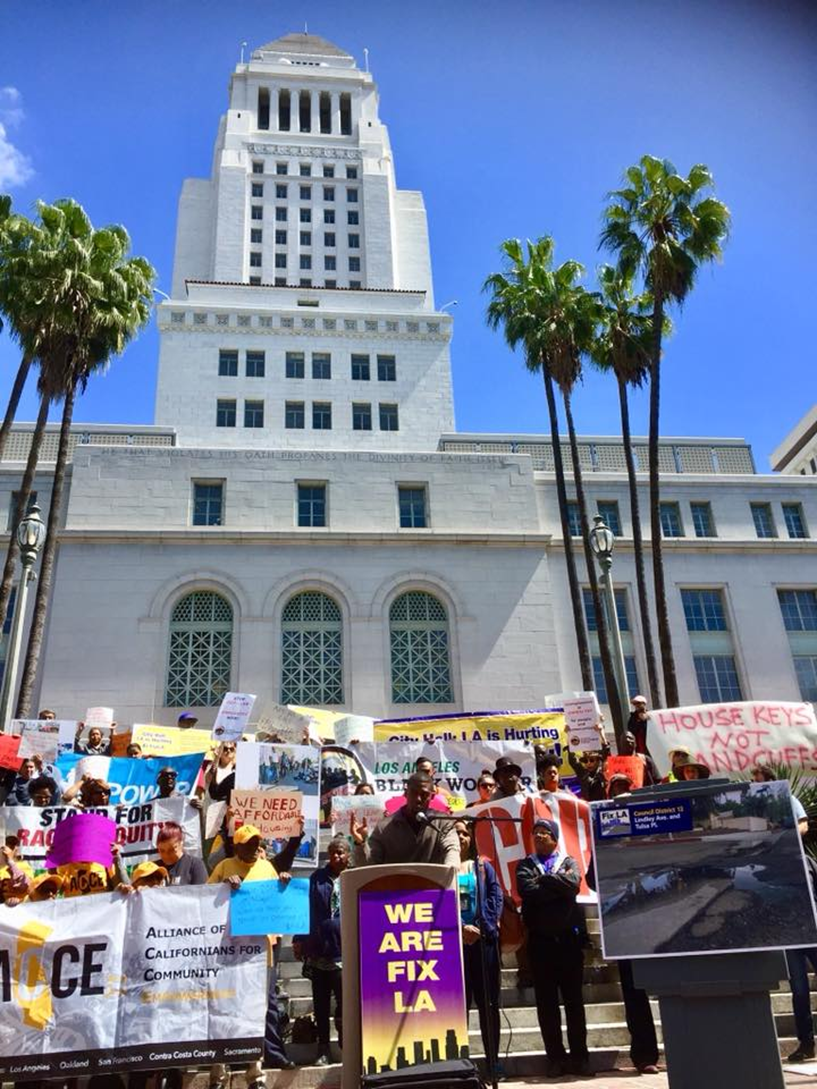
From crisis to renewal? Affordable housing and homelessness in Los Angeles

In dark times, I take inspiration from the great social scientist Albert Hirschman’s commitment to  the search for ‘a bias for hope’, for  “avenues of escape from exaggerated notions of absolute obstacles…. avenues in  which the inventiveness of history  and a ‘passion for the possible’ are admitted as vital actors”. Viewed from this perspective, the point of departure for effective action is not some idealized vision of how things should be, but  clarity  as to how things actually are – with this clarity providing the basis for a search for practical entry points capable of setting far-reaching cumulative change in motion.  This passion for the possible has inspired my research and practice for almost a half century; it is the guiding spirit of a new  cycle of research on the Los Angeles’ region’s twin crises of homelessness and scarcity of affordable housing (AHHLA)  that I introduce in this piece.

Los Angeles’ AHHLA crisis startles. LA County is among the world’s affluent locales, with a  2023 per capita income of over $78,000, well above the American average. Yet that same year about 55,000 people were living on LA’s streets, and over 30,000 of them had been there for more than one year.  Even more startling, every year about 60,000 people become newly homeless –  a cumulative total over five years of almost 3 percent of LA County’s population of 10 million.  For those who live in Los Angeles (among whom, having moved here in 2023, I now count myself) the AHHLA crisis is existential. But its significance goes beyond the local.

As recent books by Ezra Klein and Derek Thompson (2025) and Marc Dunkelman (2025) explore in depth, a broad national reckoning is underway to assess both how failures of progressive governance contributed to the rise of toxic populism, and what might be the contours of a renewed and effective progressivism.  AHHLA is ground zero of this broader crisis of contemporary American progressivism. In what ways did decades of progressive good intentions gone wrong fuel LA’s current crisis? Are there hopeful lessons to be learned from recent efforts to address AHHLA about how progressive approaches to governance can become part of the solution?

Here, to set the stage for addressing the above questions,  is AHHLA’s economic backdrop:

  • Over the past four decades, even as the affluent have thrived,  earnings have been stagnant for the poorer half of LA’s population. As of the early 2020s, 16.6 percent of LA residents lived below baseline (rent-adjusted) measures of absolute poverty – the highest percentage among California’s regions. (California is the state with the highest percentage in the USA.) In the absence of the public safety net, the LA percentage would be 26%.
  • Beginning in the 1990s, a combination of population growth, the end of the extensive margin and slow growth environmentalism/NIMBYism has resulted in an increasingly severe shortage of housing. Between 1960 and 1990, about  200,000 housing units were built each decade; between 1990 and 2020,  the decadal average was below 75,000 units. In 2023, 45 percent of the households that earn below LA County’s median income paid more than half their income in rent.
  • The unit costs of building publicly-subsidized affordable housing in Los Angeles are almost two and a half times the equivalent costs in Colorado and Texas; startlingly, within LA the total development costs per square foot are 50 percent higher for publicly-subsidized  than for unsubsidized, market rate housing built for private (self-pay) buyers.

Considered together, the combination of stagnant incomes, rising unit costs and a near cessation of new housing construction (except at the more affluent end of the market) was to make accommodation increasingly unaffordable for lower-income Angelenos. In important part, and as per the title of an influential book, Homelessness is a Housing Problem. More on all of this in coming weeks and months.

LA’s fragmented  governance arrangements have enabled the AHHLA crisis to fester. This fragmentation  is especially ill-suited to addressing homelessness – a multi-faceted ‘wicked’ problem  that calls for a multi-sectoral, multi-jurisdictional and multistakeholder  response. The roots of LA’s fragmented governance can be traced back (at least in part; racial ‘redlining’ also played a role….) to a century-long aspiration to avoid centralized, urban machine politics and cultivate instead more localized, small-town-like governance.  Some tasks are the responsibility of LA County government, and others are diffused among the County’s 88 municipalities, of which the City of LA (with a population of four million) is the largest. This fragmentation has been exacerbated by deepening commitment over the past half-century to open, often legally-mandated public deliberative processes in advance of any action, which further complicates local government’s decision-making.  

Moving towards more top-down governance (of varying degrees of draconianism) offers one possible response to fragmentation.  But widening the distance between citizens and local government risks worsening what already is a crisis of civic alienation from government in many countries (not least of which the USA) the world over. Might there be a third way, one that finesses the traps of top-down governance accompanied by citizen alienation, or civic participation plus ineffectual governance? 

In recent conceptual work (see here for an introductory overview), I have explored the potential and limits of this third way. The articles delineate three distinct channels through which ‘socially-embedded’ approaches to public governance might simultaneously  counter fragmentation, encourage participation  and enhance effectiveness:

  • A collective effort to enhance clarity as to goals;
  • Streamlined, transparent  and participatory approaches to performance monitoring; and
  • Collaborative, multistakeholder arrangements for service provision.

Recent initiatives in LA to reduce homelessness incorporate all three channels. Why these initiatives were adopted,, and whether they will continue to unfold in ways that contribute to reducing homelessness is the focus of an ongoing research project in collaboration with  the University of Southern California’s Professor Yan Tang (an eminent scholar in the tradition of Elinor Ostrom’s work on collective action). As our research will explore, one key to success is whether the protagonists in the LA efforts will be able to craft a credible way of sharing gains and burdens within a framework that can advance the collective interest. What follows will hopefully whet the reader’s appetite for the research project.  

Strikingly, at least since the early 2010s,  momentum for scaling-up and reshaping how LA responds to its homelessness crisis has come less from government than from civil society. The efforts have unfolded in two phases. In a first phase, political and civic leaders championed a series of ballot measures that successfully raised billions of dollars to address AHHLA. However, by the late 2010s, there was a dawning realization that the magnitude of the challenge went way beyond earlier perceptions. Not only was further financing required, effectively addressing the twin crises called for better  co-operation among multiple stakeholders – something that the region’s fragmented institutions were not well placed to achieve.  A 2021 report commissioned by civil society champions took stock of the governance challenges, and proposed a menu of reforms. Partly in response to this report, Los Angeles County’s Board of Supervisors  established a Blue Ribbon Commission on Homelessness Governance  and subsequently adopted its recommendations.

Since mid-2024, there has been an extraordinary burst of energy and  reform aimed at aligning LA’s multiple stakeholders  around a coherent governance platform for reducing homelessness. Major initiatives include:

  • The creation by LA County’s Board of Supervisors of a robust, formally-empowered multistakeholder platform, with a mandate to “help align the region’s approach to homelessness and provide critical accountability and oversight to ensure more meaningful results”.  
  • The  development and official adoption of specific, measurable targets for reducing  homelessness.  
  • The initiation of work by  the Los Angeles County Affordable Housing Solutions Agency (LACAHSA), established in a 2022 resolution of the California State Senate to increase the availability and affordability of housing in LA.
  • A radical restructuring (currently at an early stage, but on an accelerated timetable)  of the lead public  LA County and City agencies responsible for overseeing and implementing the LA region’s response.
  • A new effort to specify performance standards for each of the many elements that go into the homelessness response – as a necessary basis for both resource allocation and accountability.

The hope is that the above initiatives will together finally provide the coherence and momentum needed to make real inroads into  homelessness – and thereby  break a longstanding corrosive cycle of overpromising and then underdelivering.  Whether this will happen remains uncertain,  but if it does  LA could go from being seen as a notorious example of the failure of well-intentioned progressivism to effectively address urgent social challenges, to  becoming an exemplar of a renewed, legitimate and effective 21st century progressivism. What happens next thus matters well beyond LA itself.  Watch this space for further updates. 

Now what? The despair, complacency and (un-strategic) resistance traps

Back in 2016/17, when I was living in Washington, resistance was in the air. Resistance was not futile, but it turns out to not have been enough – so here we are. As history is again teaching us, in moments like these we risk falling into any one of a variety of traps. [One trap, which I am working to avoid in this opening paragraph – even as a principal purpose of this blog post is to share some extraordinarily apposite historical material – is to be too quick to draw the H—– or the Na– analogy……]. Complacency can be a trap (see the quotes below from Sebastian Haffner…). So, too, (as we learn from the same historical example…..) is unstrategic resistance – it plays into the hands of those who see accelerating polarization as the way to open up doors to personalized authoritarianism that had so far remained closed.

But, as we also are learning yet again, in times of crisis a nostalgic call to go back to the way it was cannot trump the peddlers of rage. As Antonio Gramsci understood, the crisis is precisely that “the old is dying, the new cannot be born, and a great variety of morbid symptoms appear.” As readers of my Working with the Grain blogs know, my longstanding, Quixotic quest has been to try and give some shape to the “new”. (See, for example, here and here.) This effort continues; I have much new work to share in coming weeks and months. Today, though, I can’t resist sharing some gleanings from eight years ago that, yet again, serve for me as wake up calls. The photograph that leads this blog (….it can be a source of morbid amusement to play with possible captions…….) is new. But as you can see here (where you can also see the original photograph…..), the text remains the same……

********

[July, 2018/October 2016]: Eighteen months into the Trump administration, I continue to be startled at the way so much of the Republican establishment has settled into a ‘politics as usual’ comfort zone, along the lines of ‘we may not like him, but many of our voters do, so for now we’ll go along’.    In the spirit of George Santayana (‘those who cannot remember history are condemned to repeat it’) here are a few extracts from three classic books on early 1930s Germany. (In the spirit of full disclosure, I wrote this piece in October, 2016; I’ve updated the first para, everything else remains unchanged.)   I begin with some contemporaneous observations (written by 25 year old Sebastian Haffner in 1939:

“At first the revolution only gave the impression of being a ‘historical event’ like any other: a matter for the press that might just possibly have some effect on the public mood. There was no revolution on January 30, 1933, just a change of government….. The general opinion was that it was not the Nazis who had won, but the bourgeois parties of the right, who had ‘captured’ the Nazis and held all the key positions in the government……. At the time, while I experienced the sequence of events it was not possible to gauge their significance. I felt, intensely, the choking, nauseous character of it all, but I was unable to grasp its constituent parts and place them in an overall order. Each attempt was frustrated and veiled by those endless useless discussions in which we attempted again and again to fit the events into an obsolete, unsuitable scheme of political ideas…….  How infinitely stupid the attempts at justification, how hopelessly superficial the constructions with which the intellect tried to cover up the proper feeling of dread and disgust. How stale all the isms we brought up. I shudder to think of it. …. Daily life went on as before, though it had now definitely become ghostly and unreal, and was daily mocked by the events that served as its background….” – Sebastian Haffner, Defying Hitler: A memoir (pp. 104; 136-7)

And here is a more scholarly description of some aspects of the process from Richard Evans: “Voters were not really looking for anything very concrete from the Nazi Party in 1930. They were, instead, protesting against the failure of the Weimar Republic. Many of them, too, particularly in rural areas, small towns, small workshops, culturally conservative families, older age groups, or the middle-class nationalist political milieu, may have been registering their alienation from the cultural and political modernity for which the Republic stood……. While conventional politicians delivered lectures, or spoke in a style that was orotund and pompous, flat and dull…..Hitler gained much of his oratorical success by telling his audiences what they wanted to hear. He used simple, straightforward language that ordinary people could understand, short sentences, powerful emotive slogans…..[General] Schleicher now [January 1933] saw a Hitler Chancellorship as a welcome solution: ‘If Hitler wants to establish a dictatorship in the Reich’, he said confidently, ‘then the army will be the dictatorship within the dictatorship’…” Richard Evans, The Coming of the Third Reichpp. 265; 171

And here is an extract from Ian Kershaw: “Hitler was, in fact, in no position to act as an outright dictator when he came to office on 30 January, 1933. As long as [President] Hindenburg lived, there was a potential rival source of loyalty — not least for the army…… ” [BL: Then, as I summarized in an earlier post, came the burning of the Reichstag……and Hindenburg’s death in mid-1934]….. “…By summer 1934, when Hitler combined the headship of state with the leadership of government, his power had effectively shed formal constraints on its usage…. Conventional forms of government were increasingly exposed to the arbitrary inroads of personalized power. It was a recipe for disaster….” Ian Kershaw, Hitler: A biography.

Eighteen months after life had seemed normal,  disaster was well underway……