The drumbeat of dispiriting daily news makes it difficult to look beyond immediate crisis. Where to find hope? Los Angeles’ ongoing homelessness crisis might seem an especially unlikely place to look. As explored in detail here, every night nearly 50,000 people sleep unsheltered on the streets of Los Angeles County, and every year well over 60,000 people become newly homeless – and the Trump administration’s efforts to shred the safety net threaten to make things much worse, soon. Even so, as USC professor Yan Tang and I detail in a recent article in the National Civic Review, a close look at how LA is addressing homelessness offers some unexpectedly good news.
“Populists don’t just feed on socio-economic discontent. They feed on ineffective government” Ezra Klein and Derick Thompson argue in their bestselling book, Abundance, quoting two eminent scholars. Klein and Thompson highlight failures in LA’s response to its twin crises of homelessness and a massive shortfall of affordable housing as exhibit number one in a broader indictment of progressive governance. But things have moved on. [Author’s note: This post was written prior to my recent ‘Achieving Abundance blog series; an updated version that explores in detail the links between homelessness in LA and the arguments laid out in that series will be forthcoming in a few weeks.]
As the Levy-Tang National Civic Review article details, the LA region’s recent efforts to address homelessness include some bold, largely unheralded, but innovative and potentially transformative governance reforms. These reforms, the article argues, have the potential to provide a platform for far-reaching improvements in the effectiveness of the LA region’s efforts to address its homelessness crisis.
Some of the governance reforms aim to bring more top-down coherence to how hierarchical authority is exercised. Others aim to foster greater horizontal alignment across jurisdictions and service providers. The top-down reforms are moving forward at breakneck speed – a new, consolidated Los Angeles County Department of Homeless Services and Housing, is scheduled to open on January 1, 2026. Yet one can readily imagine a scenario in which, rather than embracing the possibilities of the new institutional environment, many of the multiple public and non-profit organizations working to address homelessness outside the umbrella of the new department could become pre-occupied with fending for themselves.
The “horizontal” governance reforms – the creation of two new multistakeholder bodies to support better alignment of approaches to homelessness across the LA region – potentially could address the risk of balkanization. The county-wide adoption earlier this year of a set of top-line goals for reducing homelessness formulated by the two bodies points to their potential. However, unlike the new department, the multistakeholder bodies lack any obvious and established champion. While they are making substantial progress in clarifying and consolidating their roles going forward, the risk remains that the painstakingly constructed shared vision that led to their emergence could all-too-easily be washed away by the crises (and parochial interests) of the moment.
Indeed, if they are to succeed, the new governance arrangements will need to hit the ground running and successfully confront what is shaping up as a potentially massive fiscal crisis. Addressing homelessness effectively takes resources: resources for support services, resources to help the most vulnerable pay their rents, and resources to expand the supply of affordable housing. In LA, these costs are exacerbated not only by the number of people who are homeless, but by decades of income stagnation for the bottom half of its residents on the one hand, and rising rents (fueled by an undersupply of housing) on the other.
A recent ballot initiative approved by voters raises about $1 billion annually (via increases in local sales taxes) to combat homelessness. One third of the resources is earmarked for a new initiative to build more affordable housing. The remaining two-thirds replenish earlier (now expired) commitments – and are barely enough to sustain existing programs. Even in the absence of the Trump cuts, the system already was overstretched. Current Trump administration budget proposals (some of which have so far been somewhat restrained by budget committees in the House and Senate) include billions of dollars of further cuts in rental assistance, in permanent housing support, in Medicaid-funded housing for health initiatives, and in food stamps and other safety net programs. In the context of a regional economic slowdown and the already-extreme economic vulnerability of LA’s low-income earners, shredding the safety net could result in a tsunami of new homelessness.
What, then, is the balance between good news and bad news? It seems certain that bad news lies immediately ahead. Recent gains in reducing the number of people living on the streets will almost surely be reversed. Increases in homelessness could be large. Fiscal pressures will worsen. Daunting strategic decisions lie ahead. The new governance arrangements confront a trial by fire, even as they have barely left the starting gate.
But the following also is true: Prior to the recent reforms, LA’s governance arrangements to address homelessness were characterized by low trust, ambiguous authority, and the absence of any coherent ways of fostering co-operation and holding the system to account. As the National Civic Review article explores, the new arrangements address these weaknesses. They may not survive the trial that lies ahead, but they have a fighting chance. Sometimes, crisis and adversity can focus effort in inspiring ways.
Coming months will tell. Watch this space for updates.
Changing times bring changing questions. For decades, my work has focused on incremental ways to improve development and governance in the midst of messiness. Now, though, in many countries these are times of decay and rage. When and how the fever will break is unknowable. So for now I choose to look beyond incrementalism and explore the broader challenge of better understanding – and fostering – renewal.
In exploring renewal, I take inspiration from the work of the great twentieth century social scientist Albert Hirschman. (See here,here and here.) Hirschman identified three distinct phases in a (repeating) cycle of political, social and economic change: a phase of vibrancy, underpinned by hope; a phase of disillusion, anger and conflict; followed (if a continually deepening downward spiral can be averted) by a phase of renewal. In recent papers, I explored how this Hirschman cycle has played out in recent decades in South Africa and in the USA. In both countries, the cycle was driven by changes in two sets of perceptions – in the tolerance for inequality, and in perceptions as to the legitimacy of the public domain. Citizens have become increasingly skeptical as to the public sector’s effectiveness, and increasingly question whether the purposes the public sector pursues are ones for which it has a mandate, and are in the national interest.
My new research, introduced in this post, focuses on the ways in which interactions between citizens and the public sector shape perceptions of legitimacy – in particular whether “socially-embedded bureaucracy” might help turn around disillusion with the public domain. As defined here (and elaborated in this accompanying paper) a socially-embedded bureaucracy (SEB) is characterized by:
“problem-focused relationships of co-operation between staff within public bureaucracies and stakeholders outside of government, including governance arrangements that support such co-operation”.
At least on the surface, initiatives that strengthen SEB seemingly have the potential to help renew the legitimacy of the public domain by cultivating trust – and thereby reinvigorate society’s capacity to achieve win-win outcomes to mixed motive bargaining challenges – not only at the micro-level, but systemically as well.
Notwithstanding its surface plausibility, the case for championing SEB is far from open-and-shut. On the one hand, among protagonists of SEB, enthusiasm all-too-easily outruns both the empirical evidence and conceptual clarity. On the other, SEB is inconsistent with mainstream conceptions of public sector governance; as a result its potential is all-too-easily dismissed. My new work aims to help put the empirical and (especially) conceptual platform of SEB discourse on a sounder footing. The work addresses two inter-related questions:
At the micro-level: Can SEB help improve public sector performance?
At the systemic level: Insofar as SEB indeed can help improve public sector performance, might it also transform perceptions more broadly, and in particular help renew the perceived legitimacy of the public domain?
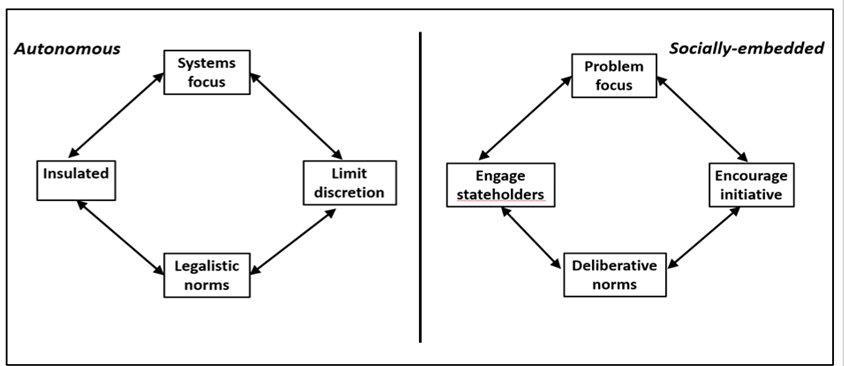
To begin with the micro-level, as the figure below highlights, the contrast is stark between SEB and conventional notions of how public bureaucracies should be governed. In the conventional view, governance is organized hierarchically, with a focus on ‘getting the systems right’ Citizens engage upstream in the chain via their selection of political representatives who oversee both policymaking and implementation. The tasks of public officials are defined by legalistic, rule-bound processes, which also insulate public bureaucracy from political interference. Civil society’s governance role is to bring pressure from the demand-side to help ‘hold government to account’. By contrast, SEB is problem- rather than systems-oriented; it incorporates horizontal as well as hierarchical governance arrangements; interactions (both within the bureaucracy and at the interface with civil society) are less legalistic and more adaptive, oriented towards deliberation and fostering initiative.
These distinctive characteristics potentially enable SEB to improve public sector performance via three channels which are unavailable to insulated bureaucratic hierarchies:
SEBs potentially can foster synergistic gains from co-operation between public bureaucracies and non-governmental actors;
SEBs potentially can transform the governance arrangements for monitoring and enforcement from a morass of red tape to trust-building interactions between public officials and service recipients; and
SEB potentially supports developmental alliances among reform-oriented public officials and civil society actors – thereby enabling an unambiguous focus on the (developmental) public purpose, while obviating the risk of capture.
The above is not intended to imply that SEB necessarily is superior. Social embeddedness risks adding messiness in contexts where the priority task is to enhance bureaucratic coherence; it risks enabling new modes of predatory capture of public resources. But, as recent syntheses of the empirical evidence underscore, it does suggest that it is, at the least, premature to be dismissive of SEB’s possibilities. Don’t risk throwing out the baby with the bathwater.
At the systemic-level, a very different (and again controversial) case for SEB emerges. As the background paper explores, social learning and an associated cultivation of ‘pro-sociality’ is central to the micro-level argument. Might such learning cascade upwards to the systemic level, and help buttress citizens’ perceptions of the legitimacy of the public domain? Answering this question calls for careful unbundling of interactions between public effectiveness, trust, trustworthiness, social cohesion and legitimacy – a task I will take on in a subsequent blog (and accompanying background paper). For now, what can suffice to make the key point is to contrast two contributions, fifteen years apart, by Margaret Levi, former president of the American Political Science Association.
In 2007, Levi (with co-authors Karen Cook and Russell Hardin) argued that a pre-occupation with relationships of trust between civil society and public bureaucracy is at best a distraction – and at worst a way of weakening rule-boundedness and increasing the risk of capture. Their critique is captured vividly in the title of their book, Co-operation Without Trust. Championing institutionalism, they determinedly push back against a too-easy extrapolation from micro-level success stories of co-operation to the systemic level:
“When we are assessing the reliability of governments and politicians, what we ultimately put our confidence in is the quality of the institutional arrangements within which they operate…. At the personal level, relational trust makes our day-to-day lives richer and more manageable. More often, however, and in many varied contexts, we co-operate without trust.”
The above argument is eminently plausible in contexts where institutions are strong and stable. It holds up less well, however, in contexts where a downward spiral of accelerating distrust in the public domain is underway, with institutions increasingly under threat. For one thing, institutional guardrails have turned out to be more fragile than many (myself included) might have hoped. Further, as I explore in a forthcoming paper with South Africancivil society activist Mark Heywood, in contexts of declining state capability a pre-occupation with ‘holding government to account’ can have the unintended consequence of making public officials feel increasingly beleaguered and reluctant to experiment, while fueling civic disillusion.
Once disillusion and institutional decay have taken hold, the necessary first step in fostering reversal is not yet-another -round of institutional engineering, but rather to find ways to renew hope in the possibility and desirability of achieving collective gains through co-operation,. In that spirit, and in contrast to the 2007 book, here is what Levi and Zachary Ugolnik argued in 2023 in the lead article of an ambitious 2023 exploration of pathways to “creating a new moral political economy”:
“A new moral political economy….[will be centered around]….some form of sociality and cooperation….It demands attention to the governance arrangements that facilitate, even generate, prosocial behavior”.
There are, to be sure, many ways to foster pro-sociality that have little to do with the interface between public officials and non-governmental actors; nothing in Levi and Ugolnik’s 2023 argument makes an explicit case for SEB. But, especially in light of the micro-level positive potential of SEB, the notion that sustained efforts to foster pro-sociality at micro-level might cascade upwards into systemic change should, at the very least, not be dismissed out of hand. At the systemic level, too, it is premature to throw out the proverbial baby with the bathwater.
Finally, returning to the two questions posed earlier, insofar as the answer to both is “yes” – “yes, SEB improves public sector effectiveness” and “yes, SEB can also buttress systemic-level legitimacy” – a third question naturally arises: Might problem-level SEB provide a platform for a systemic-level transformation of the interface between citizens and public officials? Here (as a prelude to further work, some already underway…..) are four places where one might look for answers:
Bottom-up: The accretion of experience and learning at the problem-level might inspire others to initiate similar initiatives. Over time, multiple small initiatives might add up to more than the sum of their parts, with a new set of ideas, offering a new vision of what is possible, taking hold. (I plan to explore this via a new round of empirical research, focused on responses to the twin affordable housing and homelessness crises in Los Angeles County.)
Inside-out: Fostering deliberation and SEB within bureaucracies by championing changes in overly-rigid and overly-hierarchical rules, and in organizational culture. (Efforts to foster relational governance within the rigidly hierarchical bureaucracy of South Africa’s Western Cape province comprises an intriguing example.)
Outside-in: While some civil society activists might respond skeptically to SEB as counter to a perceived mission of holding government to account, others might shift from a confrontational to a more co-operative vision, centered around building cross-cutting problem-solving-oriented coalitions, including with reform-minded public officials. (The forthcoming paper with Mark Heywood explores this possibility.)
Top-down – via political and social mobilization, with micro-level SEB successes preparing the ground for new transformational acts of both social and political leadership.
Might forward-looking political leaders embrace an electoral and governance platform centered around a vision of partnership between the public sector and non-governmental actors? And what are the prospects for myriad concrete, deliberative and problem-focused civil society initiatives serving as potential building blocks for a broader social movement? Mobilization centered around deliberative problem-solving would be a radical departure from contemporary pressure-cooker discourses which thrive on raising rather than reducing the temperature. But, as Robert Putnam explored in his 2020 book, The Upswing, it has happened before, and might happen again:
“A distinct feature of the Progressive Era was the translation of outrage and moral awakening into active citizenship…Progressive Era innovations were a response – seeking to reclaim individuals’ agency and reinvigorate democratic citizenship as the only reliable antidotes to overwhelming anxiety……[Similarly], our current problems are mutually reinforcing. Rather than siloed reform efforts, an upswing will require ‘immense collaboration’, [leveraging] the latent power of collective action not just to protest, but to rebuild….”

 WORKING WITH THE GRAIN: Integrating governance and growth