100 DAY UPDATE: Protecting the guardrails of democracy – some lessons from South Africa

In early February, I wrote a blog post that laid out some lessons for today’s USA’s from South Africa’s efforts to protect the guardrails of democracy. Here is a link to the piece.  A hundred days into the Trump administration, how well does the piece stand the test of time? While the four lessons it highlighted (see the end of this post for a summary…..) remain reasonably on target,   for at least three reasons South Africa’s experience turns out to be a more imperfect lens for understanding how to meet the challenges of sustaining democracy in the face of hostile actors than I realized at the time of writing.

First is a fundamental difference between South Africa’s early 1990s struggles to stay on a democratic path and those of the contemporary USA. In South Africa, those in control of the state (FW de Klerk’s National Party), while hesitant, wanted to go down the path of democratic constitutional reform. By contrast, in early 2025 USA,  the levers of government seem unequivocally in the hands of those who have demonstrated no commitment to a constitutional democratic order.

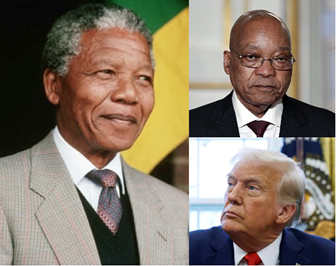
Second, while top-down cronyism aptly describes at least part of Jacob Zuma’s South Africa, and Donald Trump’s USA, its consequences depend in important part on the character and commitment of  the leaders. I won’t try to parse which of the two is more corrupt. But what does seem clear is that Jacob  Zuma – whose life had been shaped by the African National Congress and its struggle against apartheid (including ten years’ imprisonment with Nelson Mandela on Robben Island)  – was committed in at least some part of his identity  to the ANC’s aspirations and values. These values included longstanding, deeply-rooted commitments to democracy, to non-racialism, and to the rule of law. These commitments required Zuma to at least think twice before acting in ways that were directly contrary to these values.  Donald Trump shows no evidence of any similar commitment and associated restraint.  

Third is the relentless ideological zeal of at least parts of the Trump administration. An anti-government discourse has long been part of the Republican Party’s DNA. Even so,  I have been startled by the (Musk-ian) recklessness with which agencies have been dismantled, heedless of consequences in the real world. Delving further into the  ideological pedigree of the ideas held by another part of Trump’s unwieldy (but unfailingly loyal) coalition has left me feeling even more shaken and (a little) vulnerable.

Beneath the sometimes genteel language of political philosophy is the stuff of nightmares. To illustrate, here is a quote from Patrick Deneen (whose intellectual pedigree passes through Princeton, Georgetown, and currently the University of Notre Dame, and who both JD Vance and Pete Hegseth have found inspirational):

What is needed, in short, is regime change – the peaceful but vigorous overthrow of a corrupt and corrupting liberal ruling class and the creation of a postliberal order…..Where necessary, those who currently occupy positions of economic, cultural and political power must be constrained and disciplined by the assertion of popular power…… The power sought is not merely to balance the current elite, but to replace it…..The aim should not be a form of ‘democratic pluralism’ that imagines a successful regime comprised of checks and balances, but rather the creation of a new elite that is aligned with the values and needs of ordinary working people”.

For those of us who know history’s catastrophes  deep in our bones, these words are chilling. Perhaps the one silver lining is that, as of this time of writing, the agenda has been laid bare, its execution has been chaotic, and it is (perhaps) being stopped in its tracks by increasingly mobilized resistance. So, as with so much of my work these days, I’ll end by taking inspiration from Albert Hirschman’s bias for hope – in this instance the hope that, as per the first lesson of the February post, American democracy can indeed make it intact to the November 2026 mid-term elections.

*****

Here are the four “lessons from South Africa” laid out in the February piece:

Lesson #1: For the next 21 months,  the unwavering navigational north star is to get  to the  November, 2026 midterms with the machinery of electoral democracy still fully functional – avoid being knocked off course by even the most venal provocations.

Lesson #2: Leveraging checks and balances  lays important, necessary ground for victory in the struggle against tyranny – but its victories are not in themselves decisive.

Lesson #3: Keeping democratic space open requires a coalition that is broader than the usual fault lines of political partisanship –   a  sense of urgency and willingness to act not only from ‘natural’  opponents but from elite actors for whom it is more expedient to stay silent.

Lesson #4:  A vision of democratic renewal is key to a decisive victory against encroaching tyranny – more than short- and medium-term band aids are needed.

Now what? – Strategic and unstrategic ways forward

Two days into DT’s second presidency, it is clear that constitutional democracy has (re-) entered into a time of extreme, urgent danger. Despair, complacency and (un-strategic) resistance traps abound. What, then, are ‘strategic’ ways forward? From the vantage point of January 2025, the crucial point is that the USA continues to be a democracy – and it is only 21 months until the next round of House and Senate elections. The overriding strategic goal is to act , between now and then, in ways that increase the odds that control of both shift back to the only political party in the USA that remains committed to constitutional democracy – the Democratic Party (and perhaps also to encourage any brave Republicans who run on a constitutional democracy platform in their party’s primaries).

Much follows from this point of departure, way more than can be said here. But (though the speed and ruthlessness are now much greater….) we were at a parallel point at the outset of DT’s first term. Back then, I wrote a piece, “hope in the dark”, that suggested some ways forward. What follows updates that earlier piece. [While I have added some new themes, and changed some emphases, much of what I said then remains relevant, and is quoted directly. Subsequent work, linked below, elaborates on some key themes. And here is a link to the original piece.]

*****

When power shifts and the presumptions that have underpinned our way of engaging the world no longer hold, what then? For the past quarter century, many of us engaged in policy analysis and implementation have worked in the spirit of ‘possibilism’ – seeking entry points for change that, though initially small, have the potential to set in motion far-reaching, positive consequences. But more than we perhaps had realized, our work has presupposed that the center broadly holds.

We have presumed that there is a reasonably stable ‘outer’ concentric circle within which experimentation plays out, facilitating an evolution-like process — momentum for initiatives that add value, and dead-ends for bad ideas.  But with the election of Donald Trump (henceforth DT) in the USA (and similar elsewhere, though in this piece I will write principally from a US perspective) we find ourselves in a world where the stability of the outer circle, the container, has itself been put into question. How, now, are we to engage?

In an earlier effort to explore possible pathways of development for messy democracies, I distinguished between long-run vision, medium-run strategy, and short run process. The vision as to what comprises the core elements of a flourishing democracy remains intact. However,  when confronting a risk of reversal of the magnitude which is possible under a DT presidency, strategy and tactics need to shift profoundly. But how?

The air is filled with talk of resistance, of the necessity of not normalizing  a DT administration. The urgency of the moment is clear, and I do not want to lessen it. So what follows might perhaps usefully be viewed as a complement rather than an alternative to this sense of urgency.  How can we act in ways that not only respond to the short-term imperatives, but also help incubate a platform for a reinvigorated politics and society?  Here (adapting some with the grain approaches for the current moment) are some  potential entry points.

First, checks and balances institutions – for societies endowed with them, these comprise the first, and crucial, line of defense against the erosion of freedom and democracy.

Second, protect the electoral process – and win elections. As per the opening of this blog, the 2026 midterm elections are only 21 months away. Those opposed to democracy will look to ways to fuel the flames of polarization in advance. [Think: “Reichstag fire” – on which, see more here.] Resist their provocations. Stay relentlessly focused on what it will take to win votes. Political parties are THE crucial actors.

Third, cultivate alliances. Beyond checks and balances institutions and programmatic political parties, the sustainability of democracy rests on a broad societal consensus in favor of democracy and the rule-of-law. This consensus has been America’s ‘civil religion’, one reason why it is so startling that so many voted for DT [in 2016 – and again in 2024]. But it is wildly premature to conclude that a short-term expression of discontent reflects a broader abandonment of America’s core principles. Defense of democracy requires a coalition that reaches across the traditional left-right ideological spectrum. Thus, rather than responding in kind to anger and polarization, opposition to DT needs to capture the higher ground of America’s political center.

Fourth, embrace a democracy-friendly discourse —  one which, as per Albert Hirschman, “moves beyond extreme, intransigent postures, with the hope that participants engage in meaningful discussion, ready to modify initially held opinions in the light of other arguments and new information”. DT’s discourse has, of course, been the exact opposite – an embrace of whatever might help to arouse supporters, with zero regard for its truth value.  But the breakdown in discourse goes beyond DT.

Openness to evidence comprises the bedrock foundation, the necessary condition, for civilization to thrive; yet we find ourselves in a world where the arbiters of the truth value of claims are losing their legitimacy. This can be explained, in our era of rapid change, by the power of cognitive dissonance to override inconvenient evidence.  But explaining is not enough. We urgently need to rebuild mutual confidence, a consensus across society as to the legitimacy, indeed the necessity, of fact-based discourse – else (if it is not already too late) all will be lost.

Fifth, focus on the consequences for inclusion and equity of the coming tsunami of policy initiatives from the DT administration. DT’s success is a (perverse) consequence of the accelerating dualism of American society – major gains at the top, stagnation for everyone else. In his campaign, DT promised to make things ‘great again’ for the struggling (predominantly white) middle. But the reality is (again) likely to be the opposite. Here are a few  examples:

Sixth, cultivate islands of effectiveness. Developmental forces continue to be present throughout society – within civil society, at state and local level, within public bureaucracies. As I explored in depth in my earlier work, in politically contested environments developmental actors can achieve valuable victories by focusing on specific initiatives, acting collectively, and building coalitions capable of fending off destructive, predatory influences. (Here is a link that introduces some new 2024/5 work that explores the possibilities of cross-cutting alliances between the public sector and civil society.) Not all space has closed. In a generally dispiriting time, showing what is possible continues to matter — both as antidote to despair and as inspiration, pointing the way towards a more hopeful future.

Some of the entry points I have highlighted above might seem inadequate to the moment. But it seems to me crucial that we look beyond a politics that offers nothing beyond deepening polarization. German politics in the interwar Weimar years of 1918-1933 provides a cautionary tale. As a white South African inspired by the fall of apartheid, as a Jew who has refused to be defined by history, the stereotypes of others (or a narrow ethno-nationalist vision of identity….), as a parent with two American children, I continue to believe that the life worth living is one fueled by our hopes and dreams, not our nightmares. The dream that all humans are created equal, with inalienable rights to life, liberty and the pursuit of happiness. The dream of equal dignity. The American dream (perhaps even now in 2025….]. The human dream.

The Reichstag burning, and the Donald Trump big lie

Burning of the Reichstag 1933. Germany / Mono Print

Burning of the Reichstag 1933. Germany / Mono Print

The sinister undertones of Donald Trump’s [2016]  campaign have been evident from day one, with Trump’s notorious statement in his announcement speech that “when Mexico sends its people…..they’re sending people that have lots of problems….They’re bringing drugs. They’re bringing crime. They’re rapists”.  Parallels between the Trump campaign and the ‘big lie’ road to power of the Nazis in the 1930s might seem overheated, yet they have been drawn repeatedly by observers who generally are known for their sobriety. (I link below to a sampling of excellent analyses along these lines.)

The burning of the German Reichstag (‘parliament’) on February 27, 1933 was a crucial step in the Nazi seizure of power. As of late 1932, it seemed that the popularity of the Nazis may have peaked. They  won 37.4 percent of the vote (13.7 million votes and 230 Reichstag seats) in elections of July 1932. Political crisis followed immediately, and in a repeat election in November 1932  the number of Nazi votes fell to 11.7 million (and 196 seats). Though Hitler nonetheless was appointed Reich Chancellor in 1933, many among the German elites were complacent. “Within two months”, vice chancellor Franz Von Papen told a conservative acquaintance, “we will have pushed Hitler so far into a corner that he’ll squeak”.

There’s no certainty either on the details of the ‘Reichstag fire’ plot. The Nazis (with no evidence) blamed the communists for starting the fire. The communists (and some contemporary historians) have suggested that the fire was a plot by the Nazis. The usual explanation is that it was the work of a troubled, young Dutch anarchist construction worker, Marinus van der Lubbe.

Regardless of actor and intent, there is no ambiguity about the consequences of the Reichstag fire. Here is how they are described by the historian Richard Evans in his book The Coming of the Third Reich: Rudolf Diels, the (non-Nazi) head of the Prussian political police, summoned to report to the group of leading Nazis encountered a scene of frightening hysteria…. Hitler shouted as if he wanted to burst: ‘There will be no more mercy now; anyone who stands in our way will be butchered. The German people won’t have any understanding for leniency…. These subhumans don’t suspect at all how much the people is on our side…. The psychologically correct moment for the confrontation has now arrived….’. A new decree was drafted, suspending several sections of the Weimar constitution, particularly those governing freedom of expression, freedom of the press, and freedom of assembly… The Nazi seizure of power could begin in earnest.” In an election in March 1933, the month after the Reichstag burning, the Nazis and their Nationalist allies won 52 percent of the votes.

Yes, if  Trump were to win there are many steps from electoral triumph to the emasculation of the American constitution. Many checks and balances stand in the way of a  ‘Reichstag fire’ moment of a kind which destroys citizen rights. Hopefully, we won’t find out what such a journey could look like. So in that sense this post is a cautionary tale in the sense of  George Santayana’s aphorism that  those who cannot remember the past are condemned to repeat it. [Finally, as promised, you’ll find below links to  some powerful recent articles which draw the analogy between the Trumpians and the Nazi rise to power:

Rowan Williams (the Archbishop of Canterbury), A nervous breakdown in the body politic

Andrew Sullivan (former editor of The New Republic America has never been so ripe for tyranny

Michiko Kakutani (book review editor of the New York Times In ‘Hitler’ an ascent from dunderhead to demagogue

Eric Weitz, Professor of History, City College of New York Weimar Germany and Donald Trump