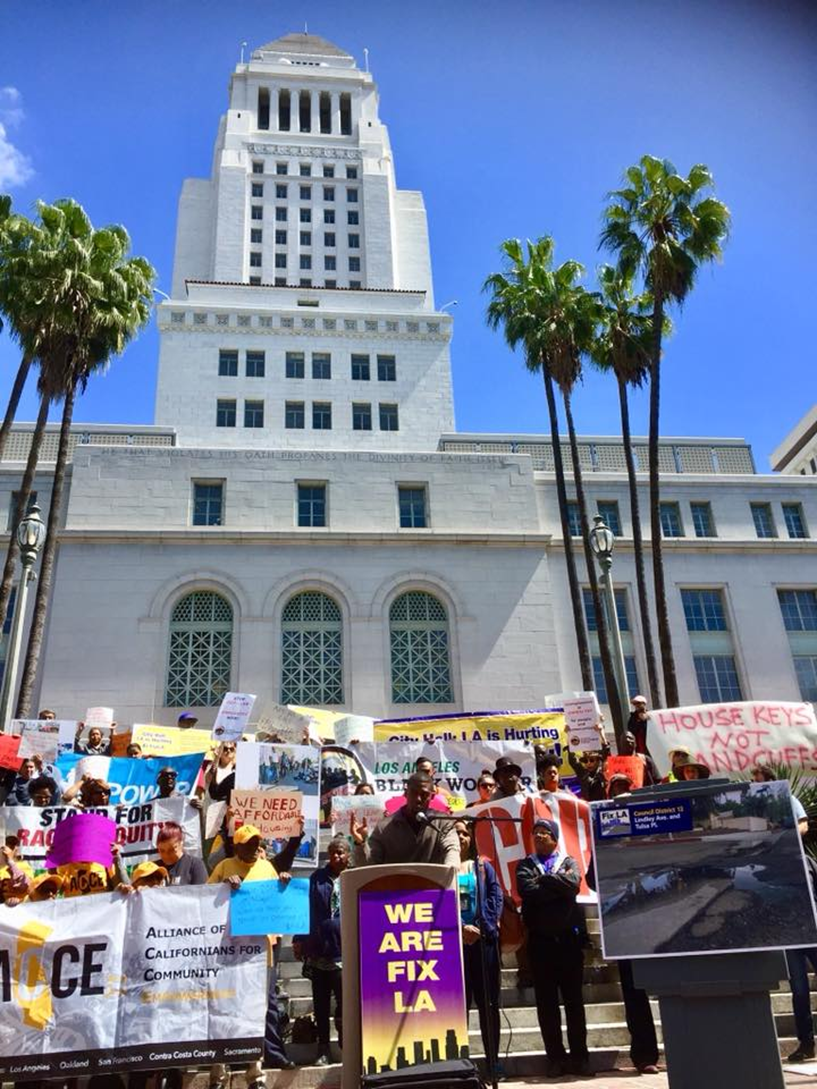
In dark times, I take inspiration from the great social scientist Albert Hirschman’s commitment to the search for ‘a bias for hope’, for “avenues of escape from exaggerated notions of absolute obstacles…. avenues in which the inventiveness of history and a ‘passion for the possible’ are admitted as vital actors”. Viewed from this perspective, the point of departure for effective action is not some idealized vision of how things should be, but clarity as to how things actually are – with this clarity providing the basis for a search for practical entry points capable of setting far-reaching cumulative change in motion. This passion for the possible has inspired my research and practice for almost a half century; it is the guiding spirit of a new cycle of research on the Los Angeles’ region’s twin crises of homelessness and scarcity of affordable housing (AHHLA) that I introduce in this piece.
Los Angeles’ AHHLA crisis startles. LA County is among the world’s affluent locales, with a 2023 per capita income of over $78,000, well above the American average. Yet that same year about 55,000 people were living on LA’s streets, and over 30,000 of them had been there for more than one year. Even more startling, every year about 60,000 people become newly homeless – a cumulative total over five years of almost 3 percent of LA County’s population of 10 million. For those who live in Los Angeles (among whom, having moved here in 2023, I now count myself) the AHHLA crisis is existential. But its significance goes beyond the local.
As recent books by Ezra Klein and Derek Thompson (2025) and Marc Dunkelman (2025) explore in depth, a broad national reckoning is underway to assess both how failures of progressive governance contributed to the rise of toxic populism, and what might be the contours of a renewed and effective progressivism. AHHLA is ground zero of this broader crisis of contemporary American progressivism. In what ways did decades of progressive good intentions gone wrong fuel LA’s current crisis? Are there hopeful lessons to be learned from recent efforts to address AHHLA about how progressive approaches to governance can become part of the solution?
Here, to set the stage for addressing the above questions, is AHHLA’s economic backdrop:
- Over the past four decades, even as the affluent have thrived, earnings have been stagnant for the poorer half of LA’s population. As of the early 2020s, 16.6 percent of LA residents lived below baseline (rent-adjusted) measures of absolute poverty – the highest percentage among California’s regions. (California is the state with the highest percentage in the USA.) In the absence of the public safety net, the LA percentage would be 26%.
- Beginning in the 1990s, a combination of population growth, the end of the extensive margin and slow growth environmentalism/NIMBYism has resulted in an increasingly severe shortage of housing. Between 1960 and 1990, about 200,000 housing units were built each decade; between 1990 and 2020, the decadal average was below 75,000 units. In 2023, 45 percent of the households that earn below LA County’s median income paid more than half their income in rent.
- The unit costs of building publicly-subsidized affordable housing in Los Angeles are almost two and a half times the equivalent costs in Colorado and Texas; startlingly, within LA the total development costs per square foot are 50 percent higher for publicly-subsidized than for unsubsidized, market rate housing built for private (self-pay) buyers.
Considered together, the combination of stagnant incomes, rising unit costs and a near cessation of new housing construction (except at the more affluent end of the market) was to make accommodation increasingly unaffordable for lower-income Angelenos. In important part, and as per the title of an influential book, Homelessness is a Housing Problem. More on all of this in coming weeks and months.
LA’s fragmented governance arrangements have enabled the AHHLA crisis to fester. This fragmentation is especially ill-suited to addressing homelessness – a multi-faceted ‘wicked’ problem that calls for a multi-sectoral, multi-jurisdictional and multistakeholder response. The roots of LA’s fragmented governance can be traced back (at least in part; racial ‘redlining’ also played a role….) to a century-long aspiration to avoid centralized, urban machine politics and cultivate instead more localized, small-town-like governance. Some tasks are the responsibility of LA County government, and others are diffused among the County’s 88 municipalities, of which the City of LA (with a population of four million) is the largest. This fragmentation has been exacerbated by deepening commitment over the past half-century to open, often legally-mandated public deliberative processes in advance of any action, which further complicates local government’s decision-making.
Moving towards more top-down governance (of varying degrees of draconianism) offers one possible response to fragmentation. But widening the distance between citizens and local government risks worsening what already is a crisis of civic alienation from government in many countries (not least of which the USA) the world over. Might there be a third way, one that finesses the traps of top-down governance accompanied by citizen alienation, or civic participation plus ineffectual governance?
In recent conceptual work (see here for an introductory overview), I have explored the potential and limits of this third way. The articles delineate three distinct channels through which ‘socially-embedded’ approaches to public governance might simultaneously counter fragmentation, encourage participation and enhance effectiveness:
- A collective effort to enhance clarity as to goals;
- Streamlined, transparent and participatory approaches to performance monitoring; and
- Collaborative, multistakeholder arrangements for service provision.
Recent initiatives in LA to reduce homelessness incorporate all three channels. Why these initiatives were adopted,, and whether they will continue to unfold in ways that contribute to reducing homelessness is the focus of an ongoing research project in collaboration with the University of Southern California’s Professor Yan Tang (an eminent scholar in the tradition of Elinor Ostrom’s work on collective action). As our research will explore, one key to success is whether the protagonists in the LA efforts will be able to craft a credible way of sharing gains and burdens within a framework that can advance the collective interest. What follows will hopefully whet the reader’s appetite for the research project.
Strikingly, at least since the early 2010s, momentum for scaling-up and reshaping how LA responds to its homelessness crisis has come less from government than from civil society. The efforts have unfolded in two phases. In a first phase, political and civic leaders championed a series of ballot measures that successfully raised billions of dollars to address AHHLA. However, by the late 2010s, there was a dawning realization that the magnitude of the challenge went way beyond earlier perceptions. Not only was further financing required, effectively addressing the twin crises called for better co-operation among multiple stakeholders – something that the region’s fragmented institutions were not well placed to achieve. A 2021 report commissioned by civil society champions took stock of the governance challenges, and proposed a menu of reforms. Partly in response to this report, Los Angeles County’s Board of Supervisors established a Blue Ribbon Commission on Homelessness Governance and subsequently adopted its recommendations.
Since mid-2024, there has been an extraordinary burst of energy and reform aimed at aligning LA’s multiple stakeholders around a coherent governance platform for reducing homelessness. Major initiatives include:
- The creation by LA County’s Board of Supervisors of a robust, formally-empowered multistakeholder platform, with a mandate to “help align the region’s approach to homelessness and provide critical accountability and oversight to ensure more meaningful results”.
- The development and official adoption of specific, measurable targets for reducing homelessness.
- The initiation of work by the Los Angeles County Affordable Housing Solutions Agency (LACAHSA), established in a 2022 resolution of the California State Senate to increase the availability and affordability of housing in LA.
- A radical restructuring (currently at an early stage, but on an accelerated timetable) of the lead public LA County and City agencies responsible for overseeing and implementing the LA region’s response.
- A new effort to specify performance standards for each of the many elements that go into the homelessness response – as a necessary basis for both resource allocation and accountability.
The hope is that the above initiatives will together finally provide the coherence and momentum needed to make real inroads into homelessness – and thereby break a longstanding corrosive cycle of overpromising and then underdelivering. Whether this will happen remains uncertain, but if it does LA could go from being seen as a notorious example of the failure of well-intentioned progressivism to effectively address urgent social challenges, to becoming an exemplar of a renewed, legitimate and effective 21st century progressivism. What happens next thus matters well beyond LA itself. Watch this space for further updates.
 WORKING WITH THE GRAIN: Integrating governance and growth