South Africa: From reconciliation, to recrimination, to….. ???

Its your faultSouth Africans no longer bask in the glow of the country’s ‘miracle’ of reconciliation. Great leadership can enable a society to seemingly transcend its deeply-rooted deformations.  But such leadership is rare — and in its absence what comes to the surface are the underlying ways in people in a society interact. Unsurprisingly, given the country’s brutal history, what has resurfaced in South Africa is profoundly discomfiting.

Two sets of inherited deformations  make the depths of the country’s  challenges almost unique among middle-income countries. The first is economic – the country’s stark inequality. In a recent working paper (click here to access)  for the DFID-funded and University of Manchester led Effective States and Inclusive Development (ESID) research programme, Alan Hirsch, Ingrid Woolard and I contrasted South Africa’s income distribution with that of four other middle income countries (MICs) – Brazil, Mexico, Turkey and Thailand. Compared with the other countries, South Africa has an extraordinarily steep distributional cliff within the top third of the distribution. South Africa’s citizens are either affluent or poor, with little in between. As our ESID paper explores, the steepness of this cliff is the consequence of a combination of continued concentration of wealth and income in the hands of the beneficiaries of apartheid, and a post-apartheid economy that is failing to expand opportunities for its citizenry.

Many countries around the world are grappling with high and rising inequality. Everywhere, finding solutions is daunting, In South Africa, however, inequality also interacts with a second challenge — a psychological one. I am using the term ‘psychological’ in a very specific way here — to point towards inherited patterns of thought, speech and interpersonal interaction. Steve Biko, putting it in the political language of the black consciousness movement, framed South Africa’s inherited legacy in this area as follows:

In time we shall be in a position to bestow on South Africa the greatest possible gift – a more human face….. As a prelude, whites must be made to realize that they are only human, not superior. The same with blacks. They must also be made to realize that they are also human, not inferior…..”

In the initial glow of democratization, it might have seemed as if Biko’s vision of a ‘more human face’ was being realized. But two decades later, and in the absence of visionary leadership, South Africa’s twin deformations are feeding off one another to produce an extraordinarily sour, conflict-prone public discourse.

In two companion blog posts, I describe in detail how this bile-filled downward spiral of (un)civil discourse plays out around specific arenas of public policy and its implementation. One post focuses on jobs and investment (access the post by clicking on this link); the other (access by clicking on this link) on the provision of public services. But the underlying logic is the same:

  • Prevailing policies reflect (as policies do in many places around the world) messy compromises among competing interests. Narrow, politically-connected interests are given special favor – and the result seems like something of a lowest common denominator. (The latter is especially likely given the current combination of relatively weak political leadership, and the reality that the governing African National Congress is itself an unruly coalition of divergent interests…..)
  • Critics of government lambast the policies and juxtapose them with their preferred alternatives – framing their discourses with claims of certainty as to the rightness of their views, and with a superior-sounding high-mindedness.
  • This framing is especially grating to those who confront the day-to-day necessities of wrestling with imperfect realities, and who know that the likely impact of alternative proposals is much more uncertain than protagonists claim. The criticism is all the more grating is that it comes disproportionately from white South Africans who enjoyed elite status during the apartheid years, and who frame their criticisms using seeming code words like ‘capacity’, ‘competence’ and ‘standards’……
  • Government and ruling party spokespeople respond with defensiveness and anger – with the latter both real (given the country’s history and interpersonal baggage), and also tactically useful as a way of deflecting attention away from some of the shortfalls in policy and implementation.

The result, at least in the short-run, is stalemate.

But with creeping economic decay confronted by rising social dissatisfaction, and fueled by an increasingly confrontational discourse, stalemate is not a sustainable equilibrium. One way or the other, stalemate WILL be broken. How? One possibility is a downward spiral of political disaster. Another is a deus ex machina of visionary new leadership. I prefer to focus on a third alternative, laid out in depth by Nobel-prize winner Elinor Ostrom.

For all of their sharp ideological disagreements, most of the current South African discourse operates out of a shared set of ‘top-down’ assumptions as to how policymaking and implementation works – politicians (taking a lead from voters) set goals; high-level technocrats help turn these general goals into detailed policy; the bureaucracy implements. Ostrom contrasts this hierarchical way of thinking with an effort to achieve results by co-equals working collaboratively – fully cognizant of (and committed to managing constructively) the tensions between their private purposes and collective ends. Building on decades of research, she identifies a set of necessary good practice design principles for collaborative governance to succeed.

Ostrom focuses narrowly on the governance of common pool resources such as fisheries, forests and irrigation systems. However, as I spell out in detail in my book Working with the Grain (published in 2014 by Oxford University Press)  the applicability of her insights is far, far broader. They apply directly both to efforts (to be explored in an upcoming post) to improve public service provision, and efforts (explored in the complementary blog post accessible via this link) to accelerate private (as well as public) investment and job creation.

An Ostrom-style, working-with-the-grain vision points in a very different direction from South Africa’s usual policy discourse. Its point of departure is a recognition that for most developing democracies, the way forward is a messier one. Gains come, not from discovering some ‘magic bullet’ that will magically unlock seemingly intractable challenges, but rather through the accumulation of successes across many ‘islands of effectiveness’. And each island, depends for its success on stakeholders engaging in the hard work needed for collaboration to succeed.

This, in turn, calls for taking seriously Steve Biko’s dictum – that genuine co-operation requires us all to learn how to engage with one another as absolute equals in rights and dignity. Considered alone, each individual success may seem quite modest. But taken together, the cumulative consequences of achieving concrete development ‘wins’ – and achieving them in a way that builds on the founding spirit of South Africa’s democracy — can be far-reaching.

To get its economy moving again, South Africa needs to rediscover the capacity to co-operate (WWG implementation series #3)

jazz instrumentsFinding a way to reinvigorate economic dynamism in a context of high inequality is a daunting challenge under any circumstances.  But in South Africa, this search increasingly  is being made even harder by an addiction to framing  policy choices in polarizing ways — short-circuiting rather than building momentum for forward movement.

It doesn’t have to be this way.

  As I argue in a companion blog post (“”from reconciliation, to recrimination, to…??”), the search for ways to turn things around is bedeviled by the country’s apartheid history – directly by the country’s continuing stark inequality (examined comparatively in an ESID working paper co-authored with Alan Hirsch and Ingrid Woolard), and indirectly by ways of communicating that undermine the search for creative responses to crisis.

One might have hoped that South Africa could draw on the spirit of its democratic ‘miracle’ of 1994 to address the country’s rising crisis of economic hopelessness. Instead, the opposite seems to be happening  —  a dysfunctional policy discourse is giving  zombie-like life to deeply habitual and deeply destructive approaches to engagement.

Harvard economist, Dani Rodrik  points to the possibility of an alternative way forward. He famously distinguishes between the function and the form of economic policymaking. According to Rodrik:

First-order economic principles do not map into unique policy packages. There is no unique correspondence between the functions that good institutions [and policies] perform and the form that such institutions [and policies] take. Reformers have substantial room for creatively packaging these principles into designs that are sensitive to local constraints and take advantage of local opportunities.

Here is one example of how, notwithstanding Rodrik’s dictum,   South Africa’s current economic policy discourse quickly degenerates into dispiriting polarization:

  • Providers of investment resources and entrepreneurial energy (rightly) argue that it makes no sense for them to invest if they lack confidence that they will be able to benefit economically from successful investments – and high-mindedly frame their arguments in terms of the sanctity of law (and thus of property rights).
  • Historically disadvantaged, but newly-politically-influential groups (rightly) recognize that, absent broader initiatives to transform the economy, the benefits of increased investment will flow disproportionately to established elites, bypassing them. Conditioned by decades of struggle, respond skeptically and suspiciously to high-minded, superiority-tinged recourse to the ‘sanctity of law’.

In this dialogue of the deaf, the result is stalemate and continuing economic decline. Indeed, even during the minerals boom of 2000-2008, mining investment in South Africa was flat, in large part because of contestation and recrimination along the lines laid out above.

And here’s another example:

  • Many economists and businesses (rightly) argue (vociferously, and with great certainty) that wage settlements above ‘market clearing’ levels and other labour market rigidities inhibit employment creation. But they do not add that (in ‘economist-speak’) the rate of employment creation subsequent to liberalization depends on the elasticity of demand for labor — and that the structural rigidities of South Africa’s minerals-energy complex imply that over the short-to-medium-term, the elasticity of demand (and hence employment creation) is likely to be low.
  • Meanwhile, employers and workers argue (loudly) over their annual agreements. Worker organizations embrace the rhetoric of revolutionary struggle — even in the face of evidence (summarized in our ESID paper) that unionized, employed workers have become a labour aristocracy, largely embedded within the top third of the distribution. Employers, on the other hand, ignore the implications for employees of South Africa’s distributional cliff of inequality– namely the reality that prevailing labor-market rigidities are what protects their employees from sliding rapidly from relative comfort to near destitution.

The result, again, is continued polarization and stalemate, limited job creation – and deepening pessimism as to South Africa’s economic future.

How labor markets operate, how economic power is distributed, and how property rights are protected are indeed central to South Africa’s economic performance. But might there be other ways forward than a pre-occupation with zero-sum alternatives which fuel old, destructive way of speaking and (not) listening?

As the companion blog post details, Elinor Ostrom, 2009 winner of the Nobel Prize in economics, offers an alternative. Her lifelong work focused on the challenge of how to achieve results by co-equals working collaboratively – fully cognizant of (and committed to managing constructively) the tensions between their private purposes and collective ends.

Here are five potential entry points for Ostrom-style multistakeholder collaboration in support of job creation and investment – focusing on possibilities at regional, sectoral and meso levels (where the prospects are perhaps better of moving beyond the ugly polarization of headline-level discourses). Each is ‘low hanging fruit’, in the sense that many of the foundations for implementation already are in place:

  • Social compacts around job creation, at sub-regional and sectoral level – a major push for an employment-oriented special economic zone in, say, the Eastern Cape (where the Coega industrial development zone already provides the requisite infrasutrctural platform) underpinned by negotiated agreement among stakeholders to do what it takes to create a large number (500,000 say) of new jobs.
  • A reinvigoration of labour-skills upgrading – where a multi-stakholder governance structure was established in the latter 1990s (in the form of Sectoral Training Authorities), but with weak follow-through on the part of both private sector and government actors. The result has been a consolidation within government of policymaking and implementation for ‘further education and training’ – but (in part because of the absence of sustained private sector involvement) continuing disappointing outcomes.
  • A determined effort to strengthen participatory governance in basic education. A strong role for School Governing Bodies formally is laid out in the South African Schools Act — but it was included there to protect elite (former Model-C) schools, not as a platform for inclusive governance more broadly. Yet research from other parts of the world (and some striking examples within South Africa) suggests that — with pro-active support — SGBs can play a powerful, constructive role.
  • A reinvigoration of sector-level broad-based black economic empowerment (BBEEE) initiatives. These were negotiated sectorally in the early 2000s, then consolidated using a balanced BBBEE scorecard (which focused broadly on transformation vis-à-vis ownership, management, skills and enterprise development). But with little collective commitment – and no collective mechanisms for ongoing monitoring, conflict-resolution and enforcement – they have receded into the background, and the fires of contentious BEE debates continue to burn.
  • Strengthened support (including via fiscal resources) from business elites for the expansion of successful public employment programmes for unskilled adults – these both provide employment, and support the provision of local infrastructure and services, especially in low-income areas.

Each initiative comprises a constructive step in the direction of building a genuinely inclusive economy. And each requires sustained co-operation among diverse stakeholders for its successful implementation (perhaps less directly so in the case of public employment; I include it because its embrace requires established elites to recognize that South Africa’s job creation and inclusion crisis goes beyond anything that can be met through familiar market-based solutions).

To be sure, these five initiatives are hardly sufficient to resolve South Africa’s vast, continuing challenges of exclusion and inequality. Even so, taken together, their successful implementation could be a game changer – a signal of the renewed willingness of South Africa’s diverse citizenry to turn away from polarization and recrimination, and rediscover the power of joint, co-operative problem-solving….. and thereby renew the possibility of looking to the future with hope, rather than recrimination and despair.

President Obama on ‘with the grain’ leadership

rafting1smThe description below, by President Obama, of the essence of leadership in complex times, is extraordinary. Reflect back on his presidency, and its achievements — reversing an incipient economic collapse, making (near) universal health insurance available for the first time in history, ‘bending the curve’ on American policy vis-à-vis  climate change. grasping the nettle on immigration reform — and, hopefully, with a nuclear deal with Iran, modeling the possibilities of a foreign policy whose point of departure is the open-hand of a search for mutually beneficial options. One of the features of  effective ‘with the grain’ efforts at change is that the achievements seem somehow unsatisfying — until one looks back, and sees how long is the distance has been travelled…….

“I have strengths and I have weaknesses, like every President, like every person,” President Obama told [David Remnick of the New Yorker – click here to link to the New Yorker article]. “I do think one of my strengths is temperament. I am comfortable with complexity, and I think I’m pretty good at keeping my moral compass while recognizing that I am a product of original sin. And every morning and every night I’m taking measure of my actions against the options and possibilities available to me, understanding that there are going to be mistakes that I make and my team makes and that America makes; understanding that there are going to be limits to the good we can do and the bad that we can prevent, and that there’s going to be tragedy out there and, by occupying this office, I am part of that tragedy occasionally, but that, if I am doing my very best and basing my decisions on the core values and ideals that I was brought up with and that I think are pretty consistent with those of most Americans, that, at the end of the day, things will be better rather than worse.” “I think we are born into this world and inherit all the grudges and rivalries and hatreds and sins of the past,” he continued. “But we also inherit the beauty and the joy and goodness of our forebears. And we’re on this planet a pretty short time, so that we cannot remake the world entirely during this little stretch that we have. … But I think our decisions matter. And I think America was very lucky that Abraham Lincoln was President when he was President. If he hadn’t been, the course of history would be very different. But I also think that, despite being the greatest President, in my mind, in our history, it took another hundred and fifty years before African-Americans had anything approaching formal equality, much less real equality. I think that doesn’t diminish Lincoln’s achievements, but it acknowledges thatat the end of the day, we’re part of a long-running story. We just try to get our paragraph right.”

FINALLY — in case you’re wondering why I decided to illustrate this post with an image of river-rafting, here are the final few sentences of Working with the Grain:  “A  vision of ‘good governance’ is perhaps somewhat helpful as a north star that can help guide navigation, but it is no more than that. If the journey requires crossing a stormy sea, voyagers must navigate the heavy winds, and the churning currents. Inevitably, the winds, the tides, the ocean will  bring  new, unanticipated, and sometimes seemingly intractable challenges. Our task is to bring our best effort to the search for ways forward. We can do no more than that, and should strive to do no less.”

Bill Easterly and the Denial of Inconvenient Truths

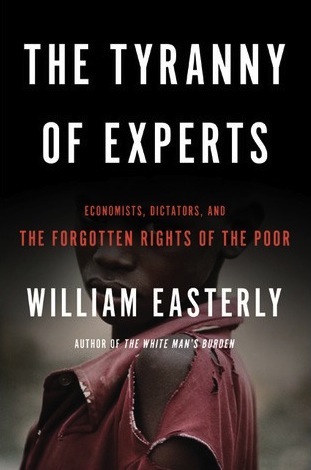
Easterly tyrannyIn his 2014 book,  The Tyranny of Experts, Bill Easterly  uses his rhetorical gifts to make the case for  ‘free development’. In so doing, he takes his trademark blend of insight and relentlessness to a new  level. But in this moment of history that has been described by democracy champion, Larry Diamond as a “democracy recession”[i],  is it helpful to argue by taking no prisoners and not letting inconvenient truths get in the way?

[An edited version of this review appeared in the May, 2015 edition of the Chatham House journal, International Affairs. The journal is ‘protected’ by a paywall, so the full published version cannot be accessed without a subscription. The link HERE connects to the abstract as it appeared in the journal. This post includes the initial full review, as submitted to the journal.]

Easterly, to be sure, communicates powerfully two big and important ideas. The first is that, as per his title, behind a seemingly technocratic approach to development are some inconvenient  political realities. As he puts it:

The implicit vision in development today is that of well-intentioned autocrats advised by technical experts…. The word technocracy itself is an early twentieth century coinage that means ‘rule by experts’” (p.6)

In surfacing the implausible assumptions which underlie a world view of ‘rule by experts’, Easterly does us a service. One cannot engage effectively with today’s difficult realities on the basis of a vision of decision-making which ignores the inconvenient truths of  self-seeking ambition, of contestation over ends among competing factions, and of  imbalances of power which marginalize the interests of large segments of society. (Of course, as this essay will explore, many of these difficult realities arise – in different ways – in both   predatory authoritarian and messily democratic settings.)

The second powerful idea is The Tyranny of Experts paean to freedom – “a system of political and economic rights in which many political and economic actors will find the right actions to promote their own development”.  (pp. 215-216). With  eloquent libertarian rhetoric of a kind which Ayn Rand would no doubt have applauded, Easterly argues that:

“we must not let caring about material suffering of the poor change the subject from caring about the rights of the poor”. (p.339)

Yes, but we also must not fall into a trap which parallels that of the technocratic fallacy – and let our high-minded advocacy of the rights of the poor blind us to the challenges of how to translate our rhetoric into reality. And it is here that Easterly’s Tyranny falls way, way short.

In 1997, reflecting on lessons learned in the aftermath of the fall of the Soviet Union,  Alan Greenspan, former  Governor of the United States Federal Reserve Bank (and a proud acolyte of Ayn Rand)  noted that:

The biggest surprise is what the the years immediately following the fall of the Berlin Wall… (have taught us)… about how and why our own Western economies and societies function….Many of the states of the former Soviet bloc did get something akin to a market system in the form of a rapid growth of black markets. [But] black markets, by definition, are not supported by the rule of law. There are no rights to own and dispose of property protected by the enforcement power of the state. There are no laws of contract or bankruptcy, or judicial review and determination again enforced by the state. The essential infrastructure of a market economy is missing.”[ii]

Easterly and Greenspan surely would agree (as do I), that  sustainable democracies rest on the foundation of  both a well-functioning rule of law and a government capable of providing a core set of public goods.  How these institutions take root and strengthen is perhaps the central challenge confronting contemporary advocates of democratic, rights-based development.

Recent years have witnessed the publication of a rich body of scholarship on how institutions evolve in the course of development.[iii] As this literature underscores, countries diverge from one another in the patterns of leads and lags through which  public sector capability and the rule of law strengthen. In some settings statebuilding leads, and the rule of law lags; in others the sequence is reversed. But either way, once one  leaves behind  the fairy tale notion that all good things come together and takes seriously the question of sequencing,  Tyranny’s  central claims fall apart.

Consider first the sequence  where a strong public sector emerges ahead of the rule of law.  Good economist that he is, Bill Easterly of course recognizes the central role of the public sector in the provision of the public goods that are central to the development process. From public health, to transport infrastructure, to intellectual property — examples of public goods are scattered throughout Tyranny. But beyond offering a few bromides on how democracy can improve public sector performance, Tyranny  leaves entirely unaddressed the question of where public sector capacity comes from.

Here is how Francis Fukuyama describes the statebuilding-led development sequence:

 “To be effective, [state-building] needs to be accompanied by a parallel process of nation building — the creation of a sense of identity which supersedes loyalty to tribes, villages, regions or ethnic groups……Successful democracies have benefited from historical nation-building projects that were achieved by violent and nondemocratic means….. [These projects often involve]….intolerance and aggression, and so often must be accomplished using authoritarian methods.”[iv]

This pattern is, of course, directly contrary to the rights-based approach to development laid out in Tyranny.

In a world where things needn’t be only black or white, a  straightforward response (even for a committed democrat) to the historical record  might be to recognize that that there can be multiple pathways of development. (I follow such a  line of argumentation in my recent book, Working with the Grain.[v])  But rather than explore inconvenient truths in a way  that opens the possibility of eclecticism, Tyranny  uses reductionist empirical methodologies to try and make them disappear.

Take the case of Korea (to which Tyranny devotes a strikingly large number of pages). Contemporary Korea is one of the most successful democratizers of the past half century.  But contra Tyranny’s  insistence on rights-based development as the one-and-only way forward,  Korea’s transition to democracy in the late 1980s was preceded by a quarter-century of hyper-rapid, authoritarian-led growth  which transformed the country from a low-income, seeming basket-case to a thriving upper-middle-income economy and society.  Voluminous, detailed studies have documented the remarkable  institutional transformation wrought by General Park in the years subsequent to his taking power in 1960; the studies also have shown how this transformation provided a robust platform for development in subsequent decades. [vi]

Tyranny ignores all of this. Instead it draws on a data-set of 6-800 autocratic leaders, identifies “around thirty-five would-be benevolent autocrats” and asks “whether growth changes when the leaders change”.  It then goes on to argue that:

“…if all of the leaders in a given country achieve high growth, that is really evidence that the country itself matters more than do  the leaders in influencing growth. The list of high-performing leaders includes three different leaders from South Korea: the dictators Park Chung Hee and Chun Do Wan, and Roh Tae Woo who oversaw a transition to democracy. Together these three leaders account for most of South Korea’s growth [over the relevant period],  so it is more likely that conditions and events in South Korea mattered more than did the policies of any of the individual leaders. (Or, possibly, it was the region of East Asia that mattered rather than South Korean leaders…..).” (pp. 324-5) 

Tyranny’s  narrative of how Korea’s success played out at micro-levels is even more divorced from reality. Numerous studies have documented how General Park leveraged his political authority to direct the role of the private sector in Korean development. As Leroy Jones and Sakong Il described it in a classic study, “the dominant partner is unequivocally the government….. [which]…can ensure the failure of any businessman, should it care to do so….the government’s wishes are tantamount to commands, and business dare not take them lightly.”[vii]

In stark contrast, Tyranny extols the virtues of Korea’s private sector as a powerful example of what a free economy can achieve. The book uses the example of one Chung Ju Yung to open its chapter 11,  entitled “Markets: the Association of Problem-Solvers”. Again, to give a flavor of the argumentation of Tyranny, it is useful to quote at length:

“Chung Ju Yung understood something that…most development thinkers never have… A better way to solve your own problems is to join an ‘association of problem-solvers’ in which you….[use]  your problem-solving talents on behalf of others in ‘some other area’ …. […than your immediate needs…..and they reciprocate..]. …… (pp. 239-240) …The ‘some other area’ for Chung was initially modest: he turned out to be good at fixing cars… When Ford arrived in the 1960s looking for a Korean manufacturer to make cheap cars, Chung impressed them with the grease-monkey savvy left over from his days in auto repair. ‘There was nothing I did not know about a car’, said Chung, ‘that was why my company got the contract’….. Ford did not take it too seriously when Chung refused to allow Ford any ‘management participation’….. Likewise they indulged Chung when he wanted to move from assembling kits to actually doing Korean models collaboratively with Ford engineers….” (pp. 240; 269-270)

Chung Ju Yung (as Tyranny notes) was  the founder of the chaebol, Hyundai – today one of the world’s leading automobile manufacturers.  But the inconvenient truth that Tyranny fails to explore (and the literature cited above documents in voluminous detail) is the centrality of ‘Korea Inc’s’ partnership between business and government to Hyundai’s success. Government provided financing; directed the company into some ‘strategic-priority’ sectors (shipbuilding, where Hyundai subsequently became one of the world’s leading companies, is one of many notable examples);  limited competition in these sectors; tightly managed the relationships with foreign partners; and forced the pace of penetration into export markets. Hardly an exemplar of the power of free markets in action!!!

Now let us to turn to the sequence where development is led by the  strengthening, not of public sector capability, but of the rule of law. (This is the sequence advocated in Tyranny – and  indeed is the normatively preferred sequence of advocates of democratic development, myself included.)  The scholars cited earlier  trace the origins of the rule of law to a combination of religious strictures on secular power, and centuries long contestation among privileged elites in late medieval and early modern Europe. This historical literature offers arresting insights, but  its very-long-term perspective renders these of limited practical relevance from the 5-10 year time horizon of practitioners and politicians.

Tyranny  draws on this literature – but, for all of its intent to contribute to the practical policy discourse, avoids  the question of how to get from here to there, and instead  revels in breathtakingly oversimplified ‘sound-bites’. Take, for example,  its treatment of the role of cities in the emergence of the rule of law:

Holy Roman Emperor Frederick Barbarossa had been trying hard to assert his divine right of kingship in northern Italy….Arrayed against him was something new in European history—independent cities that recognized freedom for their citizens….The May 29, 1176 battle that would help determine the future of individual rights turned on a random event – a lance hit Frederick…The German troops thought he was dead and retreated in panic…. Neither Frederick nor his successors would ever again attack the free cities…Over the succeeding centuries, individual freedom would take shape in these free cities and spread to other parts of Europe”. (pp. 129-130)

A lovely story (properly footnoted with citations to its scholarly sources), articulately told — and complete with a fairy-tale-like call to the ramparts of freedom, and a happy ending.  Consistent with the argument in Tyranny, serious scholars indeed generally agree  that free cities were important  in the emergence of the rule of law. But these scholars also underscore that the  process played out over many centuries, with European cities caught in the middle — sometimes the victims, and sometimes the beneficiaries of  ongoing contestation between emerging monarchs and local notables. The process  was long, messy and circuitous, fraught with violence, and variable in its outcome;  the result was contingent on country-specific power dynamics.

But the real-world challenges of pursuing a rights-based development pathway go beyond the slow pace at which the rule of law generally consolidates. In addition, countries developing along this pathway find it especially difficult to build capable public sectors. Fukuyama highlights the problem. Building on his detailed review of the historical record, he concludes that early rights-based, democratic development almost certainly will be accompanied by public sectors  organized along clientelist lines. Clientelism should be seen, he argues:

 “as the natural outgrowth of political mobilization in early-stage democracies… with large numbers of voters mobilized [by] mass party organizations distributing widespread favors through complex hierarchical party machines…… Clientelistic structures emerge…when democracy arrives before a modern state has had time to consolidate into an autonomous institution with its own supporting political coalition.”

The pattern described by Fukuyama is a  familiar  one. In many  of the 60 or so countries that were part of the so-called ‘third wave’ of democracy in the latter 1980s and early-1990s, efforts to  improve public service provision all too often have played second fiddle to the need to reward political allies with patronage jobs and sole-source procurement contracts. But perhaps less familiar than the contemporary pattern  is the historical experience of efforts in the United States to build a capable public sector on top of a pre-existing foundation of individual rights and democracy.  This experience is powerfully revealing.

For much of the nineteenth century, all federal positions in the United States government were patronage appointments – either made directly by the President, or allocated by him among members of congress to distribute as ‘spoils’. Employees were required to be politically active on behalf of their sponsors, and to contribute  up to 10 percent of their salaries to party coffers – else risk losing their job. Federal employees had no job tenure. In 1885, when Democrat Grover Cleveland won the presidency, he fired all 40,000 (Republican-appointee) postmasters, and appointed his own loyalists. In turn, when Republican Benjamin Harrison won the presidency in 1890, he replaced all (now) 50,000 democratic appointees with Republican supporters. It took almost a half-century for America’s public sector to evolve from this classically clientelist pattern towards one that was more systematically merit-based. The process was driven by a combination of incremental top-down reform and bottom-up pressure – all underpinned by the social activism of the American Progressive Era of the 1880s-1920s.[viii]

In making the case for right-based development Tyranny draws extensively on the American experience. Easterly uses a series of time-lapse vignettes of the economic evolution of his Manhattan Greene Street neighborhood from the 1650s to the contemporary period to illustrate evocatively the transformational power of market-led, rights-based development. Tyranny, however, consistent with its general approach that rights-based development can do no wrong – and that any other pathway can do no right — ignores almost entirely the inconvenient truth of just how dysfunctional was the American public sector in the first century plus of the life of the republic.

I could go on – Tyranny’s self-certain, ‘take no prisoners’ approach offers plentiful pickings for any reviewer not predisposed to treat every word in the book as gospel truth. But perhaps enough has already been said to demonstrate quite how disconnected Tyranny is from the realities of this time of evident challenge and complexity.

There is, though, something much more important at stake than a style of argumentation. Contrary to what surely is Bill Easterly’s intention, in my view Tyranny’s systematic denial of inconvenient truths does a  disservice to those of us seeking to pursue democratic pathways of development. Part of the disservice is the risk that grandiloquent, maximalist rhetoric might be believed — and fuel certainty, hubris and over-reach among policymakers. (One might hope, though, that this risk is lower today than it was in an  earlier, more innocent era – an era which could be dated as being from the end of the Cold War to just before the invasion of Iraq.). But a more fundamental, and more insidious problem with over-the-top argumentation is that that it misdirects attention – away from both the challenges that matter, and the truths that have the potential to inspire.

Maximalist rhetoric – and its implication that the overthrow of tyrants is sufficient to conjure rights-based development into being – short circuits learning. Both the historical record and contemporary experience underscore that strengthening the platform for rights-based development is a long, challenging, painstaking process. As I detail in Working with the Grain, rule of law institutions, capable public sectors and democratic processes consolidate slowly over time. Transformation occurs not in one fell swoop, but as the cumulative consequence of many small initiatives, large and small, each involving ongoing experimentation, learning and adaptation. In consequence, and contra Tyranny, rather than being pre-occupied with grand visions and across-the-board overhauls, development and democracy practitioners might more usefully focus on achieving concrete results incrementally and cumulatively via “islands of effectiveness”.

In Working with the Grain,  I explore a variety of possible entry points through which active engagement by citizens, firms, and public officials can gradually and cumulatively transform clientelistic countries into better-performing liberal democracies:

  • Public entrepreneurs at multiple layers of government can foster ‘islands of effectiveness’ even within a broadly dysfunctional public service —  focusing on achievement of a very specific public purpose (better schools, better infrastructure, less stifling regulation), and endeavoring to build within their domain both a team with the skills and commitment to achieve that purpose, and the network of external alliances needed to fend off opposition.
  • Champions of private sector development can shift focus from efforts to effect far-reaching reforms of the business environment (efforts which all-too-often run aground in the face of political incentives and powerful vested interests – and focus instead on more narrowly targeted initiatives to establish special economic zones where both the rules of the game and infrastructural support can be more private sector friendly.
  • Civil society group can forge a middle path of engagement —   neither locking-in to confrontational action, nor surrendering principle in search of the next donor- or government-funded contract, but rather focusing on the quality of service provision, both partnering with providers and holding them accountable for how public resources are used.
  • Northern activists can seek eyes-wide-open partnerships with globalized firms – anchored in collectively designed and transparent, mutually monitored commitments to, say, rein in bribe-giving, or to target exploitative practices vis-à-vis environmental protection, labor standards, and the extraction of natural resources.
  • Scholars and practitioners can monitor governance in ways that encourage a long view – foreswearing overheated rhetoric in the face of year-to-year changes in indicators of corruption, the rule of law, or government effectiveness, and using monitoring to provide a platform for nurturing constructive dialogue on trends, identifying lagging areas, and exploring how they might be addressed.

As each of these examples suggest, the process through which rights-based development takes root is more akin to a painstaking marathon than to a triumphant sprint.

Finally,  even worse than the misdirection of attention  away from practical challenges, a style of salesmanship which aims to sell rights-based development through grandiloquent claims ends up selling democracy short. In part, this is the classic problem of overpromising:  Inevitably, the claims  collide with the difficult realities of what is feasible — with the gap bringing disillusion in its wake. But the problem is an even deeper one:  Overheated salesmanship does not do justice to the promise of rights-based, democratic development.

At its essence, what democracy offers — and what authoritarian alternatives do not — is an invitation to citizens to work to shape their own lives and to participate peacefully in the shaping of their societies, according to their distinctive visions of freedom and justice.  This journey is a challenging one – with much democratic ‘messiness’, and corresponding disappointment along the way. But no matter how challenging the journey, once the invitation to engage has been embraced, the personal dignity it offers cannot be taken away. Rhetorical flourishes that undermine their own credibility by overpromising outcomes obscure this essential truth, the true heart of  the democratic idea — its inspiration, its source of sustainability.

*****

[i][i] Larry Dianond, “Democracy’s Deepening Recession”, The Atlantic, May 2, 2014.

[ii] Remarks by the Chairman of the Board of Governors of the US Federal Reserve System, Mr. Alan Greenspan, at the Woodrow Wilson Award Dinner of the Woodrow Wilson International Center for Scholars in New York on 10/6/97. Published in Bank for International Settlements, BIS Review, Vol 64, 1997.

[iii] Major contributions include Francis Fukuyama, The Origins of Political Order (New York: Farrar, Straus and Giroux, 2012) and Political Order and Political Decay (New York: Farrar, Straus and Giroux, 2014); Douglass C. North, John Wallis and Barry Weingast, Violence and Social Orders (New York: Cambridge University Press, 2009); Charles Tilly, Coercion, Capital and European States, AD 990-1990 (Cambridge: Blackwell, 1990); and Daron Acemoglu and James Robinson, Why Nations Fail (New York: Crown Books, 2012).

[iv] Francis Fukuyama, Political Order and Political Decay, pp. 185; 320-1

[v] Brian Levy, Working with the Grain: Integrating Governance and Growth in Development Strategies (New York: Oxford University Press, 2014).

[vi] See, for example, Byung Kook Kim and Ezra Vogel (eds), The Park Chung Hee Era: The Transformation of South Korea (Cambridge: Harvard University Press, 2014); Jong-Sung You, “Transition from a Limited to an Open Access Order: The Case of Korea” in Douglass North, John Wallis, Barry Weingast, and Stephen Webb (eds.), In the Shadow of Violence (New York: Cambridge University Press, 2013); and Atul Kohli, State-directed Development: Political Power and Industrialization in the Global Periphery (New York: Cambridge University Press, 2004).

[vii] For two classic studies, see Alice Amsden, Asia’s Next Giant: South Korea and Late Industrialization (New York: Oxford University Press, 198); and  Leroy Jones and Sakong Il, Business, Government and Entrepreneurship: The Korean Case (Cambridge: Harvard University Press for Harvard Institute for International Development,, 1980); the quote in the text is from pp.66-68.

[viii] For details of the American experience, see Daniel P. Carpenter, The Forging of Bureaucratic Autonomy: Reputations, Networks and Policy Innovation in Executive Agencies, 1862-1928 (Princeton: Princeton University Press, 2001)

How inequality can corrode

SA inequality conversation op edMany of the most virulent consequences of inequality are evident in South Africa’s increasingly sour, contentious and dysfunctional politics. The op-ed piece linked below gives the highlights of a paper on the subject, which I co-authored with the University of Cape Town’s Alan Hirsch and Ingrid Woolard. The paper assesses  comparatively the magnitude of South Africa’s inequality challenge,  and suggests some possible  ways forward. http://theconversation.com/the-missing-middle-of-south-africas-economic-ladder-threatens-stability-42020


The BBC’s James Deane on the implications of WWG for media activism

BBC Media ActionThe attached post by James Deane, Director of BBC Media Action’s Policy and Learning group, explores in a thoughtful, challenging way my “working with the grain” approach from the perspective of a media activist. James’ comments are an expansion of his comments as discussant for my keynote speech in Paris last week at the OECD Development Advisory Committee’s GovNet meeting….. http://www.bbc.co.uk/blogs/bbcmediaaction/entries/b5adf6cd-61cb-4997-aeda-0a9139fed8ad?fb_ref=Default


Smart problem-solving and Selma-style campaign tactics

selmaDavid Booth of the Overseas Development Institute wrote an extensive set of comments on the democracy series (on the People, Spaces Deliberation site which re-published the posts; link below). I thought it useful to re-publish his comments (plus my response) here.

DAVID  BOOTH’S COMMENT ON: “DEVELOPING DEMOCRACIES CAN THRIVE – MESSILY”:

“Brian, I hope many of your readers will follow you in foreswearing the seductive utopianism of transformative democratic change. Incremental progress – small steps forward in political, economic and social spheres that reinforce one another and become cumulative – is as good as it gets in the real world. And it’s well worth having. Big-bang democratisation has never happened in history. The illusion that it can happen (implying, among other things, that it is invariably a good idea to overturn dictatorships) has become a major force for bad in the world, especially when it feeds the arrogance of global power in areas like the Middle East.

But as well as agreeing, let me challenge you to go further, in two ways. First, I think we need to respond to those who are impatient for change by providing an alternative vision of how incremental progress can be maximised and retrogressions avoided. I don’t think ‘sustaining momentum’ quite provides that. And I don’t think anybody is going to be terribly excited by a vision of progress that is no more than democratic utopianism running at very slow speed.

So why not embrace vigorously that other theme of Dani Rodrik’s recent writing: the virtues of systematic problem-driven policy experimentation, the assumption of which is that there is no pre-written script of progress, whether economic or political; countries have to discover what works for them. And when they get the hang of this, as in China, the resulting change can be far from slow. Is there a good reason why this thinking would to economic reform but not to political development and democratisation?

Just before writing this I was watching the movie Selma on a plane, and I know Martin Luther King is a hero of yours. The film reminds us that democratic progress is partly about politically smart tactics, and those have to be learned; there are models but no textbook.

Second, one of the reasons the democratisation script is not pre-written is, obviously, that countries have very different ethno-regional and social structures. You will agree that one of the things young democracies in the developing world have handled particularly badly is ethnicity. I would suggest that unnatural nation-state structures inherited from colonialism combined with political constitutions that are leading examples of isomorphic mimicry – the opposite of context-sensitive problem solving – are behind a significant part of the poor rate of institutional improvement to which you draw attention.

So a major part of the agenda of experimentation and discovery around democratisation that I invite you to advocate needs to be about this. It needs to be about finding pathways and forms of politics and political institution-building that are capable of handling ethnic division in a constructive way – of taking the sting out of what Lonsdale calls ‘political tribalism’ and harnessing his ‘moral ethnicity’ to development.

Both of these challenges are difficult, for sure. But I suggest they may excite some of those who feel that people like you and me are offering a rather dismal alternative to democratic utopianism.”

DAVID BOOTH’S COMMENT ON VISION STRATEGY AND PROCESS

“Brian, I am still catching up with your excellent democracy series. In this one, you do take the argument forward in some of the ways I was appealing for in my comment on the previous one! I think parts of the challenge remain, though. Some of your bulleted suggestions here do feel a bit like the standard utopia in slow motion. I think we can and should be putting more accent on smart problem-solving and Selma-style campaign tactics.”

AND HERE IS A SOMEWHAT EXPANDED VERSION OF MY RESPONSE TO DAVID ON THE “PEOPLE, SPACES DELIBERATION” SITE.

David: Your comment on this and my earlier post has had me thinking hard….. It led me to make the suggestion, at a presentation at the OECD’s Development Advisory Committee, that we might consider replacing “good governance” with an agenda of “governance activism in service of inclusive democratic development“. I suggested  that this agenda might include:

  • Agricultural development — building the bargaining power of small farmers
  • Human development for all — bringing transparency & participation out of their technocratic shadows
  • Cities that work for all – including inclusive services; and clean city government
  • Natural resources justice — Who benefits? Who gets hurt?

Finally, here is a link to the “People, Spaces Deliberation” site.

Reframing democratic development — vision, strategy and process

no_easy_walk_to_freedom How,  in today’s complex and uncertain times, can those of us working at the interface between governance and development sustain  what the great twentieth century development economist, Albert Hirschman, called  “a bias for hope”?

In two recent blog posts (click HERE and HERE)  I took stock of the evidence as to the extent of governance improvement between 1998 and 2013 among 65 democratic countries (the large majority of which made their initial transition to democracy subsequent to 1990). The results left me feeling even more skeptical than when I wrote Working with the Grain as to the practical relevance of maximalist “good governance” agendas. We need an alternative approach.

To tease out an alternative, it is useful to begin with the classic three-part tripod for orchestrating change – clarifying the vision, developing a strategy for moving towards the realization of that vision,  and delineating step-by-step processes for facilitating implementation. Using this lens, the classic ‘good governance’ discourse turns out to be all vision, empty of strategic content, and counterproductive vis-à-vis process.

‘Good governance’ generally directs attention to the destination, to   how a well-functioning democratic society is supposed to work — and seeks to motivate by cultivating dissatisfaction with the gap between the destination and the way things are. Yes – electoral accountability, a strong rule of law, a capable public sector, robust control of corruption, and a ‘level playing field’ business environment are all desirable.  But the institutional underpinnings for many of these are demanding – and advocates generally stop short of laying out any practical program for getting from here to there. With no proactive agenda for action, the all-too-common result is to end up fuelling  disillusion and despair, rather than cultivating hope.

There is, though, an even deeper problem with maximalist advocacy: it sells democracy short. In its essence, what democracy offers – and authoritarian alternatives do not – is an invitation to citizens to work to shape their own lives and to participate peacefully in the shaping of their societies, according to their distinctive visions of freedom and justice.  This journey is a challenging one – with much democratic ‘messiness’, and corresponding disappointment along the way. But no matter how challenging the journey, once the invitation to engage has been embraced, the personal dignity it offers cannot be taken away. This invitation, not empty guarantees of success,  is at the core of the democratic vision — its inspiration, its source of sustainability.

This brings us to process —  the second pillar of the change tripod. In the later stages of his career, Albert Hirschman turned his attention from trying to understand strategies for economic development, to trying to understand  how we thought and spoke about them. His  purpose, he asserted, was: “…. to move public discourse beyond extreme, intransigent postures of either kind, with the hope that in the process….participants engage in meaningful discussion, ready to modify initially held opinions in the light of other arguments and new information..”

 The renowned Vietnamese Buddhist monk, Thich Nhat Hanh, points to why the quality of discourse matters greatly.  “Peace”, he suggested  “is every step:Freedom is not given to us by anyone; we have to cultivate it ourselves…. here and now, in ourselves and in everything we do and see…. (in) every breath we take, every step we take….. The question is whether or not we are in touch with it. We need only to be awake, alive in the present moment.” Insofar as democracy is an affirmation of dignity, its promise is not accessible only when some distant destination is reached. Its potential is also here and now — realizable through a process that, in and of itself, is an affirmation of that dignity.

Dignity also is central  to the third leg of the tripod for the orchestration of change –a strategy for democratic development which has the affirmation of human dignity at its heart. As an alternative to what one might call ‘Big-G’ reforms of governance systems,   Working with the Grain (Oxford, 2014) lays out a ‘small-g governance’ strategy for deepening democracy among countries which have formally embraced democratic forms, but whose practices fall far, far short of a normative ideal. A ‘small-g’ strategy focuses on a search for concrete gains vis-à-vis specific problems – and emphasizes the pursuit of these gains through active citizenship, through participation and engagement among equals.

The immediate goal of a  ‘small-g’ strategy is to nurture “islands of effectiveness” — to identify entry points for focused engagement among a variety of stakeholders with high-powered incentives to see the outcomes achieved.  Working with the Grain explores in depth a variety of potential entry points:

  • Public entrepreneurs at multiple layers of government can foster ‘islands of effectiveness’ even within a broadly dysfunctional public service —   focusing on achievement of a very specific public purpose (better schools, better infrastructure, less stifling regulation), and endeavoring to build within their domain both a team with the skills and commitment to achieve that purpose, and the network of external alliances needed to fend off opposition.
  • Civil society groups can forge a middle path of engagement —   neither locking-in to confrontational action, nor surrendering principle in search of the next donor- or government-funded contract, but rather focusing on the quality of service provision, both partnering with providers and holding them accountable for how public resources are used.
  • Northern activists can seek eyes-wide-open partnerships with globalized firms – anchored in collectively designed and transparent, mutually monitored commitments to, say, rein in bribe-giving, or to target exploitative practices vis-à-vis environmental protection, labor standards, and the extraction of natural resources.
  • Scholars and practitioners can monitor governance in ways that encourage a long view – foreswearing overheated rhetoric in the face of year-to-year changes in indicators of corruption, the rule of law, or government effectiveness, and using monitoring to provide a platform for nurturing constructive dialogue on trends, identifying lagging areas, and exploring how they might be addressed.

Gains from any individual initiative might initially seem small, but individual islands can pull a wide variety of related activities in their wake, adding up over time into far-reaching economic , social and political change – while affirming, at each step along the way, the positive promise of democratic development.

Vision, process and strategy become a mutually reinforcing pathway of democratic development. The vision brings the promise of dignity to center stage;  the process is one that systematically affirms that dignity; and the ‘small-g’ strategy  offers ample opportunity for the practice of ‘active citizenship’ for engagement among equals. Taken together, these elements perhaps indeed offer a new basis for sustaining Albert Hirschman’s ‘bias for hope’ — but in a different intonation from that usually evoked by democracy’s advocates.

The usual intonation of democracy advocacy is a drumbeat of exhortation, of a world on the march to some more perfect destination on the horizon. But, as per Albert Hirschman and Thich Nhat Hanh, hope can also come in a quieter pitch: softer voices, calming rather than raising the temperature, searching, encouraging deliberation, reflection, co-operation.  Over the past two decades, democracy advocates have been sobered by the messy complexity of what it takes to get from here to there. Perhaps going forward, it is not in the drumbeat of exhortation but in hope’s softer, quieter intonations that we will find our inspiration – and our staying power.

Developing democracies can thrive — messily

participation formsIn a recent blog post, I introduced some data on patterns of governance change in developing democracies. The data confirm a central theme of Working with the Grain – that most developing democracies are messy, and are likely to remain that way for the foreseeable future. For the overwhelming majority of developing democracies, transformational fantasies are just that – fantasies. In these messy settings,  our conventional  frameworks  of good governance and technocratic policymaking are of little use. Those of us who are committed to democratic pathways need new understandings of the way forward.

This post provides the empirical detail which I promised in the earlier post – and highlights also what the reality of democratic ‘messiness’ implies for action.  As I laid out in the earlier post – and as the attached file on MAJOR GOVERNANCE IMPROVERS 1998 to 2013   details, —  65 countries are on a democratic pathway, and  have populations in excess of 1 million, and per capita incomes which (as of 2000)  were below $10,000.  The group divides more-or-less evenly between 35  countries for which the recent period has been one of continuing (albeit often uneven) economic progress, and 30  countries that have experienced limited, if any, gains on either the institutional or economic front.  The 35 countries in turn divide into three predominant patterns.

First is a group of 13 accession (and candidate accession) countries to the European Union. This group underscores that,  for all of its current difficulties,  the EU has been a powerful positive force for the development of institutions of democracy.  Twelve countries have enjoyed both substantial economic growth and institutional improvement. (Hungary, where growth has been slower, and there has been some institutional decline, is the exception.) Indeed,  six of the twelve  (Albania, Croatia, Estonia, Latvia, Romania, and Serbia) achieved truly far-reaching institutional gains  —  though, for some of these, from a weak starting point, and  with a long road still to be travelled. But for now, with no equivalent regional candidate  anywhere on the horizon, the EU accession experience remains unique, with limited relevance for other countries.

This brings us to the second pattern – rapidly-growing democracies outside the EU zone which,  in the fifteen years from 1998 to 2013, enjoyed continuing transformational gains in governance. How many countries fit into this category?  Only two – and this by a generous count!!!!  One of these is Georgia – where strong leadership between 2004 and 2013 by elected president Mikheil Saakashvili indeed resulted in extraordinarily rapid gains in measured institutional quality  (although it must be noted that, by the tail-end, of his presidency, Saakashvili confronted increasing accusations of abuse of presidential power). The other is Liberia, where institutions remain very, very weak – but where  Ellen Johnson-Sirleaf’s leadership since 2005 has reversed an earlier institutional collapse, with the gains evident in the speed with which (after an initially shaky start) the country has been able to bring its ebola epidemic under control.

In sum, the EU experience aside, a review of the comparative record finds few if any countries which offer inspiration (let alone practical lessons) for complex democratic societies seeking transformational governance change. In the aftermath of an initial democratizing moment, continuing rapid institutional improvements of the kind championed by advocates of bold leadership are exceedingly rare.

So, finally, we come to the third, most prevalent group –  20 democratic countries where the quality of institutions  continues to fall far short of transformational dreams, but where economic growth has been rapid:

  • Some countries in this group have managed some continuing incremental gains in institutional quality. Indonesia is a leading example. As per the data, other possible moderate governance improvers (from very different baselines) are Armenia, Sierra Leone, Turkey and Zambia. (Ukraine, prior to its recent travails, was also on the list.)
  • Other countries (Ghana, for example; or, at higher levels of per capita income, Panama and Uruguay) have seen little change in institutional quality over fifteen years.
  • In yet others (e.g. Bangladesh, Mongolia, Mozambique and Peru) there has been some institutional retrogression.

If one looks only at the quality of institutions few, if any, of the 20 would seem to be models of what one hoped might come in the wake of democracy. But perhaps a narrow pre-occupation with institutional quality is misplaced. What all of the countries in the group share is a sense of dynamism, of things on the move – of possibility — that can come from sustained, broad-based economic growth.

Encouragingly, as Princeton professor Dani Rodrik has laid out in detail for economic policy – and as I detail in Working with the Grain vis-a-vis governance improvement– incremental initiatives can keep forward momentum going, on both the economic and institutional fronts. We don’t need far-reaching transformational boldness of a kind which both recent historical experience and in-depth knowledge of specific country settings tells us simply is not on the cards. As long as momentum can be sustained, the private sector, civil society and middle-class actors all are likely to strengthen – and become increasingly well-positioned to push for better public services, a stronger rule of law, and greater personal freedom.

So perhaps, going forward in what promises to be another challenging year, this could be the resolution of those of us committed to democratic development: that we foreswear the seductive utopianism of transformational change, and commit instead to working in the development and governance trenches — taking satisfaction from modest gains in institutional quality; embracing inclusive economic growth which spreads benefits widely; and working more broadly to sustain forward movement (however partial it might seem). The resulting gains will surely feel uncomfortably partial – and inevitable shortfalls in relation to our imaginary visions of perfection will surely continue to pain us.

But if forward momentum can continue, then  cumulative causation increasingly can make its power felt. Decade-by-decade things will be seen to be getting better. And if  progress can be sustained for, say, a half century —  the length of time that elapsed from the end of the American Civil War in 1865 to the country’s late Progressive Era of the early twentieth century — then perhaps  the world can indeed turn out to have been transformed.

Transformational fantasies, cumulative possibilities

reality check ahead

Dreams die hard. I was on the road for much of last fall, talking about my new book  – which promotes (as I put it in a recent piece in foreignpolicy.com),   the virtues of modesty in our approach to democratic development. While my message is a sober one,  my aim is not to foster pessimism but rather to highlight pragmatic ways forward.

Yet, repeatedly, I come up against critics who bewail my seeming lack of ambition. “Why”, they ask, “do you sell short the possibilities of transformation? Isn’t what we need bold, decisive, ethical leadership which cuts through the messiness of present predicaments?  Where governance is weak, bold leaders can and should make it strong – rapidly and systematically!”.

By now, there is plenty of scholarship that makes the case that changes in governance cannot be willed into being – but rather that ‘good governance’ is the cumulative consequence of a long, slow incremental process. Nobel-prize-winner Douglass North and colleagues have clarified conceptually how personalized bargains between contending elites can provide platforms for both stability and (perhaps) the slow evolution of formal rules of the game. Francis Fukuyama masterfully  documents,  over two volumes,  the deep historical roots of the rule of law, and of the difficult challenges posed by democratization in settings where state capabilities remain weak.

For many, though, conceptual and historical perspectives remain unpersuasive. “We need change”, they insist. “Therefore good leaders should provide it.”

One way or another damage is being done. If what I argue in Working with the Grain is wrong, then my incrementalist approach is giving comfort to mediocrity (and, sometimes, venality) when boldness and excellence are called for. But if the critics are wrong, then it is their seemingly visionary argumentation that is doing damage – holding up the impossible as a standard,  and thereby fuelling the inevitable disillusion and despair that comes in the wake of failure.

To try and cut through these contending arguments, I have turned to some facts. Subsequent to the exuberant phase of democratization of the early 1990s, many democracies (both new and more longstanding) have made major economic, social and political gains. But what has driven these gains?  Is it continuing governance transformation, driven by sustained, bold leadership? Or is it a more messier process —  ‘muddling through’, but nonetheless on balance successful?

One way to get a better sense of these achievements and their drivers is to review cross-country evidence. I focus here on progress across two dimensions – trends in economic performance and trends in institutional quality.  The attached file of MAJOR GOVERNANCE IMPROVERS, 1998 to 2013  summarizes the observed patterns for the full set of 65 countries that are on a democratic pathway, have populations in excess of 1 million, and whose per capita incomes as of 2000 were below $10,000.  The group divides more-or-less evenly between 35  countries for which the recent period has been one of continuing (albeit often uneven) economic progress, and 30  countries that have experienced limited, if any, gains on either the institutional or economic front.

In the companion post linked here, I explore the empirical detail.  But here is the headline conclusion:

  • European Union accession countries aside, only two countries – Georgia and Liberia – experienced continuing transformational gains in governance subsequent to their initial democratizing moment.

Only two countries…(!!!) ..…Georgia and Liberia…(!!!)…. Hardly a powerful platform for transformational claims!!!

Given these realities, surely we need to set aside our transformational fantasies and base our actions and advocacy not on our dreams and desires, but on the track record of what is feasible. But this need not mean setting our sights low. Over time, the cumulative consequences that follow from the accumulation of many seemingly small victories can be profound. But focusing on incremental gains calls for a different mindset than has prevailed in the recent past – it calls for us to set aside our infatuation with instant gratification and commit to sustained effort for the long haul. Development, including in its governance dimensions, is not a sprint, but a marathon.