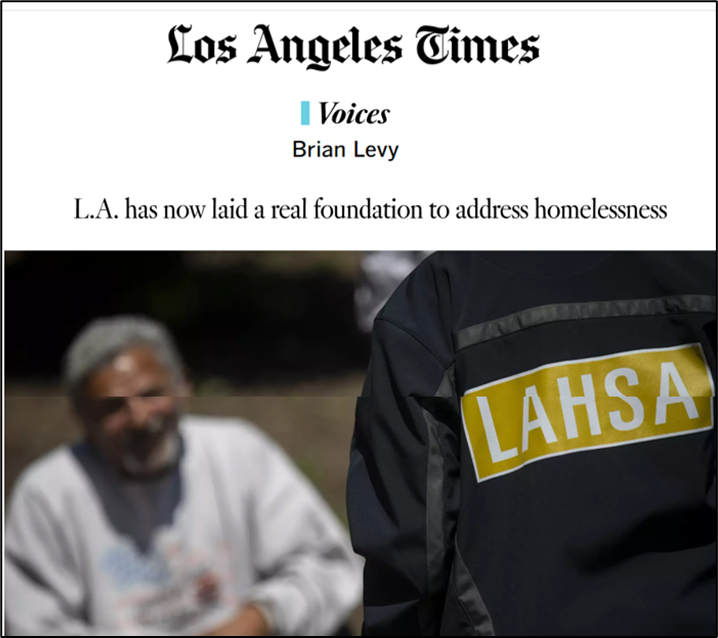
Beneath the surface of Los Angeles’ continuing homelessness crisis, something promising has been underway – a sustained effort by a a committed group of public officials, political and civic leaders from across the region to crafting a set of ambitious and achievable goals that can guide the region’s efforts. As I explore in an Op-Ed piece published today in the Los Angeles Times, “In a fragmented governance environment like L.A.’s — and for a multifaceted problem like homelessness — goal clarification is a vital early step. Clear goals serve as a shared point of reference for setting priorities, helping multiple participants to better align their choices. They provide a platform for institutions to be held accountable by the public.” https://www.latimes.com/opinion/story/2025-05-21/los-angeles-city-county-homelessness-goals
For those who cannot access the piece via the link, see below for the full pre-publication text.
******
“Los Angeles’ continuing struggle to reduce homelessness has become exhibit number one for a broader critique of the failure of progressive governance. Recent tensions between city and county government over how to organize the provision of homeless services have not helped. But look a little deeper and something more promising comes into focus.
For the past nine months, a committed group of public officials, political and civic leaders from across the LA region have been collaborating to develop a road map for reducing homelessness – and, in so doing, to break with LA’s longstanding pattern of overpromising and underdelivering. Central to their endeavors has been the crafting by a multistakeholder ‘Leadership Table’ of a set of ambitious and achievable goals that can be a north star guiding the region’s efforts.
These efforts reached a crucial milestone in late March, when LA County’s Board of Supervisors endorsed three monitorable top-line goals, including specific targets for 2030. One goal aims for a 20 percent reduction in the number of people becoming newly homeless each year. Another aims to place 30,000 people into permanent housing—an increase of over 50 percent from current levels. A third targets a reduction in the number of people living on the streets in 2030 by nearly a third.
I have spent decades exploring comparatively, as both practitioner and scholar, the ways in which participatory approaches can enhance the public sector’s problem-solving ability. That experience shows that, far from being a pie-in-the-sky academic exercise, a focus on goals can yield enormous practical benefits.
In a fragmented governance environment like LA’s – and for a multi-faceted problem like homelessness – goal clarification is a vital early step. Clear goals serve as a point of reference for setting priorities and making difficult choices. They provide a platform for civic accountability. Further, the combination of goals, their monitorability, and accountability to citizens fosters practicality – sustaining civic support requires that target goals are neither so modest as to cause cynicism, nor so overly-ambitious that they set the stage for failure. Viewed from this perspective, the way in which LA has gone about collaboratively crafting and codifying its top-line goals provides a basis for cautious optimism that its homelessness governance system may finally be on a path to sustained gains.
To be sure, at first blush the goal of reducing LA’s unsheltered population by not-quite a third over five years is hardly headline-worthy. Ending homelessness would be relatively straightforward if the task was simply to find suitable housing for the approximately 50,000 people who currently live on LA County’s streets. Indeed, contrary to the common perception that little is being done, LA’s homelessness support system currently permanently re-houses about 20,000 people each year, more than any other city in the country.
But the region’s homelessness crisis goes well beyond the number of people on the street at a point in time. Each year, a combination of wage stagnation, an extreme shortage of affordable housing, and other personal hardships results in over 60,000 people becoming newly homeless. Given these realities – plus the likelihood that federal budget cuts will shred the social safety net – reaching the target of 30 percent less unsheltered homelessness by 2030 would be a major accomplishment. But getting there will require both public officials and civil society to move beyond business-as-usual.
For public officials, clear, ambitious-and-achievable goals provides the requisite platform to stop endlessly cycling from one seemingly appealing initiative to another, and engage systematically with the dual challenges of improving effectiveness and efficiency. Effectiveness calls for decisions on how to prioritize scarce resources: Which interventions are most effective in reducing inflow into homelessness? Which services and supports—psychological and social support, rental subsidies, or interim housing—best help homeless people get permanently housed? And, looming above all of these, how to expand the supply of affordable housing?
Clarity vis-a-vis effectiveness enables efficiency to move to the front-burner: For each prioritized intervention, what is a minimum set of acceptable standards? Do public, private and non-profit providers meet these standards? What will be the mechanisms for improving performance, or clawing back resources, from providers that fall short?
For civil society, an informed embrace of ambitious-and-achievable goals provides a basis for moving beyond exhortation and criticism, and embracing new ways of providing the accountability and oversight needed to ensure meaningful results. This includes – and goes well beyond – tracking whether agreed-upon targets are being met.
All-too-often insider interests that stand to lose from reforms that take effectiveness and efficiency seriously will try and protect the status quo. Civil society can bring countervailing pressure. Such pressure might come from purpose-built multistakeholder arrangements (for example the ‘Leadership Table’ that led the goal-formulation effort) and other local organizing groups and coalitions. Local officials will also no doubt recognize the risk that if they fail to make progress on these goals, voters may turn against them at the ballot box.
The people of LA identify homelessness as the region’s number one crisis. The successful recent effort to collaboratively set and adopt ambitious and achievable goals for 2030 is a major milestone. Success in meeting these goals could rebuild the public confidence in local government that has eroded over many years. To be sure, it’s still early days, and there is much uncertainty. But the stakes couldn’t be higher. If LA’s effort to combat homelessness can stay on track, there would be a golden opportunity to flip the narrative – from being a poster child of the failure of good intentions to address urgent social challenges, to becoming the face of a renewed and effective 21st century progressivism.
 WORKING WITH THE GRAIN: Integrating governance and growth