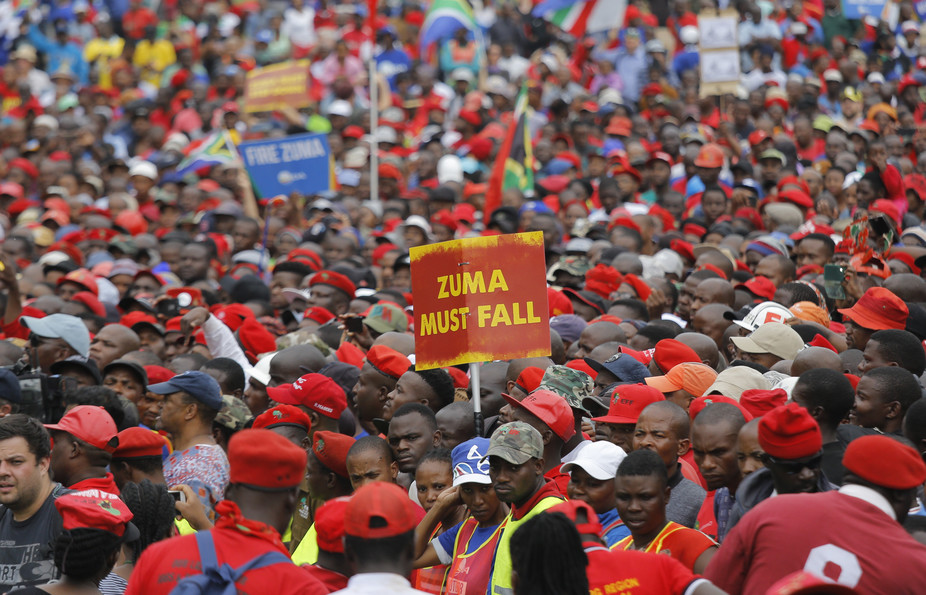
 Locking in to binary narratives of ‘good’ vs ‘bad’ governance can blind us to the depths of a crisis when it arrives. As I argued in a piece (originally published in The Conversation; I extract the full text below), there is a continuum between rule-bounded and patronage governance. At the far end of that continuum lie predatory kleptocracy and institutional breakdown. These last are the threats that South Africa now confronts. Hopefully the crisis can be seen for what it is — and not obscured by the fact that ‘wolf’ has been cried so often in response to South Africa’s typical (and inevitably messy) pattern of middle-income governance. What is happening now is not typical — once predatory kleptocracy takes hold, a downward economic and political spiral can unfold rapidly. The full text of the original piece follows immediately below:
“Frustrated by the promiscuous use of the accusation of “corruption” to cover all sins, in recent days some scholars of contemporary South African politics have offered alternative framings. Indeed, it is helpful to look beyond the details of venality, and identify some deeper patterns. But there is a risk that the result could be to inadvertently and wrongly take the edge off a sense of urgency.
At this moment of crisis, there are two mis-framings in particular that potentially have pernicious consequences. The first is an over-eagerness to describe any and all shortfalls vis-à-vis “good governance” in binary terms – as “proof” that a rule-bounded polity and economy has been entirely overtaken by patronage. The second is a conflation of the distinction between patronage and predatory kleptocracy. Both end up, inadvertently, downplaying the magnitude of what is at stake.
To illustrate the hazards, I will draw on a recent piece by Nic Cheeseman in which he says:
It’s time to look to the rest of the [African] continent for evidence on how the crisis within the country’s ruling African National Congress (ANC) is likely to unfold.
Cheeseman says that South African President Jacob Zuma understands politics through a patrimonial lens. Zuma has “set about entrenching himself in power by promoting loyalists within the party and the state. This while condoning corruption and sacrifice policy for patronage.”
Cheeseman continues:
Putting this process in its historical context is important: it makes it clear that while Zuma has been a disaster, it would be naïve to think that he is the sole source of the ANC’s problems – or that his removal will solve them. It also shows that South Africa is not exceptional, and instead faces similar problems to many other countries on the continent.
And Cheeseman adds:
One small silver lining to this cloud is that we can use the experience of other states to better understand the prospects for South Africa. One thing we know from Kenya and Nigeria is that the kind of politics practised by the president quickly embeds clientelism within key parts of the government and bureaucracy.
A binary framing of the tension between rule-boundedness and patronage along the above lines underplays the differences between the patterns of governance in low-, middle- and high-income settings. It also underrates the ways in which these differences are aligned with systematic differences in the ways in which polities and economies function.
Measured in purchasing power parity, South Africa’s current per capita income is four times that of Kenya. It is twice that of Nigeria, and similar to that of middle income Brazil and Thailand. Also worth noting is that it is less than one quarter that of Australia or the United States.
These differences in income are mirrored in the most robust available estimates of variations in the quality of governance. South Africa’s 2015 scores on both government effectiveness and control over corruption are somewhat above both the global median. The country scores better than middle-income Brazil, Colombia, Mexico, Thailand and Turkey. South Africa’s scores are way higher than those of lower-income Kenya and Nigeria.
Personalised patronage
The point is not simply an empirical one. As Nobel prize-winning economist Douglass North and his colleagues have explored in depth, underlying a continuum in the balance between personalised patronage and impersonal rule-of-law institutions is the reality that political, economic and institutional development co-evolve.
An initial platform of institutional stability provides a basis for economic and political actors to organise. Their greater strength provides in turn a basis for further strengthening of institutions. Over time, polities and economies become increasingly complex, and are underpinned by increasingly complex (and increasingly impersonal) rules.
Unlike the other African countries to which Cheeseman refers, as a middle-income country South Africa’s economy and polity continue to be anchored (albeit imperfectly) in impersonal rules. This relative rule-boundedness is underpinned by three things:
- the size of its middle class,
- the complexity of its economic organisations, and
- (so far) the shared commitment across most of the diverse political spectrum to constitutional mechanisms for resolving conflict.
The forces that can mobilise in support of rule-boundedness are thus far more powerful than they are in Kenya or Nigeria.
In fairness to Cheeseman, it is worth noting that he does identify these differences, though his focus is on similarities between South Africa and other African countries. It is also worth noting that, as I have argued in joint work with Alan Hirsch and Ingrid Woolard, unless South Africa’s extremes of inequality are addressed, the stresses on the country’s institutions will continue to be large.
But one has to recognise that there is a continuum between rule-boundedness and patronage. That underscores that on both the economic and political dimensions South Africa potentially has a long way further to fall from its current messy institutional realities. And for a middle-income country such as South Africa, should the forces committed to rule-boundedness lose out entirely, the downside is much deeper than in lower-income countries.
Jobs for the boys
This brings me to the second dangerous mis-framing – a conflation of the distinction between patronage and kleptocracy. As Harvard’s Merilee Grindle explored in her brave book, Jobs for the Boys, patronage itself functions along a spectrum. Here is how she put it:
Patronage systems are not synonymous with bad governance. Ministers and other high level officials have the capacity to use their appointment power to attract highly qualified staffs to carry out specific policy initiatives … Managers with discretion over hiring have significant opportunities to create islands of excellence. Discretion in hiring can provide means for escaping the rigidity of personnel laws and regulations.
But:
Inherent in the flexibility that makes patronage systems available for a variety of goals is the problem of their instability and politicisation considerable potential for unwise use and the undermining of the public purposes of government. The fatal weakness of patronage systems is that they are capricious, not that they are inevitably incompetent.
At the limit of this capriciousness is predatory kleptocracy.
As I have argued elsewhere, “state capture” goes beyond patronage – both in kind, and in consequence. It involves predation without restraint.
As theorists of grand corruption sometimes like to put it, “a fish rots from the head down”. Once predatory kleptocracy takes hold, a downward economic and political spiral can unfold rapidly. That is why it is so urgent to call what is happening by its true name.
Rule-boundedness and patronage fall along a continuum. Most middle-income countries are located somewhere in the middle. They depend for their functioning not on “good governance” but on complex, “good enough” economic and political institutions.
The tension between rule-boundedness and patronage is a game of inches, one which plays out incrementally over the medium term. But at the far end of the continuum lie predatory kleptocracy and institutional breakdown. If the forces currently struggling to protect South Africa’s imperfect, but functional institutions were to lose to predatory kleptocracy, then watch out below.”
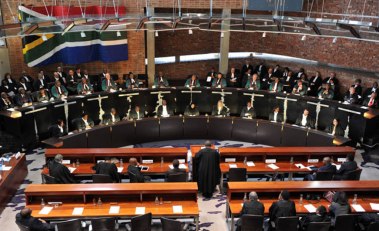 Good news!!! –
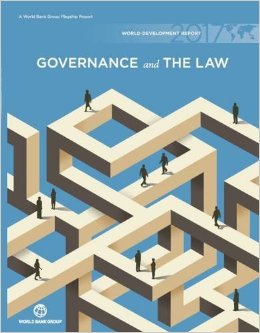 The 2017 WDR is a landmark document for the development community. Historically, the point of departure for development practitioners (including those within the World Bank) has been to promulgate technocratic, ‘best practice’ solutions to development challenges. For more than two decades, this ‘best practice’ approach has been put into question by a growing avalanche of research on the political, institutional and governance underpinnings of development. The 2017 WDR does an heroic job of assembling and synthesizing this voluminous research into a compelling statement of why ‘best practices’ fail to address some core constraints, and thus do not achieve their intended results.




 WORKING WITH THE GRAIN: Integrating governance and growth