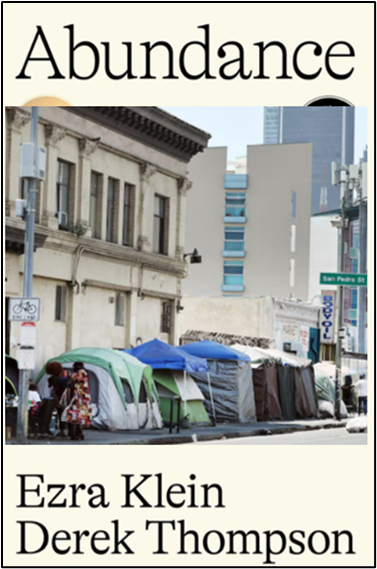
A month ago, as part of a series of short pieces on Abundance, I signaled that I was working on an article that considered Los Angeles’ homelessness challenge through an Abundance lens; the article has now been published in American Purpose. This short, orienting post explains why I have been engaging with the Abundance debate, how that connects to my work on homelessness in Los Angeles, and where some of my related work can be found.
I was drawn into the Abundance conversation because it addresses questions that have motivated my work over many decades: How to achieve gains in addressing concrete problems in the midst of broader governance messiness? And, more broadly, how to renew civic confidence in the effectiveness and legitimacy of the public domain? My longstanding focus has been on addressing these questions in middle- and lower-income countries where governance is messy. Three years ago, in moving to LA, I decided to explore whether this work might have some relevance in helping to address LA’s twin challenges of homelessness and a scarcity of affordable housing.
LA is often treated as Exhibit One in arguments about progressive governance failure. But it is also a place where, beneath the surface, large-scale and serious efforts are underway to reform how the problem is governed: clarifying goals, reworking institutional arrangements, building shared understanding among stakeholders, and trying to learn systematically about what works and what does not. Progress is uneven and uncertain — but the effort itself has been determined and sustained. Looking beyond the crises that are shaking the broader polity and society, they potentially offer hope for what can come after.
For readers interested in my engagement with the Abundance debate, here are links to three earlier posts:
https://workingwiththegrain.com/2025/12/08/achieving-abundance-towards-a-new-political-order/
This post takes a big-picture view, using a political order lens to assess what Klein & Thompson have achieved, and where their argument falls short in bridging vision and action.
https://workingwiththegrain.com/2025/12/08/achieving-abundance-from-vision-to-action/
This post explores three mutually-reinforcing entry points that can help address the book’s gap between vision & action: a focus on problems, not just systems; deliberative rather than legalistic bureaucratic norms; and coalitions between non-governmental actors and reformers in the public bureaucracy.
https://workingwiththegrain.com/2025/12/08/problem-focused-coalitional-governance-in-action-three-case-studies/
This post uses three mini-case studies to explore a central dilemma for civil society that emerges from Abundance’s vision: When is civil society’s primary role to engage with the state adversarially—and when is it more productive to enter into (sometimes) uneasy, problem-focused coalitions with reformers inside government?
For readers interested in my work on affordable housing and homelessness in LA, here are links to three articles:
(i) An empirical analysis of LA homelessness as a flow:
https://workingwiththegrain.com/2025/10/31/la-homelessness-setting-the-stage-for-painful-choices-an-empirical-re-framing/
(ii) A Los Angeles Times Op-Ed piece on LA’s recently-adopted goals for addressing homelessness:
https://www.latimes.com/opinion/story/2025-05-21/los-angeles-city-county-homelessness-goals
(iii) An article in the National Civic Review on recent governance reforms in the Los Angeles region, co-authored with USC Professor of Public Policy Shui-Yan Tang:
https://www.nationalcivicleague.org/ncr-article/addressing-homelessness-the-los-angeles-regions-bold-governance-reforms/
 WORKING WITH THE GRAIN: Integrating governance and growth